



Hello fellow strange pilgrims, this week’s flash fiction made me think about every time I’ve chosen comfort over freedom and then wondered why I felt trapped. We all know the Prometheus myth, but this piece gives us the eagle’s interiority—which I love because it shows how good stories can be hiding in old material, and that there’s always room for elevated, philosophical narratives told in a simple, easy-to-read way.


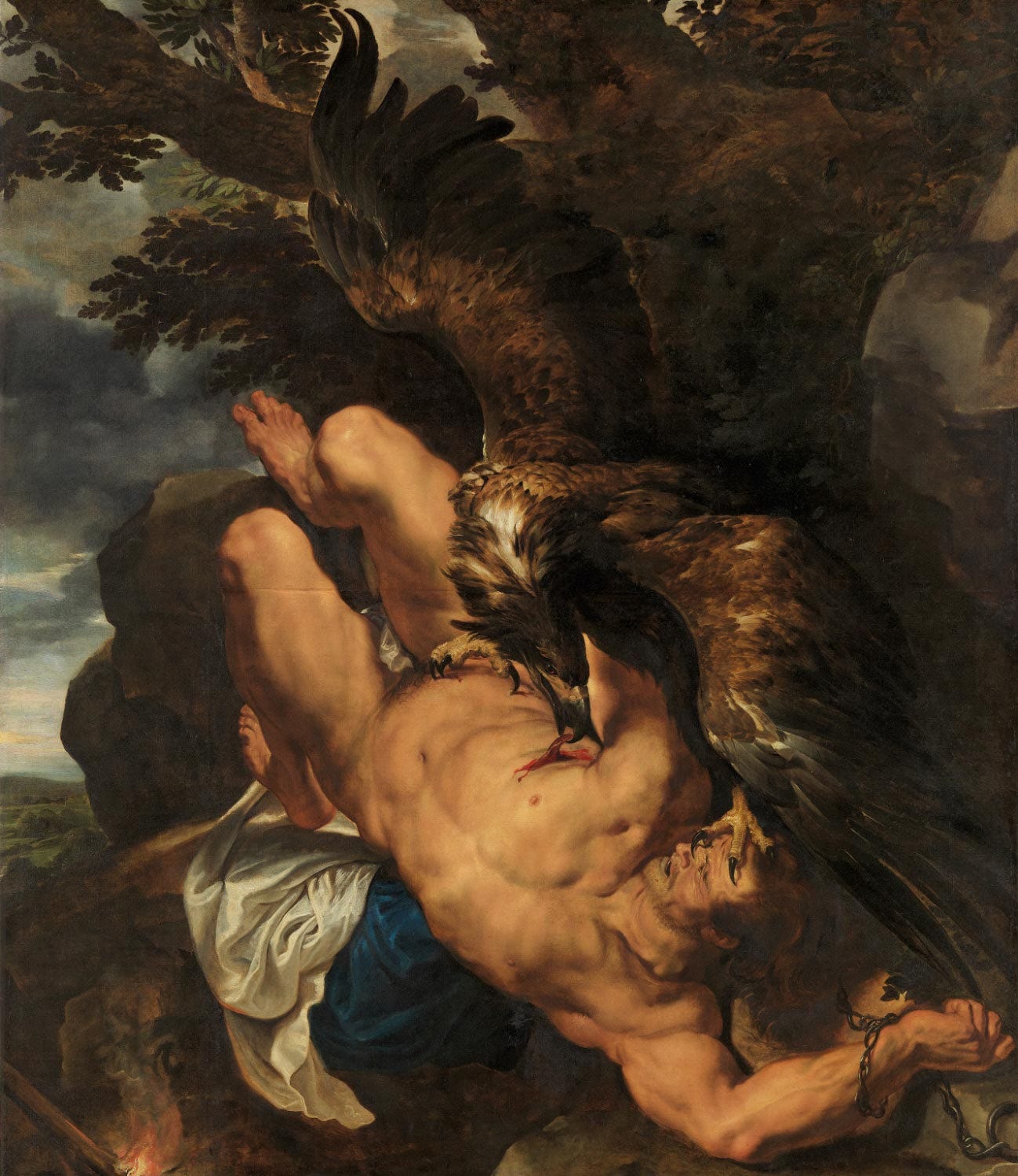

For too long has the suffering of Prometheus overshadowed the equal misery of the eagle.
It’s true that initially the great raptor was elated. When Zeus appeared before him—encircled with lightning and sporting the cavernous smile of the gods—the eagle could scarcely believe his ears. Free food for life and lobes of liver to boot? He was a gargantuan creature with a belly to match. All night he shivered between the snowy peaks of the Kaukasos and all day he scoured the desolate mountains for food. Countless hours of hunting on the endless craggy expanse, and for what? The occasional snack-sized mountain goat. Puny birds more feathers than flesh. Who wouldn’t be tempted by the hot, shimmering organ of a titan? The eagle agreed, and Zeus tussled his bronze feathers before disappearing in a thunderclap.
At first things went well enough. The eagle would wake late, yawning in the cool mountain air, and leisurely flap his way up the slope to where Prometheus was chained with his liver and skin magically regrown. The eagle would tear open the new flesh and gorge on the new liver, then head back to the nest for bed. Rinse and repeat. Sure, the chattering of Prometheus was irritating. The titan tried every tactic in the book to dissuade the eagle from his meal. Promises of riches. Appeals to their fellow outcast nature. Offers of other organs. But he was easy enough to tune out, especially with one’s head plunged in his warm insides.
Yet the same immutable laws that govern mankind hold sway with gods and monsters. One grows accustomed to anything. Even the rich liver of a titan starts to wear on the palate. And so it was that one day, as the eagle sank his beak into the familiar guts and the titan screamed loud enough to shake the mountains yet again, that a strange feeling overtook the eagle. He pulled out his blood-stained head. He looked at himself. Really looked. He had grown weak and lazy. His great wings that had once carried him around Greece and beyond to uncharted realms now could barely haul his engorged body up and down the short mountainside. Was this what his life had been reduced to? Hadn’t he once had dreams?
The eagle told Prometheus that he was free of the eagle’s torment. The eagle was off to start a new chapter in his life. Shyly, he thanked the titan for their time together and wished him the best of luck with loosening his chains. Prometheus was too shocked to even respond. He was silent as the eagle flapped away into the misty morning. The eagle felt revived. Didn’t the air feel somehow fresher? The sky more cloudless and bluer than it had been in years? His eyes pierced for miles, scanning the distant and exotic lands.
But the eagle’s excitement did not last. It was cold and he found nothing worth eating for days. Stability and security might not be glamorous, but so what? Most monsters lived brief and pitiful lives of hunger and want. Here he was throwing a good thing away for nothing. In the distance, he saw dark storm clouds rolling in. He told himself it must be Zeus coming to punish him. He turned back to Kaukasos. The waiting titan could only sigh.
Months passed. Years. Generations upon generations. The eagle was sad and lonely. He’d never known another creature like himself, having been born—through the chaotic logic of the heavens—from the womb of a dragon and the loins of a giant. His siblings included a three-headed dog and a many-headed serpent, completely unbirdlike in mindset and manner. And anyway, they never visited.
This great bird who had once known the entire skies saw his domain reduced to a single slope. With each meal, his body grew softer and more useless. He was swollen and mangy. His sharp beak, long his pride, had dulled from the titan’s thick skin into a knobby mess. Each morning, he awoke thinking that if he had any courage, he would starve himself to death and at least rid the world of one more useless monster. But he was afraid and hungry. Gods, he was always hungry. Had Zeus put a curse on him as punishment for trying to fly away? It wasn’t long before the eagle couldn’t even think such thoughts. He was a mere automaton now. Sleep, feast, sleep, feast, and sleep again. If his younger self—that glorious raptor so keen-eyed and joyous on the eastern winds—had flown by then would the old bird even have recognized his glorious former self?
We shall never know. All that is recorded in the songs is that time marched on until the eagle, deaf from the titan’s screams and blind in one eye, now slept beside Prometheus. He was too old and tired to even fly. He found peace only when engorged and sleeping, in the dreams in which he still soared across valleys and oceans in search of prey, a free creature riding the open winds, which is how they say the great and noble Herakles found the eagle, heroically slaying the sleeping beast with two arrows—one through the heart and one through the middle from beak to the tail—to earn his place among the heavens with the assent of Zeus, who had anyway long grown bored of the whole affair.

Tell us your origin story as a writer. When did you begin? What first drew you to writing as an instrument for asking questions that can’t be explored any other way?
LINCOLN MICHEL: It’s always tempting to mythologize one’s artistic life, and I could spin a story about growing up a strange and lonely boy in a rural area of Virginia who discovered that books were a portal to a wider world and became a kid who hid novels in my math textbooks to read in the back of the class and found writing was the means to let out all the weird ideas bouncing around in my head. That’s somewhat true. But if I’m honest, I think I became an author almost by default.
I always wanted to be an artist of some kind—preferably a punk rock singer or Surrealist painter—yet found I simply wasn’t good at most art forms. I was a bit tone-deaf. Never quite found the knack for drawing or the resources for filmmaking. Etc. I didn’t start writing fiction until I was in college. It just clicked. I had a talent for it, at least more than other arts I’d tried, and I could execute the ideas in my head in fiction in a way I couldn’t in painting or anything else. I really was a voracious reader as a kid and was always fascinated by narrative even when I was obsessing over video games or album liner notes, so maybe in retrospect I was always going to be a writer. But I didn’t realize that until my early 20s.

What does your writing routine look like? Do you thrive in structure or wildness? And when you begin a piece of writing, what tends to announce itself first: a voice, an image, an unease, a philosophical conundrum?
LM: I’ve always been bad at structuring my writing time, and today (working full-time plus being a father plus writing a newsletter and other freelance work) I don’t have the luxury of a solid routine. I write when I can. Notes on the phone in the middle of the night, a few hours at a café in the day, editing on the subway commute, and so on. I think most writers have to be time thieves in this way. You learn to smuggle away time for the art when no one is looking.
Unlike my writing practice, my writing itself is often structure-driven. I need to see the shape of the work in my head before I can write. For short stories, this tends to mean I think about the story for a while and get a sense of its form before I draft. For novels, typically I’m testing out different approaches and getting a sense of the project through drafting. Once I’ve written 30-50k of this, I understand the shape and can really write the book.
Otherwise, I find my work to be idea-driven. I don’t mean a message I want to convey, but a concept or a theme I want to explore. Voice is always central too. How something is expressed is inextricable from what is being expressed, for me at least.
Most artists are preoccupied by certain obsessions: lust, longing, death, the self. What persistent preoccupation—emotional, intellectual, or spiritual—threads through your work? Are there motifs, themes, or impulses you’ve tried to abandon but that keep returning, insisting on their relevance?
LM: When I was younger, I was working on a collection I was calling The Complete Chronicle of Confusion. It was a collection of stories, parables, myths, and paradoxes around that topic that I never finished and probably never will. But I think confusion, illogical rationalizations, sudden realizations, the lies we tell ourselves until they become our truths, the myths and ideologies and stories we create to try to make sense of existence… these are topics I’m always thinking about.
I also always try to keep a sense of humor and playfulness in my work. I was inspired to write by authors like Calvino, Le Guin, Kafka, Nabokov, and others who never acted like serious literature was incompatible with mischief and fun. I’m trying to have a good time writing and hopefully the reader has a good time reading.
If not a writer, who would you be?
LM: I said punk rock singer and Surrealist artist above. I also thought, for some reason, that I’d be a philosophy professor at one point. But who knows? Life is strange. Any of us could have lived infinite other lives, if our circumstances were different. I’m sure there are multiverse Lincoln Michels who would seem totally alien to me.
What’s the best piece of writing advice you’ve ever received? Alternatively/additionally, what’s something you’d like to offer as advice to emerging writers trying to make a mark?
LM: These are topics I’ve written about, so if you don’t mind my linking:
The best advice I’ve ever received is to finish things. Finish the draft, then revise. Finish the story, then write another story. Writers can easily get stuck in the swamp of never-ending tinkering and endless revisions. You learn more by finishing something and moving onto the next thing. Rise, repeat. My article on that:

I’m not sure about making a mark, but good advice for emerging writers is to take your weirdest/dumbest/most insane idea and write it as seriously as possible. This is perhaps a way of saying “find your voice,” by which I mean leaning into your unique obsessions, concerns, and ideas. What’s the book that only you can write? It’s probably a strange one, but then you do have to take the writing seriously. Balance the Dionysian inspiration with Apollonian execution. A piece on that topic:
What are you working on now and how is it trying to ruin your life (in a good, necessary way, of course)?
LM: I’m in the middle of working on a novel about haunted houses and real estate. It is perhaps running my life in being a chaotically structured novel (see my above note about being a structure-driven writer) that is presenting unique challenges for me. But then the exciting (and/or horrible) part of being a novelist is how each book creates a whole new set of problems that require you to come up with new solutions. Who wants to write the same book twice?
Who are the artists—writers, filmmakers, thinkers, internet oddities—that have shaped your sense of narrative? How have they rearranged the way you see the world on the page?
LM: Like any writer, I think my sense of story has been Frankensteined together from countless sources. For me, it’s some weird mix of Greek mythology, philosophical paradoxes, Fleischer Studios cartoons, Final Fantasy video games, hardboiled detective novels, Kafka’s parables, Southern Gothic novels, David Lynch films, New Wave science fiction, Gothic ghost stories, The Clash, Quest for Glory, Kobo Abe, Pale Fire, fairy tales, Leonora Carrington, Octavia Butler, Donald Barthelme, Borges…one could go on forever.
Please recommend a piece of art (a painting, a film, an album, anything that's not a piece of creative writing, really) that you love and would like everyone to experience.
LM: Picking something randomly from the list I just typed, how about Cab Calloway’s rendition of “St. James Infirmary Blues” animated in the 1933 Fleischer Studios Betty Boop cartoon Snow White. It's short and viewable on YouTube:

LINCOLN MICHEL’s most recent novel is Metallic Realms (Atria Books). He is also the author of the story collection Upright Beasts (Coffee House Press) and the novel The Body Scout (Orbit). His fiction appears in The Paris Review, Granta, McSweeney's, The Baffler, Lightspeed, and elsewhere. He writes the weekly literary newsletter Counter Craft.

Note on Art
The eagle in Rubens’s painting1 is magnificent—bronze-feathered, powerful, wings spread wide as it tears into the titan’s liver. This is the creature Zeus promised eternal abundance, before comfort reduced it to something mangy and swollen, sleeping beside its prey. The painting captures what was lost: a glorious raptor keen-eyed and joyous, before the mechanical repetition of sleep, feast, sleep, feast transformed it into just another useless monster waiting for Herakles’s arrows.
Image: Prometheus Bound. Used for editorial commentary purposes only. All rights reserved.

Lincoln, this is a beautiful story. And such a human one too, in how it made me think of change and the discomfort it comes with, and how satisfaction and familiarity often act as blinders. Great job!
This makes me wonder if zeus wasn’t trying to save the mountain goat population