



Hello fellow strange pilgrims, I won’t dilly dally much today because I really want y’all to dive into not one but two new amazing flash pieces from the wonderfully weird and wild imagination of GennaRose Nethercott (one of my most favorite contemporary writers and poets). Go forth!


The Museum of Doors
It begins at the entrance: a paint-peeled green door with a faulty latch, the twin of your apartment door back home. Within, you will find every other door you have ever passed through. The tall wooden door with the crystal handle from your grandmother’s house. The door to the driver’s side of your first car. The door you closed when you left the termite-ridden farmhouse you shared with your husband and never reopened, and all the doors that came after. Shop doors and doors to the bedrooms of one night stands and hissing electric doors into department stores and the hospital door through which you first exited after being born.
Most of the doors you do not recognize or remember, but the metal placards insist you have, at one point, crossed through them. Some of the doors don’t look like doors. A door can be many things. One door is your first lover, fumbling with your bra clasp in the dark. One door is the phone call from your sister, the tremor in her voice when she found your father on the sofa after his stroke. One of the doors is the horse who bucked you off when you were eleven, marking the moment you realized you were mortal and fragile and would one day pass through the final door of death.
There is a special exhibit in The Museum of Doors containing all the doors you almost opened… but chose not to. They stand sarcophagus-tall and sealed–relegated to their own wing, away from the others. For an additional fee, the curator will pull a delicate silver key from his pocket and let you slide it into the lock of one of these doors. You must not turn the key–though yes, it fits. You must not open the door. You can only stand there, the metal warming in your hand. On the other side, you hear another you breathing–wondering who they would be if only they had left this door closed.

The Museum of Cats
No one knows how long they’ve been there–the cats of Viareggio. Nor is it known how many there are, save among the cats themselves. The curators, too, are cats and do not share their records with a human public. All we can say is: there are certainly hundreds, possibly thousands.
The museum itself is not a building, but a bank of large stones stacked by the shore of the Ligurian Sea. This pile stretches a good kilometer from end to end. Each boulder is roughly the size of a cat.
The cats live among the stones.
Visit in late summer, and you’ll see them sunning themselves, draped like fur coats over the rocks. Tabbies and tortoise shell. Sphinxes gone oily and pink with heat. Fat orange tomcats feasting on sardines thrown to them by visiting spectators. The cats weave in and out of white marble like shadows. When the tide is low, they breed, yowling under moonlight. When the tide is high, we do not know where they go. They turn from us. They make their plans. Strange, untranslatable plans that alter the course of human history: Every great war. Every newborn king. Every monument raised or fallen. It was planned here first, strained through a comb of whiskers.
You too have been shaped by the cats. What–did you think your choices were your own? No. The cats scratched the entirety of your life into their secret ledgers, long before you came to be. Philosophers of our own species have spent centuries debating the balance between the cats’ influence and our believed free will. And it’s easier, no? To accept that all of this, it is the cats’ doing. Your worst mistakes: not your mistakes, at all. They are merely a flea behind the ear, swatted with a careless paw.

GENNAROSE NETHERCOTT is the author of a novel, Thistlefoot, a Vermont Book Award winning short story collection, Fifty Beasts to Break Your Heart, and a book-length poem, The Lumberjack’s Dove, which was selected by Louise Glück as a winner of the National Poetry Series. A writer and folklorist alike, she helps create the podcast Lore, and she tours nationally and internationally performing strange tales (sometimes with puppets in tow). She lives in the woodlands of Vermont, beside an old cemetery.
Also by GennaRose Nethercott:

Notes on Art
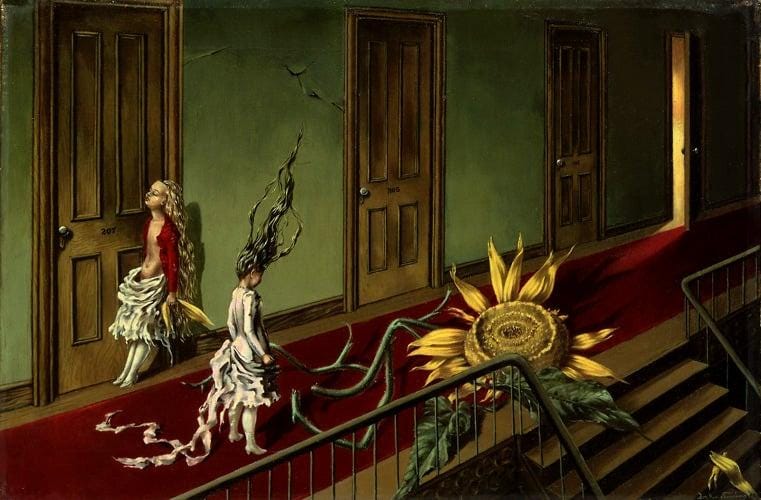
We’ve paired this piece with Dorothea Tanning’s Eine Kleine Nachtmusik (1943)1, the title of which is a reference to Mozart, translating as “a little night music. The painting depicts a hotel corridor of sorts, a place of transience, with the doors shut and numbered like exhibits, a sunflower the size of a body forcing its way down the red carpet, two girls caught in a wind no one else can feel, hair lifting, dresses already torn. Save one, none of the doors open, at least not as we are shown them. In the far corner is just one ajar door, a bar of light flooding in cleanly…beckoning…warding off? I’ve spent so long gazing at this painting and I couldn’t think of a better piece to lend visual harmony to the beguiling museums conjured by GennaRose.

Image: Eine kleine Nachtmusik © Dorothea Tanning (1943). Used for editorial commentary purposes only. All rights reserved.
When the tale is the foundation of reality in art. Thank you for writing and sharing this. There is a story I wanted to write myself but all I can remember is the title. It was called, The Museum Of Lost Memories.
Love these stories, and the painting fits alongside them perfectly