



With deliciously delirious excitement we present to you our very first selected piece by one of the most exciting voices in contemporary fiction today, GennaRose Nethercott. Frankly, as soon as we read this, we knew this would be the work that would kick off the Strange Pilgrims publishing year.


The Illuminarium never should have been built. We know that now. At the time of its conception, the Illuminarium’s makers were stupid and choked with hope. They were sad (the way all are sad), and so, they purchased a former cotton mill on the west side of town and they got to work.
Step One: Black out the windows with vinyl so no precious drop of light can escape.
Step Two: Buy up every halogen bulb from here to Rutland County.
Step Three: Plug four high-powered generators into the old mill’s electrical grid.
Step Four: Crowd into the mill. Bring nothing (when the happiness comes, the true-and-good happiness, there will be no need for material goods).
Step Five: Listen from within as, out in the vulgar world, workmen solder every exit shut.
Step Six: Strip off your clothes.
Step Seven: Turn on the lights.
They only wanted to feel the contentment they believed they deserved (do any of us “deserve” anything? Only if you believe in an ordered universe, but we digress). They only wanted mirth. They only wanted to banish the darkness; imagine, a life of only light! Free of fear. Free of shame. Light, light and only light. Without darkness there could be no suffering. Without darkness there could be no death. Holy glow, oh divine brightness, they would live forever.
Of course, we know now–from tabloid clippings and true crime podcasts–that the Illuminariasts were mistaken.
By the end of the first week bathed in light, light, only light they had begun eating their own hair, believing it to be the golden harp strings of angels. By day nine, they’d tried to carve the black, drunken pupils from their eyes. By the eleventh sleepless day (light, light, only light) the Illuminariasts were (though undiscovered for another week, yet) dead.
It was day eighteen when an electrical fire began in one of the overworked generators. The warehouse snapped into flames. Became a blazing beacon in the dark, a lantern, a star, a violence, until it burned to ash.
And then, only then, with forgiveness, did the blessed shadows come.

Tell us your origin story as a writer. When did you begin? What first drew you to writing as an instrument for asking questions that can’t be explored any other way?
GennaRose Nethercott: You know, it’s funny—I was at my folks’ house over the holidays, and found some old reports from my preschool teacher, of all people. Notes home to my parents on how little me was doing at daycare, how I was relating to other kids, that sort of thing. And what she wrote was, “Genna loves telling stories, and the other children look to her as a storyteller. But she struggles with respecting my authority.”
And that really made me laugh. Because she nailed it, I think—I’ve always been a storyteller. I’ve always made sense of the world around me through narrative and theater and art and music. But what made me dedicate myself to *writing* as my medium, specifically, harkens back to that so-called “struggle” with authority:
There’s already so much conversation around the political elements of writing. The way it’s a mode for transmitting revolutionary ideas and freedom of thought. But I think something that gets left out is how the actual, physical process of writing is radical, too. Because oppressive systems can’t touch it. In a world ruled by capitalism, writing doesn’t rely on expensive tools or editing software—like film or animation. In a country with a failing healthcare system, writing doesn’t demand a mobile body—like dance or athletics. One could argue that to write requires access to education, but illiterate bards have been telling stories and shaping folklore for centuries. In short, I chose to write because storytelling is the only art that can truly and fully circumvent authority. Just like that precocious toddler would have wanted.

What does your writing routine look like? Do you thrive in structure or wildness? And when you begin a piece of writing, what tends to announce itself first: a voice, an image, an unease, a philosophical conundrum?
GN: I have some real envy for writers with a “practice.” Bradbury used to wake up every day, sit down at his typewriter, and not stand up again until he’d composed a new short story. There’s that Ursula Le Guin regimen that went viral a while ago, which started with her waking up at 5:30 am to just “lie there and think” for forty-five minutes before she’d “get up and eat breakfast (lots).” Alas. Couldn’t be me. I tend to wake up closer to 10:30, and that’s only with an alarm set.
Basically, I write well with a gun to my head. I can go months without writing a word—but give me a deadline, and I’ll dive into a project like the deep end of a pool. I’ll literally text my friends, say “sorry, but see you in six months,” and stay submerged in my Word doc with my breath held until the thing is done. Only then will I come up for air. Which is what living in the world is, to me. That breath in. Taking in life and connecting with other people, so that when the time to dive back under comes, I’ll be able to stay there a while.
It’s not the most sustainable, energetically. And actually, the piece you’re publishing currently, “The Illuminarium”, is part of a project intended to disrupt that habit. I was experimenting with that Bradbury method of just sitting down every morning and seeing what came to me; in this case, I wanted to invent a different impossible, imagined museum each day.
As for story process—a premise always comes first. What if a staircase descended forever? What if an army were made of fog? Then, I’ll link that to a broader metaphor. What parallels this image, in the real world? An eternal staircase can be an addiction story. A fog army could explore the amorphous, intangible repercussions of war. And finally, the part I’m worst at: who are the characters in this situation, and what is the plot? These, I care less about. But unfortunately for me, characters and plot do tend to come in handy in getting a message across.
Most artists are preoccupied by certain obsessions: lust, longing, death, the self. What persistent preoccupation—emotional, intellectual, or spiritual—threads through your work? Are there motifs, themes, or impulses you’ve tried to abandon but that keep returning, insisting on their relevance?
GN: Goat fucking comes up more frequently than I personally would like. Erotic sheep and goat content. I read James Dickey’s poem “The Sheep Child” at too young an age, I think. It’s beyond my control. Your thoughts and prayers appreciated.
If not a writer, who would you be?
GN: The thing about being a writer is you actually can’t be *only* a writer. You have to collect experiences and skills in the outside world. Those are the colors on our painter’s palette. If all you do is write then what the hell will you have to write about? You have to be a person first and a writer second.
Of course, time management is an issue. And writing takes a lot of it. If I wasn’t writing, I’d probably spend more time making things with my hands. I love to sew and build things. Any excuse to learn a new craft, I’m there. Last year I spent far too much time creating a miniature Irish pub entirely from scratch, beer taps and all. Maybe I’d become a miniaturist. Or I don’t know. A sea shanty archivist? A marionette maker? The girl who operates the Spook-o-Rama ride at Coney Island? There are so many wonderful, bizarre things to do in this world.
What’s the best piece of writing advice you’ve ever received? Alternatively/additionally, what’s something you’d like to offer as advice to emerging writers trying to make a mark?
GN: In terms of “making a mark”—that is, getting your work into the world, rather than the writing process itself—let me start by saying: this is a truly idiotic source for advice, but I swear, it’s the most important principle I live by and I think about it all the time. So bear with me here.
There was this early 2000s Twitter account called Shit My Dad Says, in which this guy chronicled kooky quotes his father had said over the years. In one of these, set back when the son was a teenager, he was telling his dad about this girl at school he had a crush on. She was sexy and cool and he really liked her—but she was clearly out of his league, so he obviously couldn’t ask her out. To which his dad said (and I’m paraphrasing here), “Son, let women figure out why they won’t sleep with you, don’t do it for them.”
And honestly? That’s the best arts career advice I’ve ever come across. If the publishing industry wants to reject you? It will. If readers don’t want your work? They won’t read it. But that’s *their* job to decide—not yours. I know so many incredible artists who refuse to put their work out there because they’re afraid of rejection, or because they fear the work isn’t good enough. But honestly—that’s none of their damn business. Our job is to do the art, and shoot our shot. It’s the world’s job to decide if it wants to sleep with us.
What are you working on now and how is it trying to ruin your life (in a good, necessary way, of course)?
GN: In October, I finished drafting a new novel—a contemporary New England gothic inspired by my tiny Vermont hometown. Haunted perfume. Cursed carnivals. Missing girls and secret tunnels. Theeeese are a few of my faaavorite things.
It ruined my life in that, while writing it, I had no life. As I mentioned earlier, when I’m in project mode, there’s nothing *but* the project. I spent nine months under self-imposed house arrest until the thing was done. But that’s okay. I’ve come to understand that there are things in life that make us happy, and there are things that make us feel fulfilled, and they aren’t always the same things. My out-in-the-world time makes me happy, but doesn’t always feel purposeful. My writing fulfills me, but rarely makes me happy. And a life needs balance between both to feel complete.
Who are the artists—writers, filmmakers, thinkers, internet oddities—that have shaped your sense of narrative? How have they rearranged the way you see the world on the page?
GN: The TV show Buffy the Vampire Slayer, always—monster as metaphor. Take the emotional worlds of the characters and make it the literal supernatural law of the world. And the blend of horror, tragedy, and winking humor.
The writer Kelly Link. When I first read her short story collection Stranger Things Happen, I thought, my god, I feel like I’m looking at the inside of my own mind. I’d never had that feeling before. Link’s work granted me this incredible sense of permission to write the way I actually thought, as uncanny as it may be. That was an unbelievable gift.
Endless more, of course, but those are what I always cite as my Big Two.
Please recommend a piece of art (a painting, a film, an album, anything that's not a piece of creative writing, really) that you love and would like everyone to experience.
GN: I’ve been re-listening to Anaïs Mitchell’s 2012 album Young Man In America recently. One of the greatest albums of all time, from one of the best songwriters of our era.

GENNAROSE NETHERCOTT is the author of a novel, Thistlefoot, a Vermont Book Award winning short story collection, Fifty Beasts to Break Your Heart, and a book-length poem, The Lumberjack’s Dove, which was selected by Louise Glück as a winner of the National Poetry Series. A writer and folklorist alike, she helps create the podcast Lore, and she tours nationally and internationally performing strange tales (sometimes with puppets in tow). She lives in the woodlands of Vermont, beside an old cemetery.
Note on Art
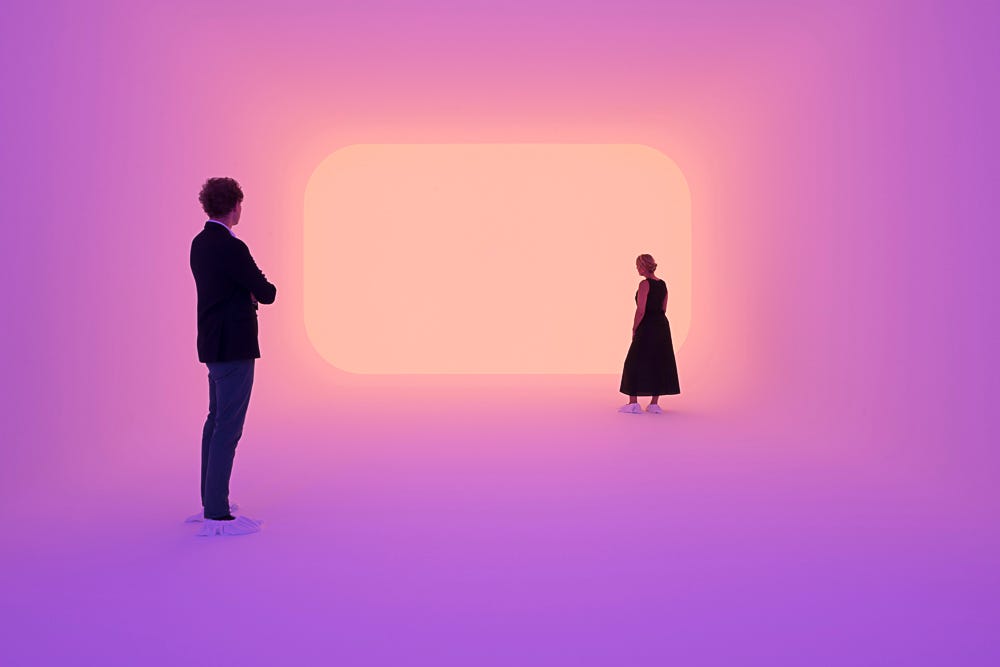
We’ve paired this piece with work from James Turrell’s “The Substance of Light”1 exhibition. Turrell builds rooms of pure luminosity—spaces where light feels tangible, where visitors report something close to religious experience. Turrell’s work asks what it might feel like to step inside pure light. Nethercott’s piece asks what it might cost to stay.

Image: from The Substance of Light by James Turrell. © James Turrell. Used for editorial commentary purposes only. All rights reserved.
This piece is deeply human and very Jungian. The shadow isn’t our enemy. It’s part of meaning. What destroys us isn’t darkness, but the attempt to erase it.
I really enjoyed this!
This story feels like small-town cosmic horror, it's hard to describe otherwise, and I love that. And the interview is awesome, looking forward to more of these :0