



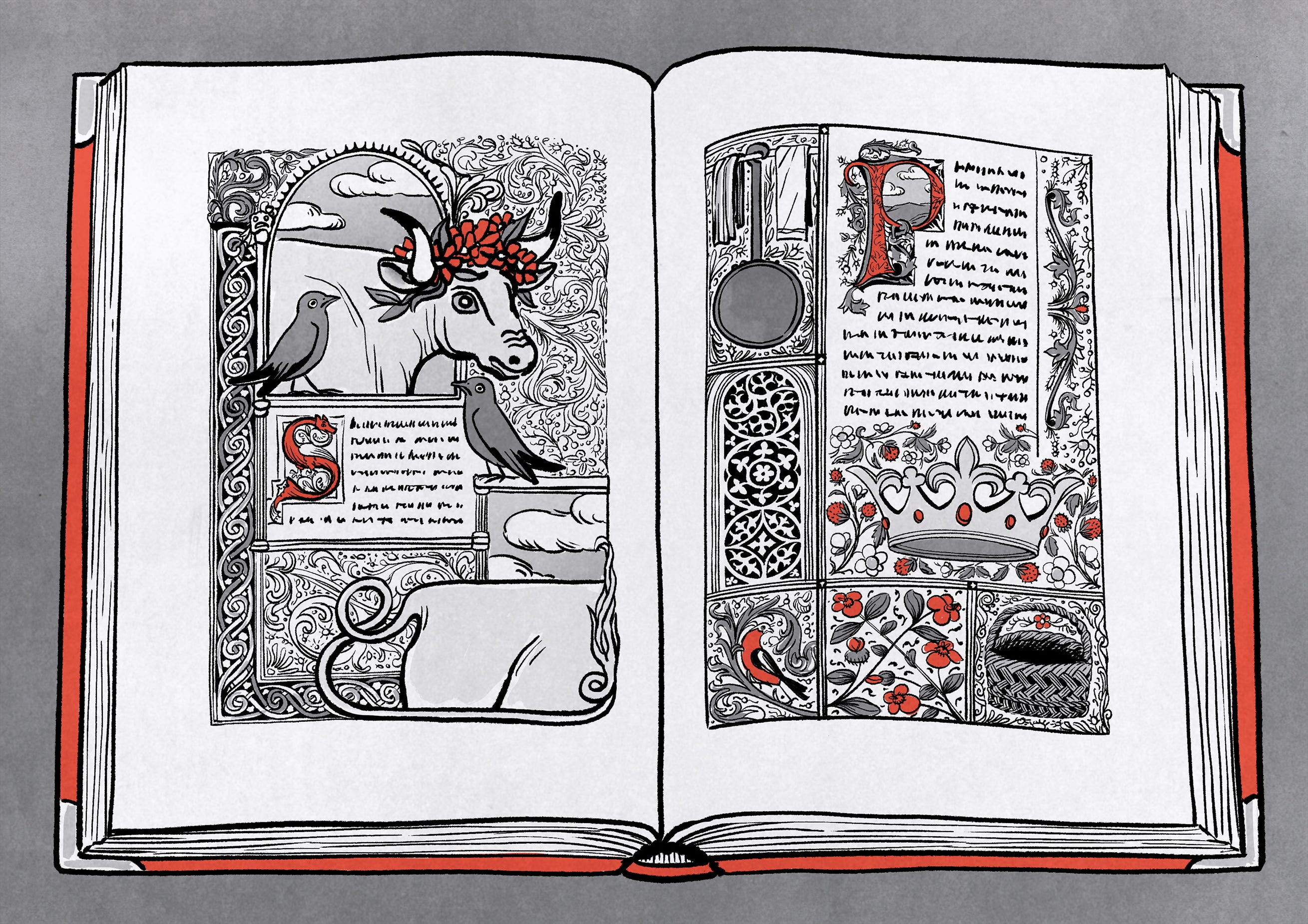
Hello fellow strange pilgrims, today we have another original gorgeous accompanying artwork from Mariam Chagelishvili. She’s outdone herself with this one, which, if you look all over Strange Pilgrims, you’ll see is hard to do since everything she creates is brilliant. I also think this was the perfect story to pair one of Mariam’s art pieces with, because boy is it wild and wonderful and folkloric and weird and just plain sweet and spiritual, damnit all the good things. I love that we get to share it with you now. Go read!



There once was a farmer who lived with his wife in the fields on the other side of the forest. Their life had been hard even in the best of times, but when a drought in the kingdom entered its second year and caused their crops to fail, the couple was at the end of their rope.
“I don’t know what else to do,” the farmer told his wife. “I think we have to sell our cow.”
“But she gives us milk and butter and cheese to trade at the market,” the farmwife objected.
“I know,” the farmer said, “and I am sorry, but without the grain from the fields, our tiny pasture is too small to keep the cow fed. If we sell her, we should have enough money to buy grain to feed ourselves over the winter, and new seeds to plant in the spring. You must sell the cow at the market tomorrow.”
In the morning, the farmwife led the cow down the dirt path that led to the village. She hadn’t gone very far when she came upon an old woman who was standing up to her waist in a pool of mud in the middle of a field, a short distance off of the path. The farmwife had never seen the old woman before but stopped anyway to call out to her. “Hello, mother,” the farmwife said. “Do you need any help?”
“Why yes, daughter, thank you for asking,” the old woman replied. “I thought that I would take a shortcut across this field, but now I am stuck.”
The farmwife looked at her cow and then turned back to the old woman. “I think that this rope I am using to lead my cow will be long enough. Hang on, and we will pull you out.”
The task was quickly accomplished, and soon the two women were leaning together on the cow. “I owe you a great debt, daughter,” the old woman said, “perhaps even my life. Where are you headed this fine morning with this magnificent animal, and how can I help you in return?”
“Sadly, I am headed to market to sell our cow,” the farmwife answered, and proceeded to tell the story of the couple’s plight.
“It is indeed fortunate that we met,” the old woman said. “I have something that will solve all of your problems, which I will be happy to trade to you for your cow.” The old woman pulled an elegant notebook from her bag and handed it to the farmwife.
With an oilskin cover, it was easily the finest item the farmwife had ever held in her hands. “It’s very nice, indeed,” the farmwife admitted, “but how can it possibly solve my problems?”
“It’s a magic notebook,” the old woman replied. “Whatever you write in it will come true.”
“How does that work?” the farmwife asked.
“I don’t know,” the old woman answered. “It’s magic. Give it a try.”
The farmwife opened the book and saw that its pages were all blank. “Do you have a pen?”
The old woman rolled her eyes. “Of course,” she said, and pulled a silver pen from her bag.
As soon as she touched the pen, the farmwife realized that it was now the nicest thing she’d ever held in her hands. “Shiny,” she said. “What should I wish for?”
“Whatever your heart desires.”
The farmwife thought it over. “Our cow has served us long and well,” she said, “but she is old and tired now. I think she might like to be young again.” Very carefully, the farmwife wrote the words My cow is young again into the book.
A golden glow immediately enveloped the cow as she slowly stretched and stood up taller and straighter. From somewhere came a sound like angels singing, and a pair of bluebirds descended to place a wreath of flowers on the cow’s head.
“Wow,” the farmwife said. “Nice touch with the birds.”
“Thank you,” the old woman replied. “Do we have a deal?”
“I don’t know.” The farmwife pretended to weigh her options. “My cow is considerably more valuable now. Is this still a fair trade?”
The old woman mentally counted to ten. “I can see that you are a shrewd negotiator,” she said. “How about if I throw in the pen?”
“Done!” The farmwife gleefully handed the cow’s rope to the old woman and had already turned quickly towards home when she thought of a final question. “Why didn’t you use the notebook to get out of the mud?” she started to ask, but when she turned around, the old woman and the cow were already gone, with not a trace remaining. “Now that is odd,” she said to herself.
When she got home, the farmwife showed her husband the notebook and the pen and excitedly told him the story of the old woman and the cow. Unfortunately, he did not share her enthusiasm. “You foolish woman,” he admonished her, “you have given away our greatest possession and received nothing in return.”
“But now we can have anything we need,” she objected. “Let me show you.” She sat at the table and opened the notebook. “How much do you think the cow would have brought at market?”
“I was hoping for at least twenty dollars,” the farmer answered.
“Twenty dollars, then.” The farmwife took the pen and wrote a dollar sign in the notebook.
“You might as well ask for twenty million,” the farmer sneered.
The farmwife considered this. “That seems like an awful lot of money,” she said. “Would we really need all that much?”
“Twenty thousand, then,” the farmer suggested. “It’s all just a cruel joke, anyway.”
“Whatever.” The farmwife very carefully wrote 20,000 after the dollar sign and set down the pen.
“Now what?” the farmer asked.
“Wait for it,” the farmwife said. As they waited, a fly came in through the window and began to flit around the room. In the silence, the buzzing seemed much louder than usual. Eventually the fly landed on the pen, which was still sitting on the table. The farmer tried to swat it with the notebook, but the fly jumped up just in time to make the farmer miss and then escaped back out of the window.
“What a useless thing,” the farmer complained. “It’s not even good for killing flies.” With that, he flung the notebook through the window, where it fell between the woodpile and the side of the house.
“I don’t understand,” the farmwife said, but the farmer had already left the cottage to sit in the woods and drink the last of the previous year’s cider.
He was still slightly hungover the next morning when they were awakened bright and early by a pounding on the door. It was the solicitor from the village, come to give them a bag of gold coins and some forms for the farmwife to sign in triplicate. The forms said that the farmwife’s uncle had died recently and left her this money.
“How much is it?” the farmwife asked.
“Twenty thousand dollars,” the solicitor answered.
The farmer’s eyes grew wide as the news slowly pierced his cider-fogged brain. The farmwife signed the papers, and the solicitor left them both to sit and stare at the bag of coins on the table.
“You foolish woman,” the farmer finally said.
The farmwife blinked once, then twice, before she turned to the farmer. “What did you say?”
“You should’ve asked for more,” the farmer explained. “We could’ve had all the money in the world.”
“Whatever would we do with all the money in the world? What would be left for anyone else?” the farmwife argued. “Besides, we have more than we need right here. What could we possibly spend more on?”
“I’m sure lots of things would occur to us,” the farmer said. “You never think big enough. Ask me again when we have the money. Here’s the pen. Where’s the book?”
“You threw it out the window.”
“Only because you made me angry. Come, help me find it.”
Together they searched the pasture, but neither found the notebook where it had fallen between the wood pile and the outside wall of the cottage. As the morning wore on without success, the farmer became increasingly frustrated. He finally reached his limit when the heat of the noonday sun began to sweat the liquor in beads out of his aching forehead.
“This is all your fault!” he accused. “You’ve hidden the book to keep the treasure for yourself. Tell me now where you’ve put it!” The farmer picked up his walking stick and waved it wildly as he chased his wife around the field.
Fortunately, she was much quicker than him, and in his dehydrated state she easily dodged his attacks and ran around him back into the cottage, where she picked up an iron skillet and laid the farmer out cold as he came through the doorway. Exhausted from the excitement, she sat to catch her breath and collect her thoughts. Looking back and forth between the sack of coins on the table and her husband lying unconscious on the floor, her thinking became clearer as her breathing slowed, until she decided that this was probably as good a time as any to pursue her lifelong dream of travel.
Packing her few clothes along with the bag of coins and some bread and cheese in a rucksack, she left the pen in the middle of the table as a reminder to her husband of his folly and headed down the lane.
The farmer awoke to a cottage grown cold as the hearth embers finally had died out, and he realized that his wife was gone for good. He cursed his own foolishness, until he saw the pen on the table and mistakenly imagined that his wife had left it for him as a final act of charity, because it was the true instrument of the magic.
Taking one of the forms the solicitor had left, he turned it over and wrote a dollar sign on its back, followed by a one and a truly spectacular number of zeroes. Midway down the page he paused, then crossed out the numbers and wrote I am the king. This pleased him enormously, and he admired it at great length before picking up the pen one final time to cross out king and write beneath it emperor. You can probably see at this point where this is headed.
With his “magic” pen and paper in his pocket, the farmer strode confidently into the market town. It happened that the actual king was coming that day to that very same town on his annual tour of his subjects, but the farmer immediately assumed that the decorations and other preparations for the real king were meant instead for the farmer.
He stepped into an invitingly boisterous inn, sat at the biggest table, and loudly demanded food and drink. Seeing his simple garb, the innkeeper demanded payment up front for the meal.
“Such impudence!” the farmer cried indignantly. “I’ll have you know, my good man, that I am your emperor!”
“And I’m the Queen of May,” the innkeeper replied, “but nobody eats for free on my shift.”
This of course infuriated the farmer, who took the paper from his pocket and waved it about, all the while questioning the innkeeper’s ancestry in a voice loud enough to draw the attention of the king’s guard from the nearby street. He yelled even louder when they picked him up and carried him off to present to the king.
Even on his best days, this particular king was never easily amused. As it happened, on this day he was suffering from a singularly painful bout of gout, which subsequently resulted in an all too predictable damper on his disposition.
The farmer, on the other hand, became increasingly delighted as he surveyed the throne room. “Finally,” he proclaimed, “I am in my proper element.”
“And why is that?” the king asked.
“Why, obviously, because I am your emperor!” the farmer replied.
“On the contrary, sir, you are clearly a lunatic, and I judge you to be a traitor against the crown,” the king summarily declared, “and order you to be executed without further delay.”
Undaunted even as they dragged him away, the farmer continued to insist at the top of his lungs that he was the rightful ruler and that everyone involved would be very, very sorry indeed, thank you very much, once the truth was properly revealed. His tirade continued right up to the point when the executioner’s axe cut off his rant.
This had an immediate calming effect on the farmer, and he quite suddenly experienced a remarkable clarity of focus. The farmer’s head tumbled into the basket and landed face up, so that the very last thing he saw was a beautiful blue sky, with a single cloud that seemed to him to be rather in the shape of a certain cow of his former acquaintance, albeit somewhat younger than he remembered.
As the rest of the farmer’s body slumped to one side, the pen dropped out of his pocket and bounced across the platform, drawing the executioner’s attention. “Shiny,” he said. Thinking it was the nicest pen he’d ever seen, the executioner picked it up and put it into his own pocket, and it quickly became his favorite, until one day when he accidentally left it on a shared table in the dungeon and it disappeared and had to be replaced with another pen, which then became his new favorite.
Meanwhile, back at the farm, a wandering hermit discovered the now abandoned cottage and decided to live there. When fetching wood to light the hearth, he found the misplaced notebook behind the wood pile. With its oilskin cover, it was easily the nicest thing he had ever owned, and he decided that it would be the perfect medium in which to record for posterity everything that he’d learned from his lifetime of asceticism.
Whenever he would reach a temporary impasse in this project, he would entertain himself by making little drawings in the margins, mostly of flowers or abstract geometric shapes, but occasionally of baby animals with overly large eyes. If inspiration struck him, he’d write simple parables illustrating his imparted wisdom, and sometimes even short verses of poetry. Many of these poems dealt with the beauty and wonder of nature, while others were more amorous in their content. His general sense of contentment at this advanced stage of his life meant that all of his stories had happy endings.
Because they were written in the notebook, everything in the hermit’s stories and poems of course came true, but since he set them all in distant parts of the kingdom, the hermit never heard anything about the events that he’d caused, and the people who benefitted from them never learned the true source of their good fortune.

1.
Tell us your origin story as a writer. When did you begin? What first drew you to writing as an instrument for asking questions that can’t be explored any other way?
KEVIN SANDEFUR: I was already writing little stories in the fifth grade, mostly Tom Corbett fan fiction. A handful of my original poems and stories appeared in my high school’s literary journal. I first started submitting work to professional markets while in college, but without any takers. After that, life intervened, and my creative energies went into accounting software development and newsletter editing/production for a string of non-profits. I realize now that these were just alternate ways for me to bring things that hadn’t existed before into the world.
It wasn’t until eight years ago that a gen ed writing class required for my accounting degree reminded me of how much I enjoyed the sound of my own voice. For me, writing is literally a form of play. My greatest joy is moving words around to make sentences and paragraphs.
I started submitting again, this time with some modest success. After my retirement, I was able to complete a Bachelor of Applied Studies in Creative Writing at the University of Iowa, and here I am now, still writing, still submitting, and still playing.

2.
What does your writing routine look like? Do you thrive in structure or wildness? And when you begin a piece of writing, what tends to announce itself first: a voice, an image, an unease, a philosophical conundrum?
KS: It varies from piece to piece. A lot of my stories come from prompts and themes suggested by publishers or competitions. “The Magic Notebook,” for example, came from a simple contest prompt: a moleskine notebook and $20,000. I didn’t have a story in time to meet their deadline; I rarely do. But the idea crawls around in the back of my head until the premise coalesces.
The one thing I need before I can go any further is the knowledge of how the story will end. The final sentences are usually the first thing I write. They also let me know who is telling the story, and that frames the voice, which in turn tells me where the story should start.
By that point I usually have enough for the story to spill out onto the page as a nearly complete whole. My first drafts are often very fast, sometimes as little as a day or two. Editing, on the other hand, can take years, and never really ends until the story gets accepted somewhere.
3.
Most artists are preoccupied by certain obsessions: lust, longing, death, the self. What persistent preoccupation—emotional, intellectual, or spiritual—threads through your work? Are there motifs, themes, or impulses you’ve tried to abandon but that keep returning, insisting on their relevance?
KS: Death. Definitely death. My mom died seventeen years ago, and one of my sisters just three years later. My father and mother-in-law passed within five weeks of each other in 2023. I’m 71 years old. I write a lot of ghost stories.
I also write a lot of pieces where things are just a little bit off. Okay, sometimes more than a little. I’m a big fan of magic realism and weird fiction.
4.
If not a writer, who would you be?
KS: I like to think I’d still be a creator of some sort. My family had a strong musical background, and years ago I did some simple compositions. I used to draw a lot when I was in college. I’ve already mentioned my career in computer programming. I’ve also been a lifelong learner. I don’t think I would ever be bored.
5.
What’s the best piece of writing advice you’ve ever received? Alternatively/additionally, what’s something you’d like to offer as advice to emerging writers trying to make a mark?
KS: Ray Bradbury said you should write a short story every week for a year, because it’s physically impossible to write fifty bad stories in a row. Kurt Vonnegut basically said just do it, something, anything, make something, even if it’s awful. It will get better.
If your measure of making a mark is to be published, I would offer the words of the Dread Pirate Roberts: “Get used to disappointment.” If, on the other hand, you write because you can’t help yourself, because you simply have to, and because nothing else even comes close to making you as happy as a perfect sentence, then you’re already doing it right.
All I’ve ever wanted since I first learned to read was to be a storyteller. I’ve spent seven decades soaking up stories from books and magazines and movies and tv shows from all over the world. Eventually, some of that just had to start leaking back out.
6.
What are you working on now and how is it trying to ruin your life (in a good, necessary way, of course)?
KS: I’m slowly adding pieces to a novel that I started at Iowa. The physical time required for the longer form is daunting, and life keeps getting in the way. I’ve never written anything longer than about 10,000 words before, but I was able to write the first 8,000 words of this story in less than a week, because I had a deadline. The going has been much slower since. And of course, it’s about death.
7.
Who are the artists—writers, filmmakers, thinkers, internet oddities—that have shaped your sense of narrative? How have they rearranged the way you see the world on the page?
KS: Ray Bradbury. Peter Beagle. Terry Pratchett. Lord Dunsany. Poe. Roger Zelazny. Harlan Ellison.
A writer’s primary job is to hold the reader’s attention to the end of the story. The best and maybe only true way to do that is to elicit an emotional response, to make the reader feel something along the way that stays long after.
In a written medium, that means that language is everything. How we say something is every bit as important as what we mean to say. Maybe more. The language must be eloquent and graceful while remaining efficient and concise, in order to deliver multiple levels of meaning in as few words as possible. The intellect is the pathway, but the target is the heart.
8.
Please recommend a piece of art (a painting, a film, an album, anything that’s not a piece of creative writing, really) that you love and would like everyone to experience.
KS: The movie “Cloud Atlas.” After maybe a half dozen viewings, I still see something new every time I watch it.
KEVIN SANDEFUR is a retired school construction accountant and recent graduate of the University of Iowa with a Bachelor of Applied Studies in Creative Writing. His fiction has appeared in The Saturday Evening Post, Pulp Literature, MetaStellar, and PodCastle. He lives with his wife and two cats in Urbana, Illinois, which is a magical place where miracles happen almost every day, and hardly anyone seems to find that remarkable.

May I say out loud how much I love, love, love the original artwork by Mariam Chagelishvili!
This was a really fun read, I love the fairytale/fable style.
I imagine that occasionally the hermit would write down a weird idea that occurred to him, like „what if there lived fish in the deep sea that carry their own light around?“ and then he would marvel at the weirdness of human imagination