



Hello fellow strange pilgrims, below I’m excited to share a story that I read and felt instantly like wanting to publish (which, no, doesn’t often happen!). There’s something in the voice that feels ancient and intimate at once — like a folktale someone’s telling you in a bar. It does the thing we’re always chasing at Strange Pilgrims: makes the strange feel inevitable, like…of course this is how people are. Enjoy!



What an upside-down world.
The gentleman: town confessor, listening ear, advisor on marital discord, financial predicaments, and cosmic questions, has been shuttled outside to stand alone in a vicious storm.
The people of the mountain are conflicted. Some have closed their curtains and sit silently by their fires with the weight of what they’d done. Others watch out their windows, silently mouthing their gratitude and asking for forgiveness.
The gentleman stands against the large fir across from Marvin and Bros Mercantile & Post, drenched, his ragged shirt melting from his body, his lips pulled back as though he is asking, What have you done to me?

That summer, there’d been a terrible drought. Crops dried up, animals died, babies cried, and dust coated everything: food, clean laundry, the insides of noses and mouths.
It was near midnight, and the moon was behind clouds, so nothing could be seen on Main Street but a candle’s flame in the window of Marvin & Bros Mercantile & Post.
Birdie was talking to the gentleman again, sitting near him in the corner, where dust collects.
This heat! she complained.
It was unbearable, and her apartment above the shop was stuffy, and on top of that, she’d outgrown her affection for her wife, who was prone to rambling on and on—in stuffy apartments, of all things. Also, Birdie’s wife was lazy, frivolous, and a slovenly eater. There was a time, Birdie told the gentleman, that she found Minna enchanting. What happened?
It would help, Birdie said, if she would speak with you as I do. But truthfully, she lacks the ambition.
The gentleman looked sympathetic, baring his teeth in a frown, his painted blue eyes focused on some distant thought—likely a thought about Birdie’s wife and her fallen status, and especially a thought about Birdie’s unfortunate entrapment.
Anyhow, you’re a good egg, old fellow, and a much better listener than Minna, said Birdie, looking energized after such a lovely chat.
She took her pocket knife and snipped off a sliver of the gentleman’s fingernail, then placed it on her tongue where it sat sharp and unpleasant, though not all that different from chewing one’s own fingernail, all things considered.
Upstairs, in her stuffy little apartment, Birdie found Minna sleeping on the sofa, flushed in the heat. She must have been plucking a button on her dress—it now hung loosely from its thread. Her dusty slippers were marking up the cushion Birdie’s mother made when she was small—a stiff little pillow, fern-green velvet on one side and embroidered dogs on the other. Birdie marched over to the sofa and pulled the cushion out from under Minna’s feet, and Minna opened her eyes.
Oh, Birdie, how lovely. I thought you’d be working all night—
This is my mother’s cushion. She made it.
Yes. I know. Funny little dogs…
The dogs were terrible, vicious-looking creatures, with tiny open mouths and gargoyle eyes. They used to give Birdie nightmares. She’d always kept the embroidered side flipped over, but now look. They had dirt on their poor little faces!
That night, in Birdie’s dream, the gentleman walked toward her as smoothly as a living person walks. His eyes were the same bright blue, only real and shining and so full of kindness, Birdie felt she would break open like an egg, spill out all her innermost thoughts and deepest feelings.
She rose from the bed and slipped downstairs with her candle, nearly expecting the gentleman would be sitting comfortably near the stove, cheerfully lit, and drinking a cup of tea. But he was standing, as he’d always been, propped in the corner, and the stove was dark.
Birdie told him about her dream. Then she told him about other dreams, specifically the one she frequently had as a child where she floated off like a balloon on a great wave of wind into the sky, watching her home grow smaller and smaller, then barely there, then gone.
The gentleman is a sublime listener.
When people speak with him, they feel he expresses concern when they are overburdened, or quiet laughter when they are being humorous, or sympathy when they are downcast.
No one knows how old the gentleman is, because he has always been there, in the memories of the people and their parents, and so on. His clothes are simple, handspun, and in a great state of decay. His eyes, long since dissolved by the elements, have been replaced by smooth stones painted with bright blue irises, and his lips are drawn back to reveal small brown teeth.
There are rumours: he was once a great philosopher in London, whose brain was meant to be studied upon his death, but when a terrible storm hit the city, he was stolen by a friend, or a cousin, or a lover, and brought across the ocean, packed in a steam trunk. Or, he’d been a world-famous clairvoyant, and after his death, was carried over the mountain trail by a travelling circus, then sold to a hermit, who was in need of a friend after discovering that his solitary existence was far more lonesome than it was spiritually enlightening. Or, he was a mountain mystic, a wanderer and a teacher, found in the caves over which Mr. Haas’ grand old house now resides, where he’d starved himself in a final act of protest against the War of the Succession in Austria, his homeland.
In any case, the people of the mountain know the gentleman to be wise, brave, sympathetic, and sharp-minded, with an appreciation for the delicate beauty found in human frailty, like a goodly doctor or patient teacher.
Minna was doing many things at once, and she didn’t care one whit that she was sweating like a boiled kettle while doing it. She was painting the banister fern-green, she was eating a hearty sandwich (roast pork and cabbage), she was listening to the gramaphone at its loudest volume (some orchestra playing some wild thing), and she was thinking about Birdie, who put up with so much, and was the most intelligent girl Minna had ever known, and was a real go-getter in every sense of the word, and a prime example of modern womanhood (working, thinking, planting her heel, et al), and an all around exemplary human being whose only real flaw was working too damn hard!
Minna was grateful for her wife, who put up with it all. Meaning Minna’s Problem.
Minna was prone to the worst stomach pains, and there was nothing really to soothe them. Though she’d tried. Rosehip tea, prickly tobacco, Pink’s Treatment for Female Pains and Inconveniences, hot compresses, cold baths, standing on her head while breathing the steam of stewed nettles. When these pains came, and they did with some regularity, she found that eating dry crackers was about the only thing to bring the slightest relief. That, and lying with her feet propped on a pillow and her head flat.
When Minna didn’t have The Problem, she was filled with reckless excitement, a frantic and bumbling energy, as if her body alone couldn’t quite believe she was free, if only for a moment. Free to do things and go places and see people. And so, when Minna was well, she painted banisters, scrubbed floors, read from her worn copy of Greek Myths and Legends, washed the dust off fern-green velvet pillows with embroidered dogs, baked cakes and brought them to neighbours, listened to Birdie’s gramophone at the loudest volume, went on vigorous hikes, and talked at length with anyone she ran into. She had ideas, and wrote them down (or, in her excitement, forgot them), she planned plans (which she rarely fulfilled, due to the inevitable next bout of Problems), and she ate ravenously, to make up for the diet of dry crackers that sustained her when she wasn’t well.
Throughout it all, her love for Birdie changed, but it did not diminish. When she was laid up, her love was grateful, a soft and quiet longing just to be near her. When she was well, her love was free. A vivid display of admiration, a real joyous and overflowing affection. But in either case, it remained strong, and big, and everlasting.
She wondered, as she painted the final brushstroke on the last spindle, what Birdie would think of the new colour. She imagined her smile growing with each step up to their little apartment.
Few had come to the shop that day—the heat was oppressive, and concerns over dying crops were too great. Birdie took down the open sign in the window and sat next to the gentleman, her brow damp and her dress sticking to her in the evening heat. In the candlelight, his skin looked yellow, like polished wax. His mustaches were mostly gone, but what remained were long, in the fashion of some bygone time. Fitting of a true gentleman.
Perhaps, said Birdie, you were once a professor. In tweeds. Spending your days in research at some ancient library.
The gentleman looked pleased to hear this. Perhaps she was right, or perhaps he was simply acknowledging that, given the opportunity, he would have made a top-notch professor.
Birdie placed her chin in her palm. Or you were a great adventurer. Exploring ancient ruins, feasting on monkeys’ brains. Discovering rare reptiles.
The candle sputtered, and outside, a dog howled from some distant farm.
I’ve always been here, raised there. She rolled her eyes upward to indicate the apartment. As you know. Such a small town. And I feel large! Like I should be sailing the seas or walking city streets or…
Birdie spoke with the gentleman until the candle was only a hissing nub. Then she went upstairs in the dark, where paint fumes assaulted her like poisonous air. When she touched the handrail, her fingers came away sticky with thick paint. Oh, Minna!
In their room, Minna was sleeping, splayed in the middle of their small mattress. After scrubbing the paint off her hand, Birdie brought a blanket to the sofa where the green velvet pillow was placed neatly against the arm, freshly cleaned and pressed. She turned it over so she didn’t have to look at those hideous dogs.
Throughout the next day, several came to visit the gentleman. Mrs. Bakshi confessed that she was becoming forgetful, and her hand shook so noticeably that she was forced to hide it beneath her other arm. She wondered if she should prepare her children for her inevitable departure? (The gentleman clearly agreed that this was the most responsible choice.) Mrs. Beddoe said she was more often than not left in a gentle stupor from her prickly tobacco, and she preferred it that way. She asked the gentleman if perhaps she was not made for this world, considering she needed to remove herself from it as often as she did? (The gentleman assured her that she was not removing herself from the world, but rather immersing herself more fully in it, and so she was free to enjoy the prickly tobacco as often as she wished). Mr. Cates confessed that he felt a stirring when he looked upon sweet Mrs. Kovalyov, and had taken to visiting her when her husband was away. (Of course, this was normal—healthy even—and nothing worth burdening oneself over.) And so on.
And each confession was followed by a sort of prayer to the gentleman—to please, if it was at all possible, put a stop to this wretched drought! After which, the visitor took up the little knife hanging by a piece of yarn, and sliced the teeniest bit of the gentleman to place on their tongues: a bit of hair, a bit of earlobe, an eyelash or a callous. A long strand from his moustaches, a short hair from near his navel. Wanting to preserve his dignity and, some would say, his handsome appearance, most avoided marring his face. And so, if a person were to lift his tattered and rotten shirt, they would find countless nicks all over his torso, little slivers of skin tidily excised and consumed for prosperity, love, luck, vigor, good weather, health, wealth, and (occasionally) vengeance.
Minna had another good day, following three bad ones. Good in body, that is, though she felt a small disturbance in spirit. Birdie hadn’t seemed herself in some time. And Minna couldn’t quite place her finger on why.
But she put that aside, and let herself enjoy the buzzing energy of a person who had been ill and now wasn’t. She cleaned the apartment, picked wildflowers for the dining table, the corner table, the bedside table, and the windowsill. She sat in the sweltering park and read her Greek Myths and Legends (poor Icarus!!), made cold chicken salad, played the piano, brought several jars of soup to Mrs. Bakshi, who was laid up. But beneath it all, lay a constant current of her concern: Birdie was not happy. Finally, after she could stand it no longer, she spoke with the gentleman while Birdie delivered a package.
It felt strange. She’d never gone near him before, always catching glimpses from behind the counter or the bottom of the stairs, from where, to Minna, he looked like a gruesome sort of doll. His eyes, though skillfully painted, of course, were a little too bright, a little too direct, his mouth curled back in a way that seemed, from certain angles, unfriendly. Minna began to speak to him, stiff and halting, but it wasn’t long before she felt the unburdening of her soul, the softening in her spine.
I love Birdie so much, she whispered, fanning herself with an old book of songs. I love her so much my heart feels enormous, filled to the brim, but I fear— she leaned in, close to his ear and lowered her voice further. I fear I’m a burden to her. I fear she doesn’t love me in return. She told him there was a time when they laughed and talked and dreamed of their futures all throughout the day, without tiring of each other. And at nights, they dipped their heads beneath the blankets, and didn’t resurface for hours.
But now we feel like strangers!
A little hair twitched, and a tiny beetle crawled out of the gentleman’s ear. Minna flicked it away and sat back to regard him. The gentleman stood in a ray of sun from the window, and his eyes, once so startling to her, had taken on warmth and light. Further, she was certain he smiled, as if to reassure Minna. As if to remind her that real love is rarely demonstrative and never simple. Eros waxes and wanes. Like a candle’s flame, philia is sometimes steady, and other times it flickers, yet it remains to guide their path…
He seemed to go on in this way, and when Minna left, she felt healthy and refreshed, as one does after spending the day near water, in a lovely breeze, while feasting on fresh fruit.
But now it was late. The shop below closed hours ago, Minna was alone, and the chicken salad had congealed into something ugly and inedible.
At picnics, and parks, and during school recess, the children sing:
Gentleman, gentleman, where have you been?
I’ve been to London, to see the queen.
Gentleman, gentleman, what happened next?
I was a war hero and came back a wreck.
Gentleman, gentleman, what was in store?
I followed the railroad, feeding the poor.
Gentleman, gentleman, what then, if you please?
I went on to cure illness, sad plights, and disease.
Gentleman, gentleman, what’s on your mind?
You, my dear friend, for we are entwined.
Birdie had poured the gentleman a cup of cold tea, wondering how she hadn’t thought to do it before. How rude! She apologized, and he looked humble, but not at all put out.
Do you suppose, she said tentatively. Do you think it’s possible that this place is too small for me? Her spine straightened with a current of excitement. I mean, this place, this store, this town. Minna. Do you think that, out there, in the wide world, there’s a better shop, something more interesting than dried beans and bolts of brown calico? Do you think there’s a better girl for me? Someone more interesting. More willing to do things and go places… and be, I don’t know. How to say it. Affectionate? Clever? Less laid up.
She felt many things as she spoke. Guilt. Strength. Fear. Excitement. The gentleman was looking directly at her. In the candle’s flicker, his eyes were lively and certain, as though he were saying Birdie was meant only for greatness. A notion reflected in her very name. Do birds survive long in cages? No. They live short lives, dull lives, friendless and unchallenged. What Birdie was feeling, the gentleman seemed to say, was the very natural impulse of all winged creatures, and she would only be truly free when she obeyed this impulse to fly away.
Birdie smiled, her cheeks flushed and her heart fluttering like the very bird’s wings the gentleman was almost certainly telling her about. She was so happy that when a new light filled the room, it took her a moment to realize it was Minna with a lamp, and not her happiness, that created the glow.
Hello, Birdie, said Minna, seeming a little uncertain. I made dinner, if you…
Birdie was not hungry, but she was also rarely rude. She looked at the gentleman, and he, of course, was still looking at her. She stood and took the little knife, then sliced off a bit of tough skin over his knuckle, placing it on her tongue, then turned to Minna, who she once loved so furiously. And she followed her up the fern-green stairs.
That night, while Minna slept, Birdie packed her bags.
Though nearly everyone on the mountain had implored the gentleman to put an end to this drought, nothing changed. Crops and rivers dried up, Misters Pike and Kovylov lost two cows, and Irving’s horse dropped dead under the scorching sun. Maybe they needed to do more than beg. Maybe they needed to help the gentleman help them.
Minna, not usually known for being subtle or sly, planted the idea so expertly that no one was quite sure who came up with the plan to place the gentleman outside, directly in the very weather they wanted him to influence. But, as Minna watched, alone from the little window above the shop, they did just that. She continued watching until they hammered the last nail through his tattered clothes into the great fir, then she let the curtain fall.
And, three days later, when the skies turned black and the rains rushed in to flood streets and pool in fields, she suggested that, given the calm of his expression, the softening of his posture, he prefered to remain outside. Look at him! The people agreed.
And though Minna never visited him again, she set a chair directly in front of her bedroom window, where, when she wasn’t ill, she watched the gentleman, her heart as empty as it had been full only days before.
The gentleman, back when he had a real name, now forgotten, back when he was five and out for a swim while his mother picnicked on the bank, found a pretty little leech on his belly. The leech squirmed, shimmery and black in the sunlight. The boy went to touch it with his finger, gently so as not to scare it, and as he did so, he thought maybe he could bring it home with him. Keep it safe in a little bowl of water. Name it!
Frederick, he whispered.
Someone gasped—his mother, who flew at him and ripped the leech off, throwing it into the pond. Blood ran down the boy’s stomach like water, and he cried because he thought it was the leech’s blood and that the leech had died. And further, though the leech couldn’t speak, and had no face for expression, he felt certain that it had been friendly and wise.
That’s your blood and that filthy worm was stealing it! said the boy’s mother. Oh, stop crying. That leech would kill you without a second thought, if he was big enough for it.
What an upside down world.
Though he was too young to reason it out or form it into a clear thought, the boy absorbed this notion of upside-downness. He absorbed it like moss absorbs rain, and on through his young years: Good people become sick. A horse can’t heal from a broken leg. Old men are the most talkative and the most lonely. Salmon berries are the most beautiful, and the most sour. School makes you dumb, not smart! Teachers are mean.
Some mothers are angry. Some fathers are gone. Some children are as lonely as old men.
The gentleman’s soul became swollen with the rot of unfairness, and by the time he was old enough to mull things over and create opinions, ideas, and life philosophies, he didn’t much care which way the world was turned, and certainly didn’t want to think about it. Sure, the world might be upside down (or maybe it wasn’t), but he was upside down, too (or maybe not, who’s to say). Maybe everyone else was upside down, and he was right side up. He didn’t care.
The gentleman burned down his first house at twelve. The gentleman went to jail eight times. The gentleman laughed when his mother became sick. Why? Because she looked all funny and yellow, because she turned as skinny as a broomstick. (Of course, in a hundred years or so, this laughter would be viewed through the lens of psychological understanding, and people would recognize it as a thick coat of armour over top a sad and rotten soul, but by then the gentleman will have been forgotten and so this benevolence is lost to him)
The gentleman died face down in a farmer’s field, all drunk and piss-pants, his little brown teeth showing through grinning lips. The gentleman was embalmed by the new young doctor with new modern methods. The gentleman was stolen in the wee hours from the embalming table, and put on display in the corner of the new general store, where Birdie’s great-grandfather, Marvin P. Coates, instructed them to place him in the corner, where, to make up for his incredible debts, folks paid a penny to view him. And, after his debts were paid, the gentleman continued to stand, silent and still, as the people gave him a piece of their minds once and for all.
The gentleman isn’t meant to be out in the rain. He swells. His skin peels off in soggy sheets. His little brown teeth fall out from rotting gums, and his painted stone eyes slip from drooping sockets.
The people of the mountain continue to visit during the rains and after the rains subside. They share their problems and joys, their fears, dreams, and petty complaints. And though he no longer has the brilliant blue eyes with which they can feel truly understood and regarded, they’re convinced, in the end, that eyes aren’t all that essential. They are still relieved when they walk away, and they are still comforted by a sort of clarity of mind, having purged their dark thoughts and fretful distractions. And the gentleman, drooping now, with one arm slipping out of his sleeve, and with his neck bent sideways, and his toothless mouth gaping open for creatures to nest in, seems to say he believes every good thing will come to every person, and nothing bad should befall them, and all will be well at all times, and further, none of them have done anything wrong, nor will they ever…
And the people take the rusted knife, now tied to the great fir the gentleman is attached to, and snip off a little piece, place it on their tongues, and walk away quite pleased.

Tell us your origin story as a writer. When did you begin? What first drew you to writing as an instrument for asking questions that can’t be explored any other way?
ANGIE ELLIS: I started late! In a serious way, that is—I’ve always dabbled. We had our family quite young and that, coupled with shift work and all the rest, didn't leave me with much time to pursue other activities. I think this worked out for me. Sometimes I wonder what I would have been writing in my 20s, and though it would have been nice to begin developing my skills back then, I needed to figure myself out a bit first.
I find that when I write, it's like tilling a garden, turning up all the questions, concerns, baggage, and curiosities lurking in my mind. It’s so satisfying to put words to those things that would otherwise remain unformed and unvoiced. And I love reading stories that provide that same experience. A story that asks questions, digs around in your subconscious a bit. In both instances, the writer and reader are on a journey together, thinking things through, a little uncertain, puzzling things out days later.

What does your writing routine look like? Do you thrive in structure or wildness? And when you begin a piece of writing, what tends to announce itself first: a voice, an image, an unease, a philosophical conundrum?
AE: I’m a chaotic and completely inefficient writer. It’s a messy process of writing my way into tone, character, story, themes—letting those things emerge as I flail about. If I sit down with what I think is a clear idea or plan, I end up with trash. Every time. So, I flounder until something feels right and I get this little thrill, like, Oh! There it is! It's a matter of letting my subconscious do the heavy lifting, I suppose.
Because this is what works best for me, my starting point is always very, very small. A flicker of a feeling, a certain hairstyle on a faceless character, a type of house, or the blurry shadow of a relationship. I can’t start big. Especially with themes. Those have to sneak their way in pretty late in the process. It took me a long time to figure out how I work best—and it's interesting how different that can be from writer to writer.
Most artists are preoccupied by certain obsessions: lust, longing, death, the self. What persistent preoccupation—emotional, intellectual, or spiritual—threads through your work? Are there motifs, themes, or impulses you’ve tried to abandon but that keep returning, insisting on their relevance?
AE: I grew up with some pretty hard core religion, and that does tend to creep into my work—usually with a twist. I can recognize it quite heavily in The Gentleman, with elements of confession, communion, prayer, disillusionment. Death is often a big part of my stories. Repression. Some light nihilism. Hedonism is fun. Animals and nature often play an important role in my stories. Also familial histories, or generational trauma. And now, perimenopausal women with an axe to grind ;-)
I have learned that some of these can crop up out of habit and I do try to avoid that. For a while, I was writing a lot of middle aged women who were directionless, slightly dark, a bit off-beat, and I got pretty tired of that. So now I ask myself: Am I writing this because it’s easy? Because I've written it before? I want to watch out for that.
If not a writer, who would you be?
AE: So many things! An archaeologist. A set designer. A chef. Master gardener. I’d love to spend my life restoring some old abandoned house in France, honestly, but let’s face it...I’ll have to save that for another lifetime.
What’s the best piece of writing advice you’ve ever received? Alternatively/additionally, what’s something you’d like to offer as advice to emerging writers trying to make a mark?
AE: I’ve heard so many helpful things over the years! I like, “argue both sides” from author Colin McAdam. And from Tom Jenks, “If it's hot, write cool. If it's heavy, write with a light touch.”
I think both of these are important for new and old writers alike. The first helps you avoid caricatures, basic good guys and basic bad guys. The second helps you avoid melodrama.
What are you working on now and how is it trying to ruin your life (in a good, necessary way, of course)?
AE: A collection of linked stories. “The Gentleman” will be included, so that gives you a taste of what I’m going for. It’s been a lot of fun, and aside from being a slower process than I'd like, it hasn't yet ruined my life at all! Maybe that'll happen when we start shopping it around ;-)
Who are the artists—writers, filmmakers, thinkers, internet oddities—that have shaped your sense of narrative? How have they rearranged the way you see the world on the page?
AE: Oh boy, I feel like this list could go on forever. I recently rewatched The Ballad of Buster Scruggs, which I find really inspirational in the "Why CAN'T you write that??" sort of way. You want a wholesome, singing, dancing killer cowboy that becomes a singing, floating angel? Sure! It's truly thrilling to see movies and tv shows that free themselves from the tired and expected. I'm inspired by surprise, and like to be surprised while I write as well.
Right now I'm reading The Heavenly Table by Donald Ray Pollock, where you'll frequently meet a new side character with a long, detailed backstory, and then never see them again. I love it. Somehow it works, but I feel like we're often told to rein in that sort of thing. I love seeing people fly through these imagined barriers in successful ways. I mean, why would we want to rein ourselves in? Weird.
I LOVED The Greenlanders by Jane Smiley. She wrote it in a style that reflects old Norse sagas: distant and plain and almost monastic. You might think that couldn't possibly work for a long novel, but it's a beautiful book—one of my favourites. Because she chose to write in this ancient sounding way, the experience of reading it is completely transportive. And again, I think giving ourselves permission to choose differently can result in beautiful things. I want to be brave enough to take those chances.
Bo Burnham’s standup might not seem like a good fit for this list, but his work is so completely outside of what we've always seen, and still always see. He's created his own genre that's vulnerable, hilarious, dark, challenging, goofy, uncomfortable. I love that creative freedom, to go where your talents lead you, but also your anger, your questions, your insecurities, your weirdness. And it challenges me to ask: what can that look like in story?
Basically, I've been moved lately by broken rules, unusual arcs, wobbly structure, sparse language and flowery language, and the unique print that only that particular artist can leave on their work.
Please recommend a piece of art (a painting, a film, an album, anything that's not a piece of creative writing, really) that you love and would like everyone to experience.
AE: Portrait of a Lady on Fire. It's a beautiful movie in every single way.


ANGIE ELLIS lives on Vancouver Island, where she is working on a linked short story collection, which will include “The Gentleman”. Some of the other stories in this collection have been featured in Story Magazine and the Masters Review. Her first novel was published in 2025 and she is very grateful to have received grants from the Canada Council for the Arts and the BC Arts Council.
Notes on Art
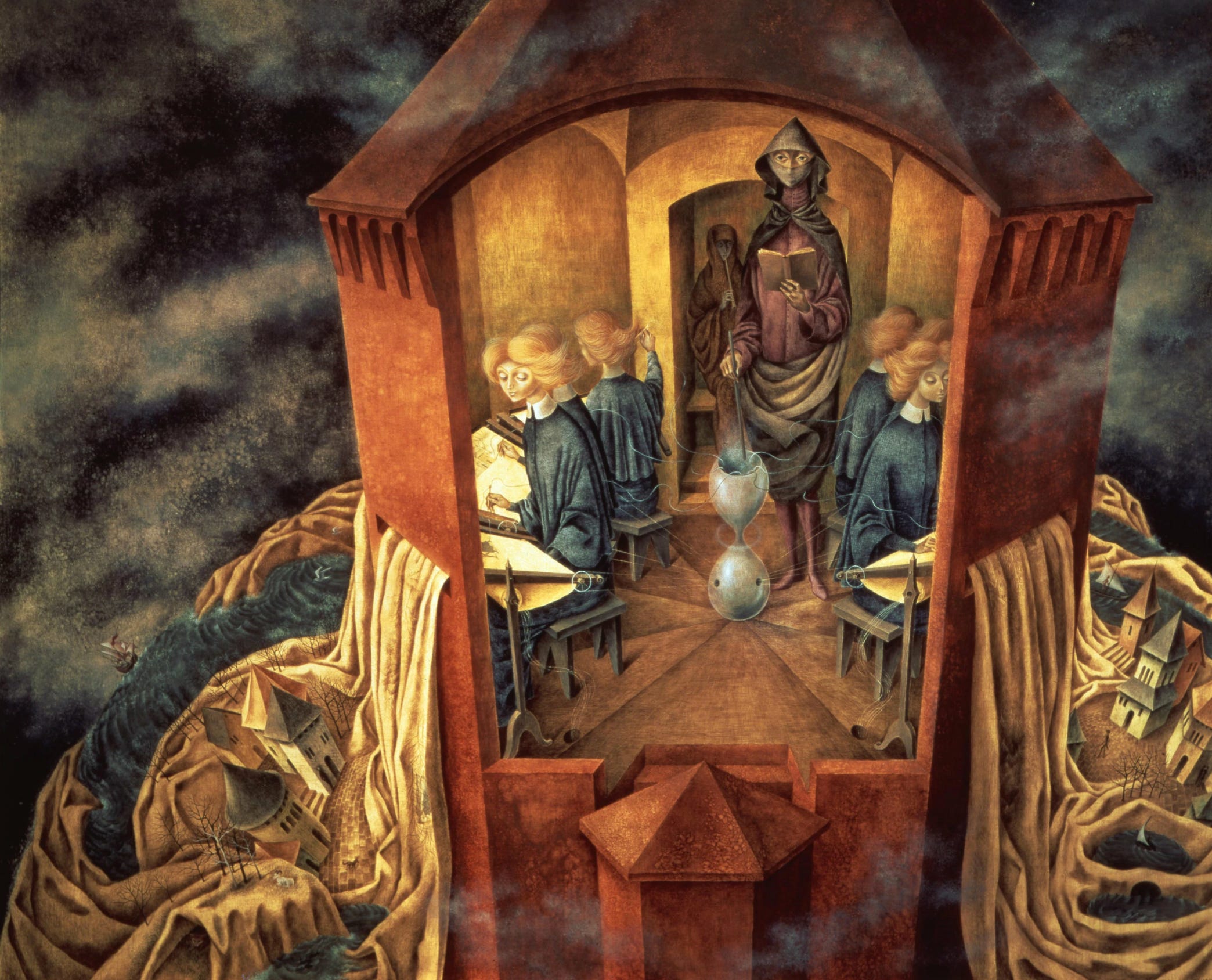
We’ve paired this piece with Remedios Varo’s Embroidering the Earth’s Mantle (1961)1. Women sit in a tower, stitching the world into existence — houses, rivers, boats — from threads that spill out the windows and become real. They’re enclosed, dutiful, working from a pattern someone else set. But the fabric has a life of its own. Angie’s story has that same quiet tilt: a small mountain town stitches meaning onto a body that can’t speak back, and the meaning spills out and becomes real to them. Birdie stitches a whole escape plan from a dead man’s silence. Minna stitches love onto everything she touches. The gentleman just stands there while the town embroiders him into a saint.

Image: Embroidering the Earth’s Mantle © Remedios Varo. Used for editorial commentary purposes only. All rights reserved.
Thank you again for choosing this story! <3
Just WOW!