



Hello fellow strange pilgrims,
I know there are many anti-AI pieces out there, so I want to start this post off a little perhaps controversially. This is not exactly one of those kinds of anti-AI diatribes. I’m not sitting in your rooms or your hearts or your lives, I don’t know who you truly are or where you’ve been or why you might feel the urge for any such things that we as humans in this strange world feel the urge for, sometimes things that are not exactly good for us, that do us great harm, and worse, that do great harm to others.
I’d like today to turn our collective attentions towards compassion to ourselves and others. And let us work to offer the side of light, a choice for the other thing that may be slower, harder on the surface, but will inevitably enrich us in ways we cannot imagine.
Below I’ll share with you five common reasons I’ve come across that folks not much different from you or I might feel the need to turn to AI. Do remember, it is now everywhere and will only continue to burgeon into our lives. So the ease with which we reach for it or might feel forced to reach for it will grow more commonplace and sooner or later it might even feel like the only choice.
But it is never the only choice. AI-fueled creativity is a pale veil of a mirage in comparison to true creativity and the power that lies in it. And the process, the road taken, to get there is perhaps even more powerful.

1.
You vs. the blank page
Whether you look upon a blinking cursor in a digital white sea or you’re holding a pencil or pen that won’t quite sit right on a seemingly infinite page before you, the blank page is a worrisome predicament. We are, each of us, beings of wonder and magic in our own unique ways, and there are depths within us that we can plumb and share beyond what even we can conceive of. But sometimes, that’s just too damn hard to get started with. So, perhaps we feel the urge to just blurt everything out to the robot and ask it to bake a sweet little cake of our ideas and thoughts and feelings and humanness. Easy-peasy?
No, unfortunately. Sleazy-oozy, more like it perhaps, sorry.
Solution: Free-writing.
Here’s an excellent description about Free-writing from our favorite free encyclopedia:

2.
Don’t know what form my writing should take
Some are blessed with a very particular kind of skillset, one that fits into a very particular form, be it long-form prose or poetry or perhaps the delightfully niche ability to write showstopper poems in the shower-fog that no one but you and perhaps the gods of water and wind will ever see. Others, though, among us, might struggle to find the exact form our stories should take. Should we pen a memoir, or a personal essay, or prose poems, or should we write a fairy-tale retelling, a horror, a sad literary autofiction, or hell a weird surreal comedy. Or, gasp, screenplays. PLAYS!?
Solution: Read this book, then write your own version of it:
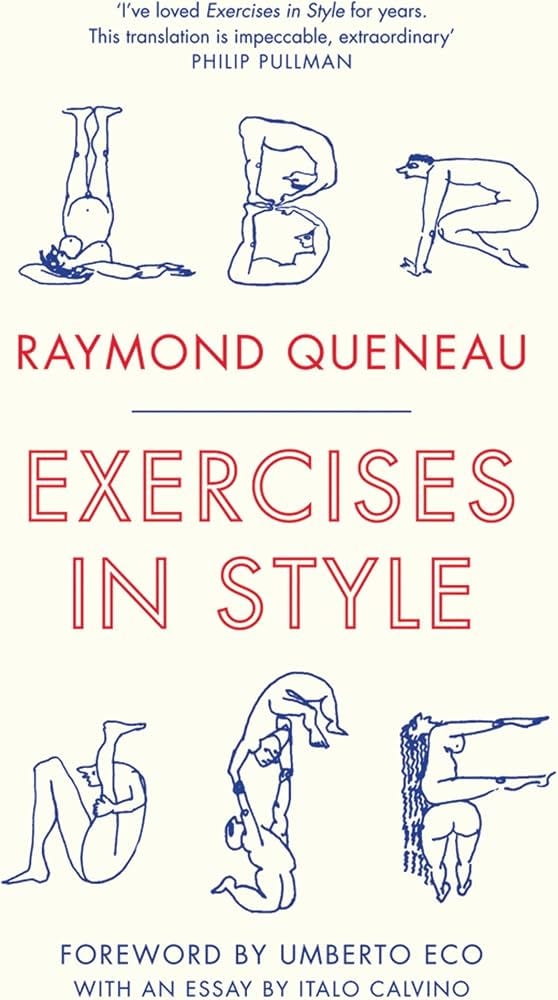
This book is a collection of 99 retellings of the same story, each in a different style. So, take your story, a scene from it if it’s long, a section, or if you’re daring then the whole darn thing, and write it as it would be written in different styles. And think beyond the conventions of genre. Write it as a police report, a series of receipts, found texts, an interview. And then find the body your story wants to live in best.
3.
Can’t figure out dialogue
Yes, indeed it might seem silly to resort to a machine to help with human dialogue, but many writers do this, and I’ve seen across socials and irl people relentlessly mocking this behavior but seldom offering alternatives. Mocking might be one may to help correct “bad” behavior, but as the child of a parent who loves this particular method of “correction”, I’d rather not engage in it, certainly not excessively and without any other recourse offered. And dialogue can be horribly difficult to master. Some writers outright hate the damn thing, and will use it sparingly to begin with. One must wonder if they too banged their heads against their typewriters and inkpots and just said fuck it, we’re doing interiority all the way through.
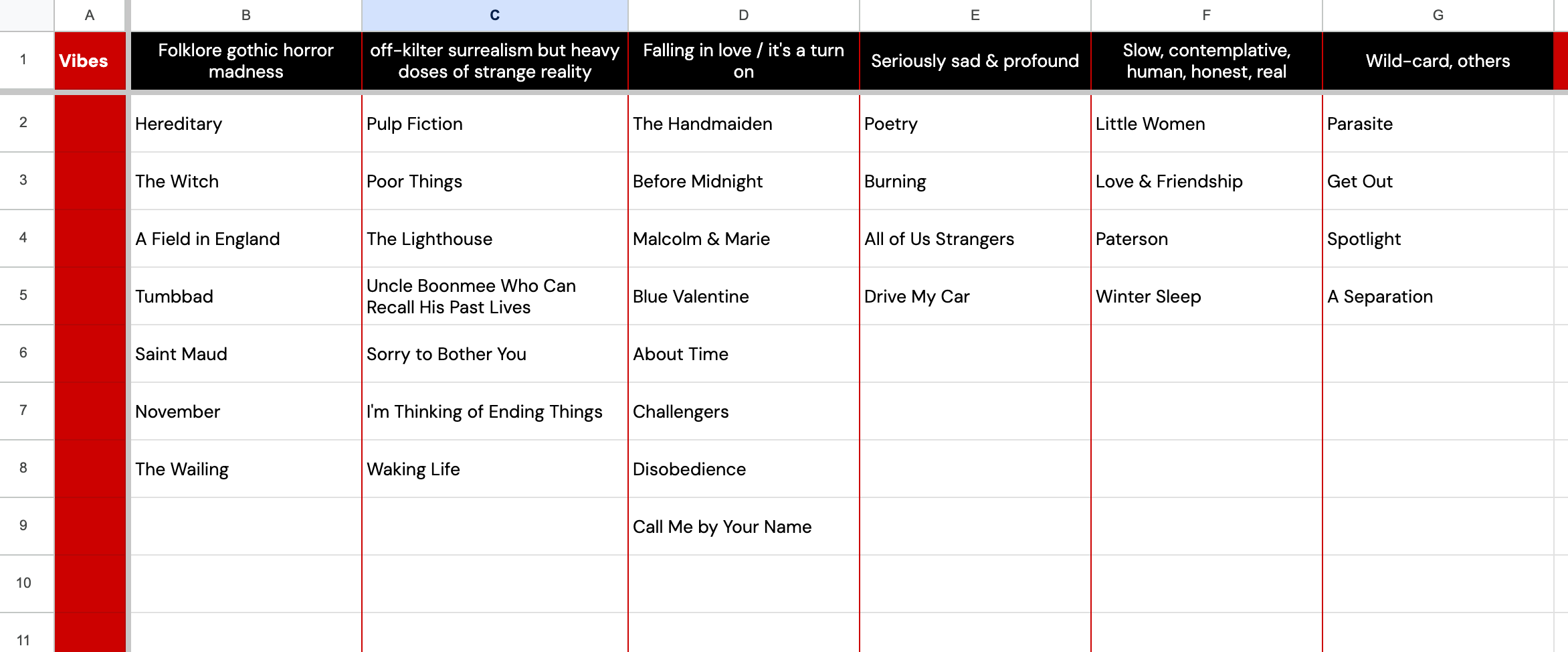
Solution: Eavesdrop OR if that makes you feel creepy, then LISTEN to these films:
4.
Need to research something connected to your plot or character(s) & it has to be accurate
One might assume that this doesn’t need to be broken to anyone at this point, but it does. AI has not cracked the highest heights of research and no great zenith has been reached. The thing is, I’m positive this is actually possible. In a hypothetical, alt-world scenario, I think it’s absolutely at the very least plausible for AI to get to a point where you can reliably use it for research. Do I think we will see this materialize in our lifetimes? No, absolutely not. Maybe some semblance of it. But the corporations behind LLMs do not care about your niche research interests or about any kind of integrity or ethics behind sourcing, acquiring, compiling, and conveying such facets of research. Part of the reason a PhD takes so long is because a factor of arguing your thesis is backing it up and the way to back it up, one way, is verifiable research, but something folks often miss, that the way to even develop a thesis worth arguing also requires research. Research is not a straight path you choose to chart with a map in hand and a “You are here” sign extending outwards along a dotted line and a clear X marks the spot. No, rather, research is a way of being. Even in it’s name, repetition, and the great whorl of infinity in knowledge is implied. Your are searching and then searching again, and indeed you are searching even for that which is to be searched. So:
Solution: Google it, but first:
Turn off the annoying and mighty useless AI Overview “feature” with an extension like this. Most of the things you might want to research for a FICTION text will be easily google-able or wikipedia-able and cross-checked with a couple other sources. If you’re writing nonfiction, I’ll tsk-tsk a bit and say you should know better, dear one. JSTOR, library access, asking actual reference librarians, Google Scholar, and finding authorities in the field is your safest, best, and brightest bet.
5.
Finding an audience for your work & building a content + marketing strategy plan to promote it
One could dedicate an entire Substack to this and of course I say this a bit tongue-in-cheek because many a Substackers (and content-makers, and vloggers and bloggers and other -ers) have done just that. As tempting as it might feel to be AI-forward in your strategy and planning here, there are real humans out there who have a far keener and more observant and useful finger on the pulse of culture today. If you desire to apply a more methodical approach to the more market-based aspects of a writing career (that often we might not have the luxury to opt out of) then there are many great resources.
Solution: Study the greats & learn from the best. Some favorites to learn from right here on Substack (in no particular order):









And now I’d love to hear from YOU. Please share what your go-to tips, tricks, secrets, little weirds are to help guide writers towards the light of human solutions and away from the dreaded vortex of so-called “AI-assisted creativity”?
This is such a great post with a lot of good ways to consider how to come up with your own ideas. Thanks for sharing vs just saying 'don't use AI.'
Fabulous post, and I appreciate the resources!