



Hello fellow strange pilgrims, today’s short story is, if I’m remembering correctly, the first short story we ever accepted for our lit mag. I remember reading it through once and then a second time and knowing that this is indeed a Strange Pilgrims tale. I hope you love it as much we do!


I should have listened to the man in New Orleans who told me I needed new shoes. He shouted at me from the door of his shop like an angry Jack Russell, telling me that he could see the soles wearing thin even from there. He was a shoe salesman, so I ignored him, dismissing his warnings as a sales tactic. If I had bought new shoes, I never would have found myself in Chicago, dying barefoot on the cold marble floor of the house of God.
That was my first sin, and it was a bell tower.
I crossed the Swamp Bridge in my mom’s old Pontiac and made it all the way to Jackson before she broke down. 327,017 miles on the machine, but the last 200 were enough to kill her. She died in front of a late-night bowling alley at two in the morning, conveniently across the street from the bus stop. The bus to Memphis would be there in an hour.
I think heaven and hell started their battle in Jackson. One of them killed the engine, and the other sent the bus.
I went inside and ordered the fries. They were crinkly, soggy, and a concerning hue. The bowling alley manager had a bird tattooed on his shoulder—a falcon, I think. It looked like he had done it himself in a poorly-lit bathroom in front of a foggy mirror. He wouldn’t let me sit at the table unless I changed into bowling shoes, so I asked for the fries to-go and ate them on the curb while I waited for the bus. A couple staggered out behind me, laughing, and she vomited on his truck tire before they peeled away.
I said goodbye to my mom and her broken Pontiac, leaving them next to the bowling alley dumpster. She might have been haunting that goddamn car, because the door cut my ankle as I closed it the last time.
This was my second sin, and it was a radiating chapel with a relic.
On the bus, I sat crisscross and bled on the seats.
I used to stack blocks when I was young. Little wooden blocks, given to me by my uncle. They were simple—unpainted cubes, cylinders, and pyramids cut from pine. They were the only toys I had apart from my imagination, but those are really the only toys a girl needs. They taught me so much about the world, although I didn’t realize it at the time. They taught me how things fit together—how atoms become space become experience, and how experience shapes the body. I learned how everything must be built from the ground up, and how everything falls.
Charlie used to play with the blocks alongside me. That was back when the only thing people expected us to be was children. That was before he grew old enough to put on boots, open a Bible, and see himself differently. Back when we could run around barefoot and no one would bat an eye. When we grew tired, we could sit in the dirt out behind the porch and stack the blocks in as many different ways as we could imagine until our fingers were sore.
There was one block in particular—an arch, proportioned just right so that it fit neatly against the rectangles—that we would fight over. We called it “the Steeple.” Both of us wanted to place the Steeple at the top of our towers, like we were building some holy place. We climbed trees for the same reason. Same reason humans started walking upright. Some invisible thread ties us to the earth and to the sky. We were hardly four feet tall and already knew about the axis mundi. Truths like that are rooted in our DNA, but sometimes those roots grow sideways and tear up the garden.
I always drew my axis mundi from the bottom of my feet to the top of my head. I did that when I was a kid, dirty and barefoot, then again when I wore shoes, then again when my shoes fell apart. Charlie found his world tree inside a church. Or maybe he never had one.
If I had given Charlie the Steeple a few more times, he might have been around for me when I needed him. But I had kept the Steeple for myself. That must have been the reason he went chasing after God. I tried to be happy that he had dragged himself out of the swamp into some kind of faith, but he had left me behind, just like my dad left my mom.
The pattern on the seats of the bus looked like someone had taken my uncle’s blocks, painted them with bright colors, and thrown them into a bowl of bright blue macaroni noodles. On the road to Memphis, after I learned I couldn’t sleep, I searched the pattern for a shape that looked like the Steeple. The street lights came by in flashes, so I searched in the same rhythm. I found it at the top of my seat, right behind the head rest. To find it, I had to sit on my knees like I was in prayer.
This was my third sin, and it was stained glass.
The bus driver woke me up in Memphis, saying “ma’am” a few times and gently touching my shoulder. The first thing I saw was a mosquito on my hand.
The nearest car rental was a quarter mile from the bus stop. That quarter mile was all it took for the shoe salesman’s prophecy to come true. Apocryphal blues in Memphis.
First the right shoe, then the left—anarchy set loose on the sidewalk in front of a strip club, beneath a billboard warning me about hell. That kind of shit only happens in cartoons. I shrugged and left the soles behind like the fossilized footprints of a dinosaur.
I kept wearing the top half of the shoes like a cardboard facade on a movie set. I doubt they would have rented me a car without them. If I had taken my time and used the two legs the Lord had given me instead of getting in that rental car, I would have arrived in Chicago at a ripe old age. I could have spent all that time eye-level with other people instead of flying right past them. Maybe then I would have finally understood what Guthrie was singing about, or maybe I would have just died barefoot along the way.
That was my fourth sin, and it was a buttress.
As I crossed the Mississippi for the second time and looked out onto the flat fields of Arkansas, I thought about the Pontiac again. I wondered how long it was going to sit next to that dumpster. Maybe the man with the falcon tattoo would take it home and fix it, or maybe it was just as dead and lifeless as Mom.
Mom may have died only a few days before I left, but she started dying before I was even born. It was a slow death, 327,000 miles of it. It started when Dad lured her to Louisiana, back when she was in love. He stayed around just long enough for her to get pregnant and start to sink in the mud, then disappeared.
Dad had poisoned Mom’s world tree the day he left her, and then she spent the next twenty years taking an ax to the roots of the tree to put it out of its misery. She hacked away until there was nothing but churned swamp, then she watered it with Bushmills until the quicksand dragged her down. After her cardiac arrest, I was left with nothing but her piece of shit car, my piece of shit shoes, and a boat-load of hatred for a man I had never even met.
I stopped at a diner just short of St. Louis. The waitress looked like she belonged anywhere but there. Her silk-black hair, high cheekbones, and burgundy lipstick made her look like those LA actresses from the 90’s—the kind you would expect to see dancing in a Lynch dream. She sure sounded country, though, and I saw her take four smoke breaks during my thirty minute stop. I thought about asking her if she would let me take her away from all of this, as if we were in some kind of movie, then I remembered my shoes and I laughed.
I did tip her a little extra, not just because she was pretty, but because she was probably burning all of her cash on cigarettes. I had to slide past the other things in my pocket to get to the cash—that slip of paper with a name and an address was still there, and so was the gun tucked into my belt. I handed a wad of bills over to her. She thanked me with a pretty smile, and tucked the bills into her own belt, in the same place I had my gun.
I forgot about her when I saw that my car was stolen. Shards of glass shimmered in the parking spot, sparkling like stars telling me where I shouldn’t go.
There were two other cars on this side of the lot. A Tacoma with Arkansas tags was full of furniture, stacked twice as tall as the truck itself in a game of Jenga you would find in a Seuss book. It had truck nuts and an NRA bumper sticker.
The only other car was a hearse. It was all black, which I think is the only color they ever come in. It was parked in the handicap spot.
Truck nuts had left his doors unlocked. I was twisting the wires of the Tacoma together, trying to get a spark without much luck, when I felt someone behind me and turned in a panic.
He was shorter than me, even with boots on, and lanky. His head looked too large for his body, but it might have just been his long, tangled hair and wild beard that framed his face like a lion’s mane. A camouflage cap mashed his hair down and a pouch of tobacco pressed against his lip. I remembered the NRA sticker and braced myself for a quick death.
“You’re doing it wrong.”
He brushed past me, setting his spit cup on the roof of the truck and taking the wires in his hands. A few seconds later, the old machine rumbled to life. He nodded at me and spit into his cup. He walked around to the back of the truck, jostled the truck nuts off, and carried them across the lot where he attached them to the back of his hearse.
Attempting to steal the Tacoma was not my fifth sin, but it did come a few moments later when I followed the lion man toward his hearse. I forgot about my bare feet, and the broken glass.
A minute later, I was sitting in the passenger seat of the lion man’s hearse, tears streaming from my eyes while he pulled shards from between my toes.
This was my fifth sin, and it was a confessional.
Lion man’s name was Pete. I held Pete’s spit cup between my thighs while he cleaned my wounds with rubbing alcohol. Pete had been living out of his hearse for a year. He had bought it from a bankrupt funeral home for cheaper than a bicycle. He assured me there was no dead body or coffin in the back. There wouldn’t have been room, anyway, between his boxes of mass-market paperbacks, skateboards, and the dirty twin mattress he slept on. It may be the only hearse in the world that smells like weed.
Pete was headed to Sault Ste. Marie. I didn’t ask why, and he didn’t ask why I was going to Chicago, or why I was barefoot, or why I was trying to steal a truck. He just offered me a ride.
As that ugly arch fell away into the horizon behind us, he asked me to tell him stories. I thought it would be painful to talk about Mom, even more to talk about Charlie, but it seemed to help a little. Pete was a good audience, and asked me good questions.
Once, when we were in sixth grade, Charlie tried to kiss me. I think he did it because he felt like he was supposed to. I didn’t know what to do, so I pushed him away. We didn’t talk about it until high school, and then we both laughed until we couldn’t breathe.
Sometime after the kiss, I asked Mom why people kiss each other. I got way more than I wanted in an answer, since she decided that was the time to tell me about how my body worked, and how other bodies worked. I’ll give her credit: she was sober for that conversation, but still just as angry.
One thing she kept telling me was that my body was a temple. I didn’t understand that at all, but I remember hearing her praying it to herself some nights.
Pete asked me about my dad—his first bad question. I flinched, and I think he could feel that he had made a mistake. Mom—or maybe God—answered for him by splattering the hearse with rain. The storm picked up fast until the wind was howling and the wipers were sprinting to keep up.
I didn’t remember much of the Bible—certainly not as much as Charlie did. And the parts I did remember were the ones Mom used as a belt. But I remember one story about how God used a storm to kill damn near everybody. He was disappointed with what he had made, and what they had made, so he sent rain to wash it all away and start over. Like Charlie knocking over his blocks when it was time to go inside for dinner. I thought about that storm when the radio started playing that strange, wailing tone.
We almost made it to the outskirts of Chicago before that storm became truly Biblical. Pete pulled toward a highway rest stop, but he couldn’t see where the road ended and the mud began. We ran the rest of the way to the plain gray building. I imagined that I was the last of the sinners running for the gates of the ark. I wondered how many of them were running on bare, wounded feet.
I didn’t look where I was running and stumbled face-first into that sweet flood water. I thought about lying there and letting it baptize me into something new. The water was too strong for me to fight—too heavy for me to draw a line between my feet and the sky. Lion man wouldn’t have it, though. He heaved me up and dragged me toward safety, breaking the latch of the building with his shoulder.
The storm raged outside of our ark for hours. The sky was so black I couldn’t tell what time of day it was. Pete broke the glass of the vending machine, and we ate Bugles while we watched the world fall away.
My shirt was torn and covered in mud. After an hour, I was freezing, so Pete took off his jacket for me to wear. He turned away to let me change, but I just took my own tattered rags off and waited for him to turn back around.
In the dim light of the vending machine, drenched in rain, mud, and sweat, our bodies didn’t really look like temples, but we said our prayers to each other all the same. After we worshiped, I somehow managed to fall asleep with Pete’s arm around my waist, the storm lulling me to sleep.
This was my sixth sin, and it was a baptismal.
I had a dream about my dad. He wasn’t in the dream, not in so many words, but I could feel him. I was on a spaceship sailing up into the heavens. No one else was there—only me—but somehow I knew I was the last hope of the human race. I was supposed to find a new planet to colonize and keep our DNA going. Keep his DNA going, though. I felt him in my blood, salty and bitter, poisoning roots like he had done before, and I couldn’t stop thinking about the flood again. About Noah and his ark.
I found his name and address carved into the floor of the spaceship. It looked just like it did on the little slip of paper I kept tucked away in my pocket. Mom never knew that I had found that in the pages of her Bible seven years ago.
Charlie told me he was going to leave only hours before he actually did it. I was furious he hadn’t told me sooner, although looking back, I don’t know if it would have made much of a difference. He tried to explain—said something about divine calling and holy purpose—but I just kept asking him why. I needed a friend, I told him. But he needed God.
After he was gone, I found Mom’s Bible hidden in her nightstand behind the liquor. I thought maybe I could understand Charlie better. The book fell open to a page in the middle, letting loose this paper. I read the paper first and saw the name. The only thing I had ever learned about my father was his name and the pain he had caused. Mom had told me she didn’t know where he went, but there I was, staring at his name and an address in Chicago.
On the Bible page beneath it, I read only one line.
“Thou dost lay me in the dust of death.”
That little piece of paper became my Bible. I kept it in my pocket for seven years, waiting until Mom finally died, so I could finally do what I needed to do. I read it over and over to myself when I bought the gun and etched it into the metal, when I ignored the shoe salesman, when I drove the Pontiac over the Swamp Bridge, when I kept sinning along I-55.
I read it again on the floor of my spaceship while it touched down onto a new world. I realized in my dream that I was barefoot. The letters were burning my feet.
Around the name and the address, a poem was written. I had heard the poem before, but it never meant anything to me then. In the dream, though, I understood that the words condemned me.
The walls of the spaceship peeled open in front of me, forming three steps down onto green grass. The sky was blue, and I could hear birds chirping. Sweet, fresh air—cleaner than I had ever felt—filled my lungs. I was supposed to leave the spaceship, but I stayed there until I woke up.
This was my seventh sin, and it was a clerestory.
My gun was gone in the morning.
The birds woke me up first. Pete was a heavy sleeper, still snoring in harmony with the vending machine. I left him there to dream about whatever spaceship he was on.
The first dim lights of the sun sparkled on the swamp outside. I was a thousand miles from Louisiana, but a vision of a bayou had followed me even here. I started looking for the gun like I was fishing for mudbugs—jeans rolled up to my knees, ankle deep in the muck.
Something was sticking up near the root of a tree—the body of a turkey vulture, turned stiff and cold and bloated with rain. I thought it had drowned in the storm, but I saw the hilt of my gun rising from its beak. I pried it open like a clam, fighting against the stiff jaw muscles, until I held the weapon in my hand.
That was my eighth sin, and it was a monstrance.
The Mississippi River once flowed north for a brief time, centuries ago, when earthquakes rocked the land and sent the currents backwards. Anyone who knows the river knows how impossible that seems, but it didn’t seem so impossible to me that day. I looked out on I-55 stretched out in front of me, winding through the hills and sparkling with rain water, and I could feel its current pulling me north.
I stole a clean shirt and some food, but I left the hearse behind. I told myself I left it to be kind to the lion man, but the car was stuck deep in the mud. It wouldn’t have gone with me, anyway.
The skyline of the city rose up toward the heavens in front of me.
All around me, as the darkness fell again, axis mundi of glass and metal stretched upward. I no longer cared about the pain in my feet. They had become a reflection of myself, smearing blood across the land. They carried me over sidewalks and streets so potholed they looked like Swiss cheese. They carried me over sharp rocks and broken glass and still-hot cigarettes—all of heaven and hell still trying to keep me away. My body was one stigmata, from my broken feet, to my tired thighs, to my hunched shoulders.
They were hunched against the misting rain that filtered through, and against the weight of my sins. I’m sure if someone had seen me—although I saw no one around—they would have thought I was a creature of some kind. My humanity had been left behind in pieces along I-55. I was a rough beast, like the poem told me I would be, my hour indeed come ‘round at last, but I was not slouching forth to be born. I was slouching forth to die.
The shadow of a bird passed over me, so large that she blocked out the rain. I turned my eyes upward and saw the steeple of a church turned blood red in the dying light.
This was my ninth and final sin. I thought it was a steeple, but it was a crypt.
In the middle of the empty city, this house of worship seemed small, but I didn’t care about the size. I cared only for the ground that it sat on. My father’s address was not a house, or an apartment. He was a church. Above the door were words etched in Latin, like his name had been etched onto my gun.
EGO AVTEM SVM VERMIS ET NON HOMO
The door was not as heavy as it should have been. The air inside smelled damp and cool, and herbal as the last smoke of incense trailed away. Nothing moved there except for me, and the wind that I pushed.
Humans are born head first, which means our feet come last. The whole picture must take shape before our feet can, and from then on, we spend our lives placing weight onto them, forcing them to carry all of our baggage while we get to look up at the sun and the stars. Mine finally gave up when they touched holy ground. They were nothing more than bloody stumps by then, but they brought me down with fury.
I crawled from there, dragging myself along the aisle, beneath the flickering candle light, toward the holy place in the center. The house of worship told me where to go, built long ago by careful hands who never knew what crimson stains would later come.
In the center of the church, beneath the highest dome, I found that name carved into the floor. My father lay buried beneath me, six feet or more below. If not for the earth between us, I could have kissed his cheek.
I think whatever we put beneath the soles of our feet becomes our worldview. If we walk in shoes, life is supported, commodified, isolated. If we walk on asphalt, life is painful, immortal, cracked.
If we walk barefoot on dirt or grass, life is familiar.
If we run barefoot in a storm, life is wrath.
If I’m right, changing your life is as easy as changing your shoes.
I never heard his voice. I was too close to death for sound to reach me. But I felt his hands on my shoulders—gentle and caring—and when he rolled me onto my back, I saw his eyes. Charlie had grown since I had last seen him, but his eyes were the same. They looked down on me from above his white collar, first with concern, then recognition, then shock.
There was a time when his eyes would have brought me comfort, but that time had slipped away from me.
My feet were broken, but I made one more axis mundi, my arm raised up toward the sky with a steeple made of metal. I gave the rest of myself to heaven and to hell, but all I had left to give was sin.

Tell us your origin story as a writer. When did you begin? What first drew you to writing as an instrument for asking questions that can’t be explored any other way?
J. NEWMAN PRITCHARD: When I was very young, my grandparents would sit with me and my sisters on a swing in their garden and we would play a storytelling game. We would each say one sentence of a story before passing it along to the next person until we reached a satisfying ending. That's certainly where I began as a storyteller. When I was much older, I began playing roleplaying games with friends. That was like unkinking a hose. Stories started to spill out faster than I could keep up, so I began writing them down, just ideas or loose outlines. At some point during undergrad, those ideas turned into true prose, and I have been writing fiction ever since. I think, because of those origins, storytelling is always inherently a collaborative process for me. I might be alone with my thoughts and the page, but I am hearing voices of other people as I write. I am hearing idioms from my southern family, strange comparisons that a friend once pointed out to me, or the weird notes that I discovered in the margins of a library book. All of that is blending together and forming the voices of my characters that sit in the room around me and whisper. I am the only one writing, but I am never writing alone.

What does your writing routine look like? Do you thrive in structure or wildness? And when you begin a piece of writing, what tends to announce itself first: a voice, an image, an unease, a philosophical conundrum?
JNP: I think I treat my creative mind like a horse I am trying to tame. It needs to have the space to run wild and show me something I never would have guessed, but it needs a gentle hand at the reins or it might buck me off and leave me in the dust of an indecipherable draft. Each new piece often begins with just a visual or emotional image. I will jot that down quickly. If I think the piece is a short story or flash fiction, I will just start writing it. If I feel like it wants to be something longer, like a novella or a novel, I will toss around some outlines before I start working on the prose. Outlines aren't to box me in, but just to keep me focused on the story I am trying to tell. "Nine Deadly Sins on I-55" began with a mental image of someone's shoes falling apart one after the other. That was the image that kept me anchored throughout the writing process.
Most artists are preoccupied by certain obsessions: lust, longing, death, the self. What persistent preoccupation—emotional, intellectual, or spiritual—threads through your work? Are there motifs, themes, or impulses you’ve tried to abandon but that keep returning, insisting on their relevance?
JNP: There is nothing that I circle back to more than the physical space that human beings inhabit. We are embodied creatures. None of us have ever had an experience that wasn't defined by the space we occupy—the confines of our body, the limits of the walls or sky or forest, the smell lingering on surfaces, the emotions carried in the air that we breathe. When I walk into a room, the first thing I notice is the way the new environment pushes and pulls me. I want my characters and my readers to experience that vividly when they enter a story. Regardless of what kind of story I am trying to tell—whether it is horror or fantasy, grounded or speculative—I will always tell a story that “Takes Place.”
If not a writer, who would you be?
JNP: Before I started writing prose, I was (and still am) an artist. Charcoal, graphite, and ink were my mediums of choice, but I dabbled in most visual mediums. For several years, I was on track to be an architect. If that had worked out, I might not have ever tried to write prose. I am grateful that I am a writer instead of an architect, but I do consider myself to be both, even if I use a word processor instead of a CAD software these days. I still draw frequently, often illustrating scenes from my own fiction. At this point in my life, my art rarely leaves the walls of my bedroom, but it helps me spend more time in the worlds inside my head. When I can’t find the words, I can often find a picture. My love of art and architecture is certainly closely related to the embodiment I discussed above.
What’s the best piece of writing advice you’ve ever received? Alternatively/additionally, what’s something you’d like to offer as advice to emerging writers trying to make a mark?
JNP: I still consider myself an emerging writer, so I don't have answers to “solve” writing, and I hope I never trick myself into thinking that I do. But I have learned quite a few things. There is no correct way to be creative, so long as you are turning inward before you ever turn outward. Your creative mind is like a pot of stew on a stove. That pot is larger than you think—it is vastly deep and wildly hungry. You have to feed it. Toss everything in there. Vegetables, roots, meats, seasonings, fats. Read so many books, talk to so many people, watch international films that you have never heard of before, wander in an art museum and pretend you are someone else for a day. Or, you can take my personal favorite: sit in a crowded restaurant and eavesdrop on neighboring tables. After your creative pot is so full that it is overflowing and you simply can't handle it anymore, then you write like you are never going to stop. And keep writing, even if you think what you are writing is bad (it isn't). You can always edit a terrible first draft, but you can't edit a blank page. Lastly, never, ever, ever go near artificial intelligence: not for brainstorming, or writing, or editing. Don't touch it with a ten-foot pole. If you do, I will find you and I will fill the inside of your computer with a gallon of Nutella.
What are you working on now and how is it trying to ruin your life (in a good, necessary way, of course)?
JNP: I don't like discussing too much about works in progress: my main motivation for writing is sharing my story with an audience, so I need to keep that motivation close to my chest to push me forward. What I can say is that my current project is a postmodern gothic horror novel. It tells the story of several individuals affected by a person's disappearance. There is a small cast of characters, a mysterious theater play, and a garden full of stone statues. This novel has already been trying to ruin my life as I have been working on it for a couple of years, drafting outline after outline. The current draft looks like a completely different story to the first one, but it still has its roots buried deep in something true. I am close to uncovering an outline that I think will carry me to the end, but I still need to toss some more things in my stew pot. Soon, though, I will be full-steam ahead.
Who are the artists—writers, filmmakers, thinkers, internet oddities—that have shaped your sense of narrative? How have they rearranged the way you see the world on the page?
JNP: Ursula K Le Guin stands out above all of the rest. She was everything I admire in a great writer, artist, and person. Every time I discover something new from her, I feel entire worlds open up within my mind, like rooms I hadn't given myself permission to explore. Ever since I started reading her work, I do not think about genre in the same way. I also have an undergraduate degree in religious studies, so I have read many thinkers from many different faiths around the world. This has had a profound effect on my writing, I think, allowing the voices of my characters to bend and shape their worldviews in ways reflective of human spirituality. Other writers consistently make ripples in my writing: Mark Z. Danielewski, Shirley Jackson, James Baldwin, Ray Bradbury, among others. The only storyteller I think about as often as Le Guin is David Lynch, especially when I am working on the realm of postmodern horror.
Please recommend a piece of art (a painting, a film, an album, anything that's not a piece of creative writing, really) that you love and would like everyone to experience.
JNP: If you enjoyed reading "Nine Deadly Sins on I-55," I can certainly recommend some films that may strike the same chords in your mind. 'Red Rock West' (1993) is a delightful noir western crime thriller starring Nicolas Cage and Lara Flynn Doyle. 'The Outrun' (2024) has been an inspiration for me this last year since I first saw it, and Saoirse Ronan delivers a spectacular performance. The Coen Brothers are my favorite directors and have influenced my writing in many ways. 'Inside Llewyn Davis' (2013) is probably the most relevant comparison to "Nine Deadly Sins on I-55", and I think you would enjoy it. One of my favorite films of all time is Charlie Kaufman’s ‘Adaptation’ (2002), and I think more people should watch it. For music, John Prine and Emmylou Harris were on repeat when I was working on this short story and will always have a permanent place in my library. I have been listening to Sunny War a lot this year, especially her songs "Ghosts" and "Whole." As for other artists, I have found so much inspiration and peace from the work of Christian Watson (@1924us on Instagram). The animation style is both startlingly unique and strangely nostalgic.


J. NEWMAN PRITCHARD is a writer living in Chicago. He has a love of stories that smell like petrichor and taste like black tea. When he isn’t writing, Jake can be found at the movies, on a hiking trail, or attempting to dissolve into a haunted twilight fog.
Notes on Art
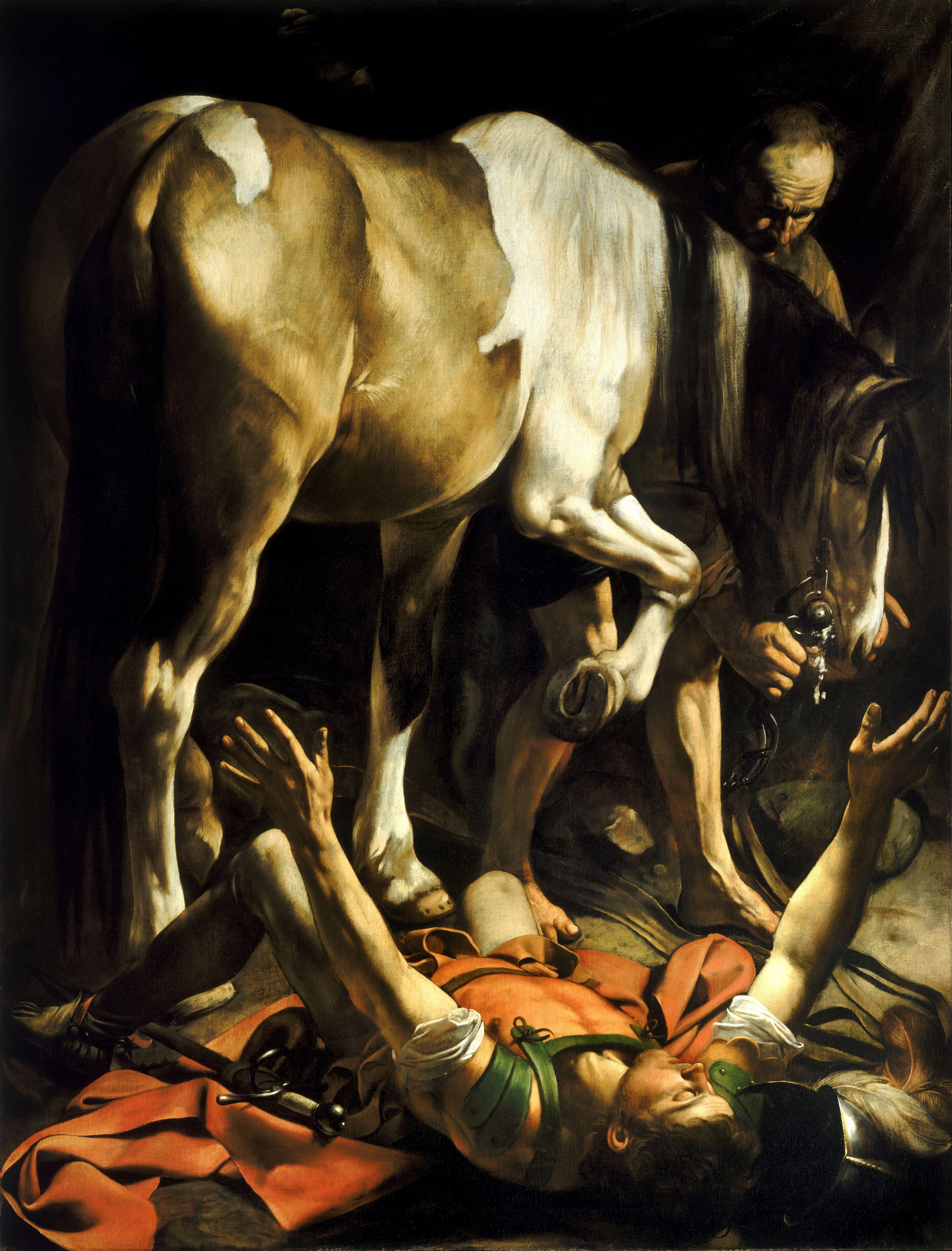
We’ve paired this piece with Caravaggio’s Conversion on the Way to Damascus (1601)1. A man lies flat on his back, arms flung up and open, eyes shut, his sword fallen in the dirt beside him. The horse fills the entire top of the canvas, one hoof raised above him, and the only other figure, partially obscured, grips the bridle and tends the animal, untouched by whatever has happened. Though the story shows no holy presence outright, we do witness a light falling upon the man and there is some sense that there is something miraculous taking place (indeed this painting depicts the conversion of Paul from someone violent and “unholy” to apostle). There is a similar propulsive, wondrous energy channelled throughout this story…and it’s one that will stay with me for quite some time.
Image: Conversion on the Way to Damascus © Caravaggio (1601). Used for editorial commentary purposes only. All rights reserved.
What a story. Charcterful, dream-like and ominous. Reads like a modern Flannery O’ Connor.
Well done!