



Hello fellow strange pilgrims, the flash you’re about to be treated to below is something that made both Karan and I say FUCK out loud more than a few times, and I feel like that’s all the preface you need from my end for this one.
As you know we are also open for general submissions right now, so if you’re sending us your work then with a gentle push we also ask you to read/catch up on what we’ve published so far.

Short Stories ✶ Essays ✶ Flash Fiction ✶ Flash CNF ✶ Micro


I own a man. I don’t fuck him—what would be the point of owning him if I did, but I pay for him with my tears and laughter and he lives in my spare room and stands in my living-room when I want him to, dressed up or down, depending on my mood.
To be fair, he’s more of a rental. I buy his labor, and every single emotion he feels during these fresh, honeyed hours. Some people do poppers and twentieth-century movies to get off, I do whiskey and an hour of him reading Anne Frank’s diary, sobbing his eyes out. An eye for an eye. After all, why wouldn’t I buy myself a healthy dose of what I sell?
People call me the quintessential post-modern porn star; I say, I’m Marilyn born anew, performer of the forgotten art of feeling too much in public, one of the last remaining flesh actors in the time of AI-only movies. I am exquisite dishevelment, rage, heartbreak, excessive pleasure… and people pay a pretty penny to watch me burn from it all.
My man, I met at one of the most exclusive live shows for the rich and notorious. There, with the glacial face of someone who knows the currency of a smile, he bartended for a silly fraction of what I make from a single lash bat on stage. Raw from telling the audience how, seven years ago, my one true love abandoned me in a shady motel half-way to LA, on what was to be our one-way trip to life unbound, I asked for a whiskey sour.
My voice clipped in places like someone fighting a panic attack. Patrons crowded me, offering the empty comfort of words mingled with praise for my art, while their fingertips crawled to my forearms or thighs, all greedy for a bit of me.
Bartender extraordinaire shook his head at my order, face unfeeling, and poured me an Irish mule, with such disinterest for my feelings, immediate relief flooded me. I offered him the job on the spot.
The man has a name but I never use it unless he performs. Unlike movie stars made of pure code, he also has a body, more attractive for how imperfect—real—it is, and he uses this instrument very well in his own art making. There is something magnificent in a handsome, substantial man, ranting in his floppy briefs, only to fall to pieces on my crimson and orange rug, as rain tumbles from the sky.
Unfortunately to believe this man doesn’t expect something of me would be delusion. Because he wishes neither to fuck me nor to see me cry as my patrons crave, doesn’t mean he wants nothing from me. What he wants obviously is a career, and in the moments that follow his best performances, when my own body stirs with the need to touch him, console him, make sweet, gentle love to him the way I don’t do anymore these days, I offer promises—the silken words on my adept tongue the closest thing to a stroke I will allow myself. Yes, he can be my opening act, my protégé, but not until he has truly learned the craft.
How convenient: I am the only judge of his talents. Deep down, I’d rather not share his art with others.
My act exhausts me and leaves little space for the gentle swaying of calm emotions a happy daily life requires. Most days, I come home cried out, fuming, or blanked into nothingness. I ask him to mirror my emotions to me, and he does, while fixing me a plate of eggs and bacon or a glass of straight whiskey.
We scream at each other about nothing at all, and it sounds almost like a game. We stare at each other in silence, weeping. We stare at each other, aroused and disturbed. We don’t touch but when I head to bed alone, the frustration reassures me that I can still feel when I am not performing.
We never touch—like me, he doesn’t have sex for money—but as time passes, I ask him for increasingly private and vulnerable slivers of him and he doesn’t deny me. How could he, when I never deny my own audience? He trusts I am training him.
I ask for an account of a day when he truly wanted to undo someone, not with his words, but with his hands, and after he swears there were none, he strangles a pineapple for my pleasure, laughing all along at my absurdity. I request a replay of his last act of sincere violence and the laughter dies as he destroys a simple sheet of paper, his features quietly twisted. I demand he surrenders the harshest words his father had for him, demand he speaks to me as if I was his mother, demand he tells me he loves me the way he did to the last person who left him.
When he does, holding me out a glass full of ice cubes, I crack and slap him, throw the glass at the window, calling him a liar, a devil, a performer.
Then I tell him he’s fired.
After that scene, I don’t go to bed; I go back to work and give my audience all of it: the rage, the lust, the loneliness. They drink my face like I’m champagne, lick my instrument with brilliant eyes, dripping with envy. Why don’t you watch each other I want to ask them. But I don’t, because I am glad to be their idol, for at my altar they lay precious tributes. A deity of truthfulness, woven, like them, from live matter—not a disembodied and unfeeling icon who cares nothing for their worship.
I come home, pockets full of diamonds—the kind that twinkles on fancy credit cards—to the wind whispering through the splintered glass of the window. On my couch, my jack-of-all-feels lies asleep, his expression fleshly, divine, volatile.
Human.

1.
Tell us your origin story as a writer. When did you begin? What first drew you to writing as an instrument for asking questions that can’t be explored any other way?
DIVYA KERNAN: It sounds incredibly corny but I wrote my very first story the year I learned to read and write. I was terribly chatty so I would often get held indoor at recess as punishment, and I started writing then. During adolescence, I also wrote that shameful (or shameless?) first novel many of us have where we’re the main character and everyone realizes how awesome we are.
More seriously, my brain processes emotions in a delayed, non-linear manner so, early on writing became the safe space for dissecting all that mess at my own pace, and through the safe distance of speculative fiction. And with practice came more intentionality: now I get more leeway to choose what complicated feelings and ‘what-ifs’ a story will explore early in the process, instead of tumbling in only to discover what it is actually about in the twentieth draft.

2.
What does your writing routine look like? Do you thrive in structure or wildness? And when you begin a piece of writing, what tends to announce itself first: a voice, an image, an unease, a philosophical conundrum?
DK: For short stories, the voice almost always comes first. I’m out there minding my own business, when suddenly those opening lines ambush me. After that, things start to assemble on their own, concepts that had floated around in my mind for a while but had no container yet, suddenly claim they belong in this particular story… and who am I to deny them? Sometimes these opening lines stay stranded in a file for months before the rest of the story has brewed long enough to emerge.
For novels, I start with a speculative premise that mirrors a question I have about our world and my identity within this world.
As for my routine, when compatible with my daily life, I try to have time with my writing in the morning as often as possible, a fixed time-space when my brain is allowed to do the dreaming into words. For longer work, I plot a little but not so much that the magic of discovery is lost.
3.
Most artists are preoccupied by certain obsessions: lust, longing, death, the self. What persistent preoccupation—emotional, intellectual, or spiritual—threads through your work? Are there motifs, themes, or impulses you’ve tried to abandon but that keep returning, insisting on their relevance?
DK: Well, my (still) short list of publications doesn’t do subtle (laugh). So yes, I’m obsessed with the complicated connection between physical intimacy and emotional vulnerability, probably because I grew up with Christianity as the backdrop. I’m fascinated by the dichotomy of how physical intimacy is often easier, more straightforward, than real vulnerability, yet our society turns it into a vehicle for shame. Sometimes I feel this part of my writing is the least original, but on the other hand it has found the most outer resonance.
This also ties into another motif of mine: the body as something independent from the mind, uncomfortable to inhabit, even foreign or hostile at times. I suspect that’s a reflection of my personal experience of being neurodivergent.
In an oddly specific way, flowers often show up in my stories too, tinted by my lyrical obsession with beauty as both enticing and toxic.
Last, identity (and how we perform it) occupies a big space in my writing. My identity sits at the edge of a lot of things, which has made it hard for me to find a sense of belonging—so I’m always chasing it through dreamworlds.
I don’t think I stand a chance of outwriting any of these obsessions!
4.
If not a writer, who would you be?
DK: Artistically, I’ve tried a bunch of things including dancing and singing (sadly, though I love dancing and karaoke, I suck at following a beat hahaha) and acting (to work on conjuring those feelings in the body and in the moment), but writing is my medium. Still, I love to touch ‘stuff’, so if I had the skills to craft with my hands (instead of with my mind!) that would delight me. Maybe a glassblower, a sculptor or a potter then?
5.
What’s the best piece of writing advice you’ve ever received? Alternatively/additionally, what’s something you’d like to offer as advice to emerging writers trying to make a mark?
DK: Annie Hartnett, who taught the GrubStreet Novel Generator for my cohort, told us that to write her novels she “told herself a story,” and, thus, encouraged us to write chronologically when drafting a first draft. I don’t always abide by this rule, but this is the one piece of advice that has enabled me to finish projects. Before that, I would discard drafts once I’d written all the tasty bits.
As for advice from my practice? I’m terrified of being trite. Yet, what does it mean to produce something original? In response to that anxiety, I aim for a sense of truth. When I edit, I listen for this grating sensation, when a word, a phrase, a line feels untrue to the story, emotionally or otherwise. I don’t always know why or how to fix it immediately, but I know I must come back to that beat and dig deeper. In the end, I think we love artists for how they offer a sense of connection to their deep, authentic truth and how experiencing someone else’s emotional landscape can help us feel our own feelings. To me, nothing authentic and sincere is ever trite.
6.
What are you working on now and how is it trying to ruin your life (in a good, necessary way, of course)?
DK: I’m wrestling with a horror novel that blends girls on bikes, neurodivergent girlhood body horror, and the gaslighting of women. This is the third novel I’m working on (not counting that self-aggrandizing teen novel!), and it is the one that draws most directly from my growing-up experiences. This makes me love the story in a more tender way than my previous stories and feel fiercely for its characters, but it takes away some of the escapism. So, there: very necessary ruining of my writing life haha.
7.
Who are the artists—writers, filmmakers, thinkers, internet oddities—that have shaped your sense of narrative? How have they rearranged the way you see the world on the page?
DK: I’m still deeply enamored with my childhood and teenage formative reads and can’t help but torture them into new forms on a regular basis, namely fairy tales, gothic romanticism (Baudelaire’s Flowers of Evil and early vampire novels), and period pieces focused on the complex relationship between beauty, love and power dynamics (Dangerous Liaisons, The Picture of Dorian Gray, and Chéri by Colette). In that vein, Guillermo Del Toro’s movies have fed my aesthetic a lot, particularly Pan’s Labyrinth or Crimson Peak.
I obviously love very many contemporary writers, across fiction genres, but I don’t understand well enough yet how they inform my writing. In non-fiction, however, Girlhood by Melissa Febos has profoundly supported me in my writing of the horror WIP mentioned above, and so have a number of Green Day songs (I’ve been a fan since forever!).
Complex speculative movies like Inception, Everything Everywhere All At Once, and one of my absolute favorite movies of all time: Arrival (based on the even better short story by Ted Chiang) have inspired me to get comfortable with layered complexity in my own writing, trust the readers to pluck all the small pieces to collage into meaning. I view this as a very impressionist way of writing stories. Series like Maniac and The OA (season 1) on Netflix also thrive on layered meanings and duality of interpretation. I love how far they go into the weird, while their core remains emotionally simple (and brutal).
On the gentler side of things, I hope to someday conjure the sense of wonder of Howl’s Moving Castle and Chihiro in my own writing without the grim fog of old-time fairy tales creeping in. About Time and Your Name are also aspirational, should I let myself write a rom-com (and not let it turn into a dark yearning creature). I even have a premise...
Last, one piece of worldbuilding I am in awe of is from the manga/anime/live-action One Piece: the use of snails as telephones is so incredibly unnecessary and whimsical—I love it! It reminded me of how as worldbuilders we have more freedom than we sometimes grant ourselves!
8.
Please recommend a piece of art (a painting, a film, an album, anything that’s not a piece of creative writing, really) that you love and would like everyone to experience.
DK: PSYCHE REVIVED BY CUPID’S KISS by Antonio Canova at the Louvre. A personal favorite since my college years!
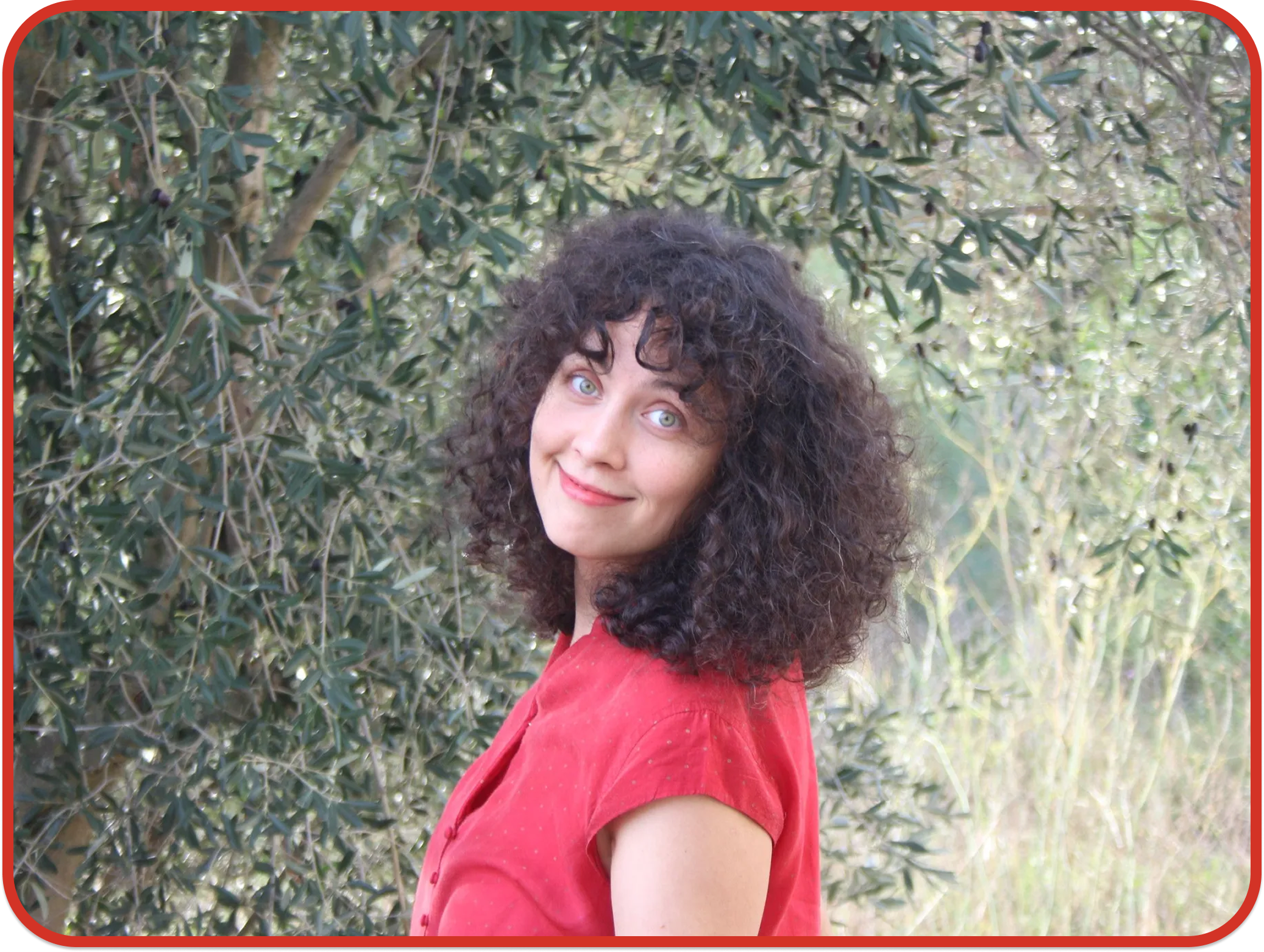
DIVYA KERNAN (she/her) is a biracial and neurodivergent writer and an alumna of the Short Story Incubator at GrubStreet, Boston. Her short story “Carmilla, or, the Making of a Girl” published in Baffling Magazine was featured on Reactor Must Read list, and her flash fiction pieces have appeared or are forthcoming in Lost Balloon and PseudoPod. You can find her on Bluesky: @divyakernan.bsky.social.
Notes on Art
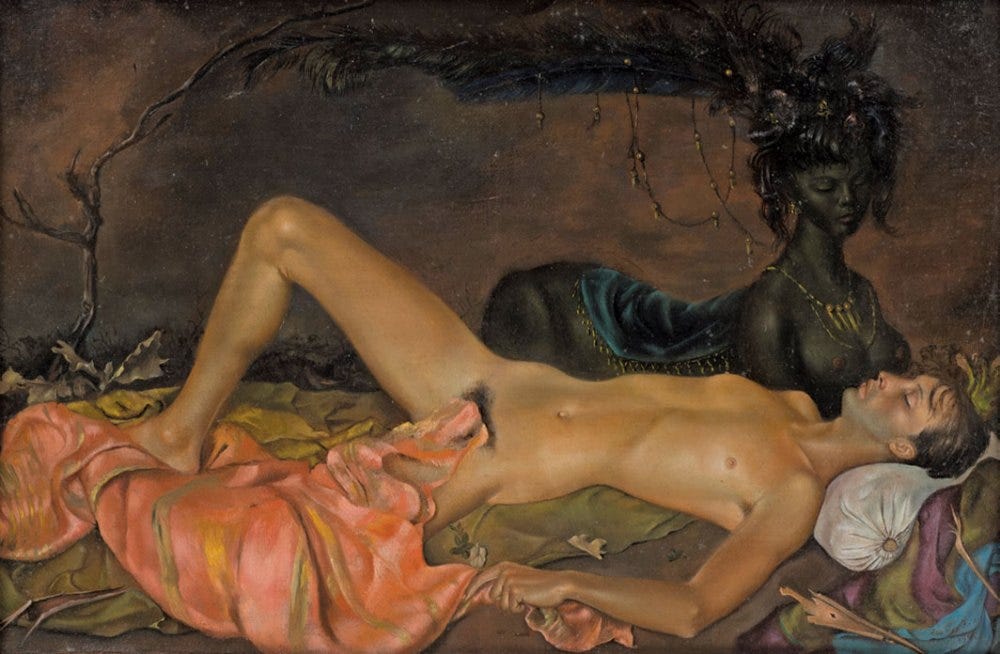
We’ve paired this piece with Leonor Fini’s Chthonian Deity Watching over the Sleep of a Young Man (1946)1. A black sphinx looms in the dark over a young man asleep, nearly naked, a strip of pink fabric across his hips. Her gaze is fixed on him. She could be guarding him or deciding what to do with him — the painting doesn’t say and in a way…we don’t ask it, we don’t feel like there’s anything missing (or well at least I don’t). I love how Fini reverses what we might generally see in art… the body on display is the man’s while the watcher is the female character here. Therein lies so much of the wild heart of this beautiful flash piece too, I feel.
Image: Chthonian Deity Watching over the Sleep of a Young Man © Leonor Fini (1946). Used for editorial commentary purposes only. All rights reserved.
Beautiful writing that ironically reflects a cruel spirit.
FANTASTIC story‼️