



Hello fellow strange pilgrims, I’m excited to share our fourth flash fiction piece, a beguiling tale that veers prophetic and comical and liturgical and musical all at once. I also love how the most seemingly commonplace things spring up alongside the most chaotic. I hope you enjoy it!



The radio man claims it is his birthday, bringing him ever closer to his Saturn return. The radio man rinses his hands with rubbing alcohol. The radio man hollers good morning to the hinterlands. The radio man reads his own palms. The radio man delivers with disarming calm an advertisement for a national therapy corporation. The radio man starts to share the weather and then refuses. The radio man shouts out the moon. The radio man, in a fit of boredom, calls for the execution of the station’s weatherman. The radio man guffaws when a caller, an apostle of the weatherman, begs for peace. The radio man talks shop with a hitman. The radio man plays the hits. The radio man sneaks a song from his sister’s band into the broadcast, pleased as a pig in shit. The radio man speculates that the war on the moon rages still. The radio man wanders away from the mic, on the hunt for sparkling water or pumpkin seeds, and his voice, spilling out of him like rabies, grows thin.
His absence breeds yawing opportunity: a woman’s voice ekes out of the silence. She blankets his listeners’ living rooms and cars and earbuds with an old song.
She is their neighbor, same as the radio man.
She is ever in his wake.
The woman sings of the country where it rains. A young girl survives in that country, and she stands on a tin roof, wearing her dead father’s boots. In the street below her, floodwaters roar by. Her house is ripped from its foundations, and it splits open, like sutures failing, walls and shingles and paint peeling from its frame. The radio man does not hear the woman’s song. Across the room, he digs in his tote for a salty treat. He is oblivious. If he did hear, he might not even recognize her voice, or the song. He might find the story moving. He might cry. He might try and save the child. Shelter and feed her. He lives there, too, after all—that country where it rains. No, he does not hear, but his listeners do. They lean forward in their seats. They rise from their beds, sweaty and bright-eyed. They whisper about the child, about how familiar she is. They crowd the radio man’s booth, shoulder-to-shoulder, like the people gathering around the girl on the tin roof. The woman is in the booth too, sitting in the radio man’s chair with her back straight, a bugle made of living flesh. She croons, her lips inches from the mic. The people do, too, they hum alongside her. The girl on the tin roof watches the brackish water carve through town. Icy water and blood cling to her hair. Her father’s boots swallow her feet. She fears she won’t be able to outrun the water. The radio man finds his treat. The flood surges. The tin roof vanishes in the water. The neighbors try to keep the girl’s head above water. They fail.
The woman’s voice fades, and the people’s humming does too, like headlights on a cold dirt road in winter, until they are pale yellow pinpricks in the dark.
The radio man returns, already chewing on the seeds. “Gosh,” the radio man says, “I found these year-old seeds, we’ll see.” The radio man swallows hard. He sucks in a long, hot breath. The listeners, in their beds and sports bars and in the black dry forest, hold each other. The voice of the radio man fills every corner of their lives. So does his hesitation. The radio man clears his throat. He carries on. The radio man wonders whatever happened to the sun. The radio man decries meteorology. The radio man yearns for spiritual relief. The radio man shares the story of the world’s end, at least according to a push notification from his astrology app—the frogs will fall from the sky, the app says, and the bombs will emerge from nowhere, already exploding. The radio man weeps. The radio man is handed an advertisement for a fast food restaurant. The radio man chokes on the ad copy. The radio man thinks of his mother and cries again. The radio man recalls an evening, deep in the throat of a long lost summer, his mother dead and his heart beating with fury and lust, when he hugged a toilet bowl in a gender neutral Taco Bell restroom. The radio man slaughters a deer on-air. The radio man attempts to describe what he sees: the light fading from the deer’s eyes, the soil bubbling out of the floor like a soda pop. The radio man says, “Turn that stuff up!” and the death of the deer, its desperate brays and the irregular beating of its heart, rattles out of the trees of the hinterlands and the listeners’ pores. The radio man trails off. The radio man is dead quiet. The radio man tries to speak, the treble of his voice straining to rise above the deer’s wheezing. The radio man tremulously reports thirty-eight days have passed since the last human death in the hinterlands. The radio man claims he has won, his voice erratic, his eyes, which the listeners can feel interrogating their spines, watery and seething. The radio man babbles. The radio man killed the deer on this day, his birthday, he says, to secure peace. The radio man believes he has ended death and misery across the hinterlands. The radio man prays that the misery never returns. The radio man opens a Sprite and loudly sips from the can. The radio man taps on the mic. The radio man pauses. The radio man smiles. The radio man coughs. The radio man declares the war has ended.

Tell us your origin story as a writer. When did you begin? What first drew you to writing as an instrument for asking questions that can’t be explored any other way?
BRANDON BROWN: Around when I was eleven, I wrote a story about Cloud Strife (main character of the video game Final Fantasy 7) hiding the Wing Gundam (a giant machine from the anime New Mobile Report Gundam Wing) outside of Midgar, the industrial city at the center of Final Fantasy 7's story of ecological disaster. It was a page long, maybe? I did not know what fan fiction was, really. But eventually, I ended up on the website Final Fantasy 7 Citadel and its forums, where folks were doing text-based roleplays based in the world of Final Fantasy 7. I spent the next decade and change writing that way—shout outs to all of the online communities that held me during that time. That was the environment in which I learned to write: communal, collaborative, and in correspondence. It started as a lot of us asking "What if?" about someone else's story and eventually gave way to sprawling stories lousy with our own inclinations and concerns. If I learned anything on those forums, it was how to listen to people, and how to build something in community.

What does your writing routine look like? Do you thrive in structure or wildness? And when you begin a piece of writing, what tends to announce itself first: a voice, an image, an unease, a philosophical conundrum?
BB: I'm a creature of habit, no question! I wish I had a routine, or a circumstance that guaranteed the writing would happen, but I really do not, at least not as I understood "routine" for a long time. It's an exciting question, though, because the space we make in our lives for writing infects the writing too. I have come to think of structure as a set of parameters. When I was younger, I set really strict parameters: write this many hours, write this many words, make sure this is the message of the story. I was often miserable back then, and I never finished a damn thing. Now, since I work from home, I drag myself to a coffee shop for a few hours and roll the dice. Thinking about word count helps sometimes, but not always. The coffee shop is not my environment, so I can relax a little. I'm elsewhere, and elsewhere is the place for writing. And I trust my gut, or try to—not always an easy thing to do. You know, all of these parameters are dials. There are a bunch of them, and they can all be played with. The key is to listen to yourself, and to be responsive.
And stories often start in a similar place! I love a prompt, especially one that places a constraint on the work. Like I said, parameters can shift, so the minute a constraint is not serving me, I give myself permission to start ignoring it. But beyond that, I find that chasing an image is how I manage to get my teeth into a story. I sit with it a while, and I try to put language to it. Somewhere in that tension, voice creeps in. The body, too. And I am always thinking about the world of the story! What kind of place has an image like that in it, and what is it like to live there, you know?
Most artists are preoccupied by certain obsessions: lust, longing, death, the self. What persistent preoccupation—emotional, intellectual, or spiritual—threads through your work? Are there motifs, themes, or impulses you’ve tried to abandon but that keep returning, insisting on their relevance?
BB: Yeah, what is rattling around in here, anyway? I think that each of us takes reality for granted, and the less stable it is, the harder it is to keep a straight face. We stay convinced by it, too, but we know that the bottom could fall out. This probably doesn't feel like much of a stretch here, right now—even if there is a lot of hope in our present situation (and there is!), the world can feel like a parade of horrors. In my last answer, I was talking about the world of a story—what is it like to live here, right? What is it like to live knowing the world is somehow deranged, and splitting apart? My work is concerned with the material conditions of living here, I think: the cruelty visited on our bodies and minds, the fracturing of community, the glimmers of what can be good too.
If not a writer, who would you be?
BB: A stage manager, or maybe an actor? I spent a few years pursuing a degree in theatre. Easy to imagine a life where I stuck with it, honestly. I would be okay with it, too: all of my favorite jobs have been intense, emotional, and highly technical operations that involved coordination and collaboration. I'm good in that kind of space.
What’s the best piece of writing advice you’ve ever received? Alternatively/additionally, what’s something you’d like to offer as advice to emerging writers trying to make a mark?
BB: Someone once said, "Don't get a big head," after a decent workshop of a story. And another mentor, as I was beating myself up for falling short of something I said I'd do, encouraged me to be easier on myself. Neither of these things seem life-changing, I know, but you have to understand: I was putting a lot of pressure on every page I wrote, every turn of phrase. There was no play, no lightness. I digested their advice into something like: let it go, at least a little. The work will be good, I have come to believe, but only if I try not to worry about that part. I have to be good, like, I have to be okay. And—is it all right if I'm a little corny?—somewhere in the dark of me, I can often hear Stephen King saying, from the end of his craft book On Writing, "Getting happy, okay?"
What are you working on now and how is it trying to ruin your life (in a good, necessary way, of course)?
BB: I am working on a short story cycle about a small town besieged by climate change and eroded reality. The form of a cycle is so fascinating, magical, and impossible. A few years ago I was working on a pair of stories—one about a girl watching an orphanage burn to the ground, the other about sisters in the wake of a wildfire. I came to understand that the stories were related. And my first instinct was that the fires must, in fact, be the same fire. I tried to line them up, but the stories resisted this. I relaxed and allowed the details to wander a little: an orphanage in the one story, a forest in the other. The towns of these stories drifted, too, but they had the same name. Eventually, I set an intention to find out how much further I could push these contradictions—what was stable, and what was always slipping? The project feels like a stupid, bonkers thing to do, and it is a ton of fun.
Who are the artists—writers, filmmakers, thinkers, internet oddities—that have shaped your sense of narrative? How have they rearranged the way you see the world on the page?
BB: When I think of the people who are formative and what work of theirs had an impact on me, I am thinking about: Frank Herbert (Dune), Stephen King (The Dark Tower), Kunihiko Ikuhara (Revolutionary Girl Utena), Hideaki Anno (Neon Genesis Evangelion), Tori Amos (Under the Pink, Boys for Pele), A.S. Byatt (Possession), Friends at the Table (Twilight Mirage, Partizan), Yoshiyuki Tomino (Turn A Gundam).
This is a kind of disparate list, but each of them has contributed to the content of my work. What I have learned from this knot of humans and their work is that stories are about people and the context in which they live—and that we ignore that context at our own peril.
Please recommend a piece of art (a painting, a film, an album, anything that's not a piece of creative writing, really) that you love and would like everyone to experience.
BB: The real answer is: please go watch Revolutionary Girl Utena, which is available from Nozomi Entertainment on YouTube in its entirety. If you do, take care of yourself—it is not always an easy watch. But a lot of folks may bounce off of that, so here is another shoutout, a real crowder pleaser: Ryan Coogler's film Sinners is a m a z i n g.

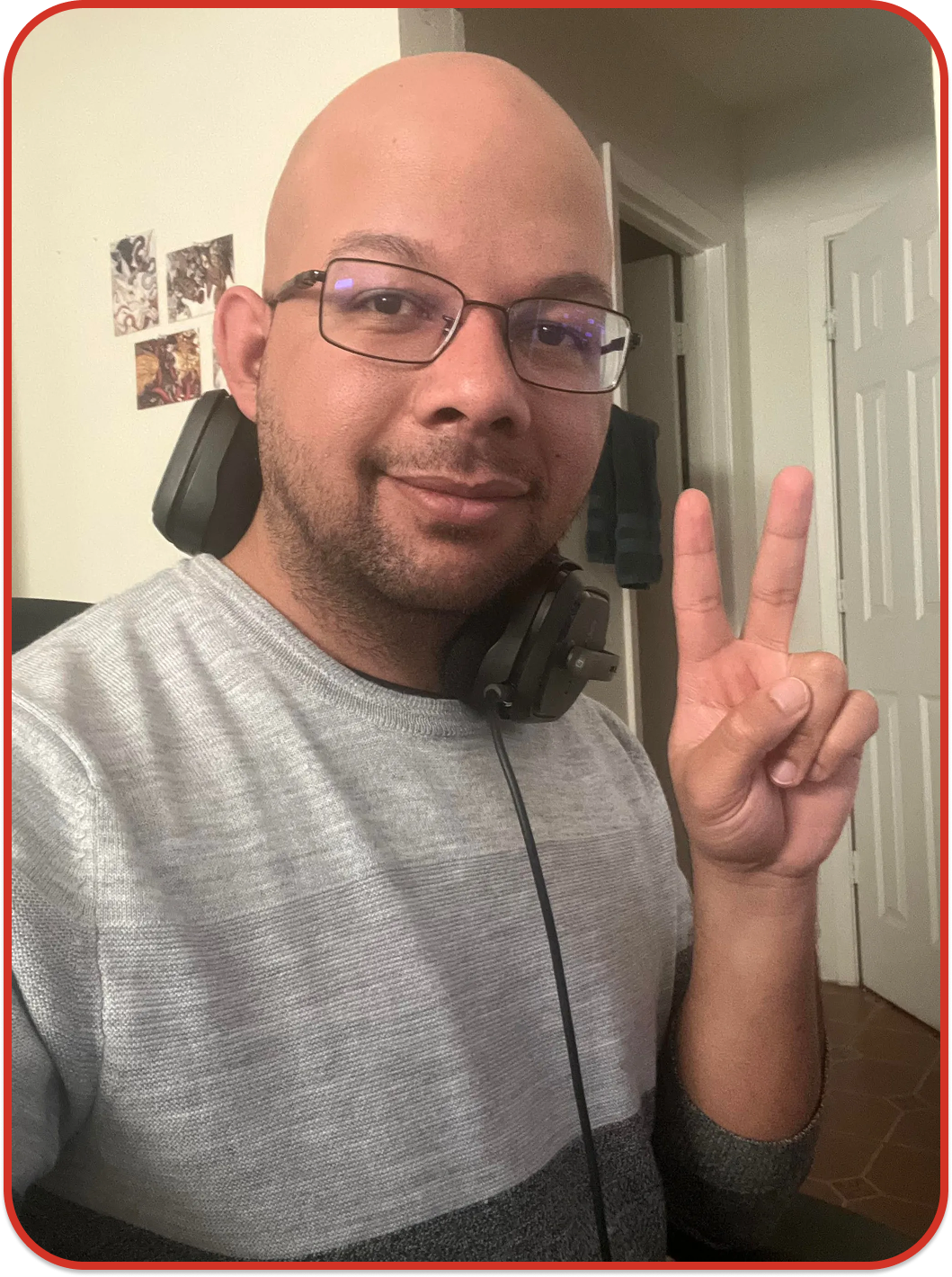
brandon brown has an MFA in Writing from VCFA—what they call their “MFA in strange stories.” Their work has appeared in Split Lip Magazine, khōréō magazine, and BFS Journal, and they are a 2025 recipient of the PEN/Robert J. Dau Short Story Prize for Emerging Writers. They are from South Carolina and live in Albuquerque, New Mexico with Felix, their loudmouth cat.
Notes on Art
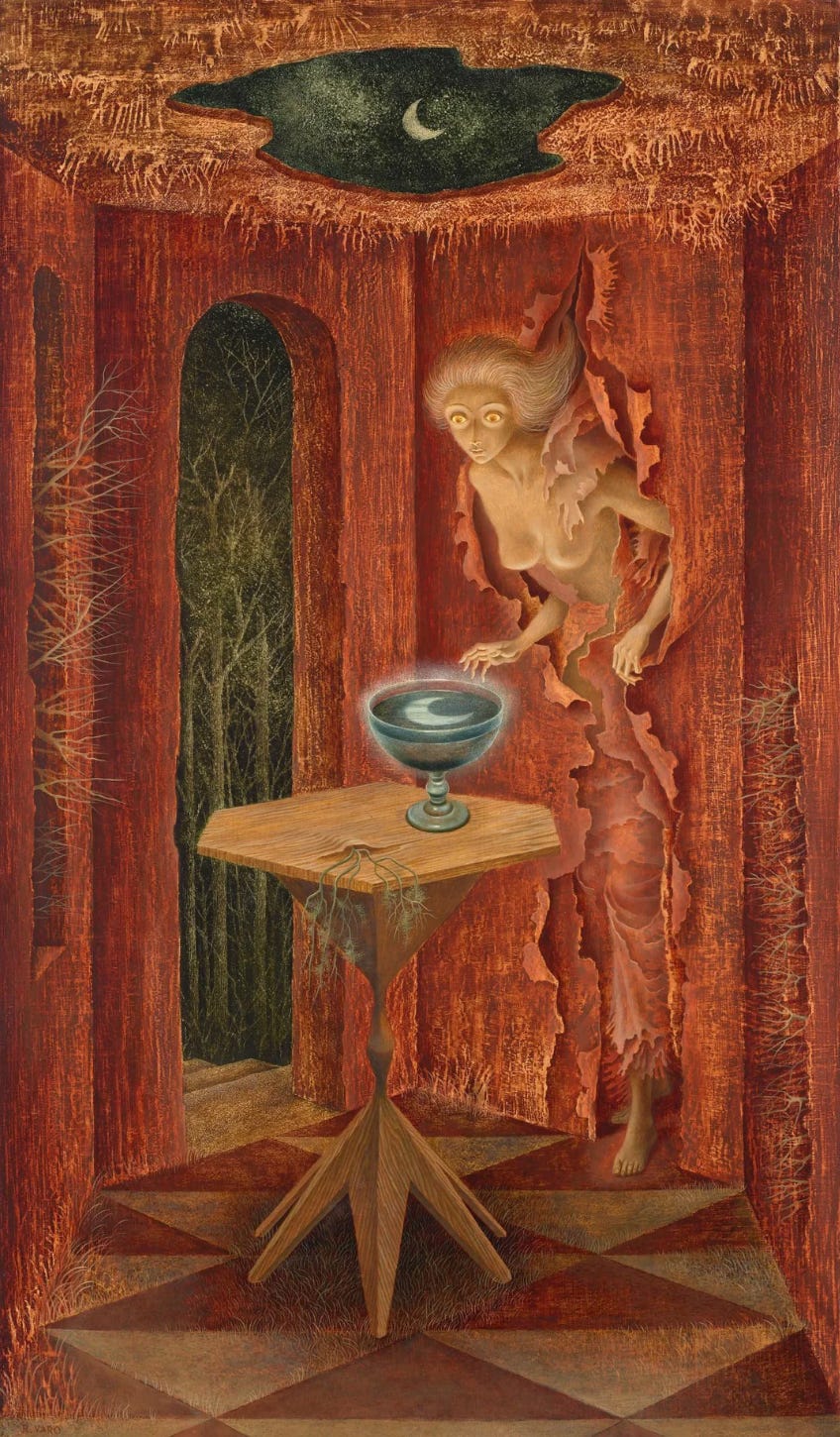
We’ve paired this piece with Remedios Varo’s Nacer de Nuevo (1960)1, in which a figure tears through a wall all wild-eyed and naked and reaches for a chalice of moonlight. Some scholars read the torn wall she comes through as the birth canal. Indeed, Varo was obsessed with liminality and what is more liminal then this strange beautiful space between being born and dying? brandon’s piece conjured a similar mood for me, as the painting and prose share a connective tissue in essence. Who knows, maybe they’re happening on the same canvas, in different dimensions.
Image: Nacer de Nuevo © Remedios Varo. Used for editorial commentary purposes only. All rights reserved.
Thank you so much for reading, everyone! Glad to hear that this strange little story resonates 📻😤
This is marvelous. Where I grew up was hit hard by Hurricane Helene, so that image of the girl on the tin roof really takes hold. And the radio man, a voice "spilling out of him like rabies". Wow. In the wake of No Kings, I feel the title takes on further meaning. Best wishes with your story cycle, I know it will be a fascinating read.