



Hello fellow strange pilgrims, this week has been one of many mini meltdowns due to what I sense is overwork, but might also just be…well, life, which is mostly work. And that’s alright. I’m happy that I can still find space to read beautiful writing like the short essay you’ll read below. Ailsa is the kind of writer whose voice feels at once calming and stirring which is to say I can bet you 10 birthday cakes you’re going to want to write after reading her piece.



When I open the front door of my apartment, the darkness and airlessness of its windowless hallway seems to seep into me. I feel like I’m living in a puddle just looking at it. So I keep the lights off. I pretend it doesn’t exist. Of course this doesn’t work. I have to walk eleven steps along it to get to the bathroom, twelve to get to the bedroom. The hallway is visible from the sofa. It’s visible from the sink.
This place has bad bones, I said to my husband when we moved into the building three years ago. In those first weeks, I tried washing the hallway walls with soap. As I cleaned in the darkness, I imagined how much better life would be if we lived in a house by the sea where every surface was touched with light. In such a serene place, I would always feel clean. I thought about this as I went over beige carpet with an industrial cleaner. When I was done, the dark hallway still refused to sparkle, and those stains would not come out.
Now I think it’s better if I stop dreaming about seaside homes. Generational predictions suggest this rented one-bedroom apartment may be as good as it gets.
Albert Camus wrote that people often “refuse to be happy outside the conditions they seem to have attached to their happiness.” I want to take away the conditions I consider pertinent to my happiness, until I have no conditions at all, until I love everything.
As a way of learning to love this hallway, and therefore my life, I was thinking I could bring more of what I love in. I could attach all of Jasper’s branches and twigs to my walls. I could drag whole conifer woods in until I’ve hidden every part of the rental that could be described in a paint catalogue as being magnolia or biscuit. But taking the outside in is against the “leave no trace” rules of the national park, so I cannot do that.
John Cage said “begin anywhere.” So the new plan is to gather bunches of clover from crown land. I can dry them out in bunches in the apartment. And they will love the hallway’s darkness, its airlessness. And they will make the hallway smell like a bee keeper’s kitchen. And I will love it.
This is not a grand or a well-thought-out plan. I’m making it up now, in a damp B.C. meadow on a Sunday morning while watching oxeye daisies wave like fried eggs beside a silver tongue of lake. Their shallow roots are creeping just under the earth. The twinflowers are out and the thimbleberries have petals soft as crepe paper.
These sweeps of mountains could be from Norway. I could be in Scotland. I could be home, if home contained the screams of dirtbikes and ATVs as well as rivers. If home was cut with logging roads and lakes formed by megadams. I don’t mind this noise and the artifice. The sky is a low wash of pink and everything is misting and rippling, the tall purple clovers especially.
I was only meant to pick one clover to press in a book, but somehow I ended up with fistfuls of flowers in my pockets and I can’t put them back. Now I’m as bad as the short-tongued bees that bite their way through the flower’s wings and keels without pollinating them.
I feel indifferent. This lake is the length of Wales and there’s clover in every direction. I could pick for ten thousand days and still I wouldn’t make a dent in the surface percentage of these weeds endemic to Eurasia and Africa. Clover now grows from the top of the earth to the bottom and all around, in nearly every location on the rotation. I wonder if these ones miss their original homes.
I get up off the warm pink stones I’m kneeling on and go over to the car. I place the flowers over the backseats, then wake my husband. It’s already eleven. The wind outside is picking up. I make coffee on the stove of the Boler. I bring the puppy up onto the bed and lie top-to-toe beside these two warm bodies. Sunday morning with the birch leaves swaying green against the windows, with the mountains rising over the lake like a fjord. I’m lying on a sky blue duvet. I’m covered in dirt and fur. I say to my husband when I was a teenager I imagined this age would involve cocktails and shoes. I say what happened? My husband looks up from his book and says you chose happiness. I see two tails wagging and think, yes.
Back at the apartment, once I’ve put the camping things away and cleaned the dishes, once I’ve messaged my mum for flower drying tips and she’s replied “hang in bunches upside down xx” from her house filled with glass and light, I snip some twine and place big bunches of clover in groups on the walls.
Broken stalks get cleared from the melamine table I’ve covered in gingham, and now the chipped linoleum resembles a florist’s shop floor. This mess I love. Using clothes pegs, I string more flowers along a line of twine above the putty-coloured light switches. This is so easy compared to pressing flowers, which requires, for tiny petals, a grace necessitating tweezers. This is such good work for a short-tongued bee.
I place another line of flowers over the grey fuse box where a previous tenant has sharpied the words ‘Car Battery Plus Here’. I am in love with all this clover, with their roundness and their scent.
I am such a good flower drier. For years already, I have been so good at making cheap plants wither in their pots. I turn to the internet and learn I have done everything wrong.
I should never have picked these flowers on a wet morning. It is a “must,” announces the author Elda Haring, that they “be picked on sunny days between noon and 3 P.M.” I should be microwaving the flowers with blue silica gel, says a New York Times article from 1981. I should be preserving them with hairspray. I should be peeling off their leaves to speed up the drying process. Otherwise I risk the potential of rot and mildew.
I should be sourcing palm spears and cotton stems from florists, says an interior designer in the Irish Independent. They would look “great in a kitchen full of raw wood, heritage paint and crumpled linens.”
I pull down my twine strings. The flowers look sad, like purple rags on a line. I strip their leaves then place the clover back up in smaller, less crowded bunches. Now they look delicate. Now they look elegant, like a keepsake of things I love: light and dew and sky. How beautiful it is, to stop time like this. Bees and fields and happiness, this is what I’ll think of now when I open the apartment door and see clover. Dragging driftwood over rocks to the fire,using a rock for a pillow and listening to mosquitoes burble in the aspen trees, I’ll remember that too.
I want more memories in the hallway. I could string honey mushroom mycelia to the wall like night lights. I could watch them bioluminesce. I could make this place magic. I could find all the fermenting, bubbling living things of the world that need the dark. They’ll love the hallway’s darkness and airlessness, and I will too.
What is this need to keep things, take things, hoard things? This taking of flowers to keep them forever feels so Victorian. But now I’m reading that people were buried with flowers in Egyptian tombs at least four-thousand years ago. I’m reading about the bones of a prehistoric man in the Middle East who was discovered among preserved posies. Maybe this desire to keep beautiful things through to the end is simply human.
I read that in the Middle Ages, when human waste flowed into the rivers and houses were dark with wattle and daub, when cleanliness was something few could afford and those in power did little to make things better, people carried nosegays, posies of flowers — violets and lavender and marjoram — to counteract the odours of everyday life. These nosegays (literally, something to make the nose gay) were viewed as a protection against disease in a time when people believed illnesses came from bad smells.
Sniffing a flower to withstand the horrors of walking through an unclean street seems absurd. If only these medieval people knew to stop throwing human waste from the windows out of chamber pots! If only the butchers had stopped casting entrails in the ditches. Then they would have no need for such things.
Covering a sad hallway in clover is absurd too. That I’m getting real joy from this superficial change in appearance seems so sad. Why don’t I really change my circumstances? I don’t know how in a town where trailers go for half a million. I’m burned out by a landlord who raises rents in a pandemic, who ignores my messages about the mould in the bathroom.
My husband’s heading out with the dog for a walk. He’s switched on the hallway lights to get his raincoat. I’m pleading turn it off before he’s even done in the closet. Your thing with the lights, he says, I can’t keep doing this.
But these lights are a sad white. They’re as bright as strip lights, as a fridge light. How could anyone stand them?
I could change them. Three years with this hallway and it’s taken this act of actually looking at it instead of hiding away to realise there are things I could change.
The next day I buy some low-wattage bulbs from the hardware store. I screw them in and switch them on. In one sense it’s glass and light. In another it’s a nosegay. It’s absurd, and it’s almost enough. This change in light, it’s making me feel something unnameable. Something hopeful. Imaginative, and bright.

1.
Tell us your origin story as a writer. When did you begin? What first drew you to writing as an instrument for asking questions that can’t be explored any other way?
AILSA ROSS: I kept a diary from about the age of twelve, but I drew and painted much more than I wrote. I then spent much of my early twenties travelling, and stopped painting, as horsehair brushes and paints and paper are expensive and take up a lot of space in a rucksack. Then I began writing much more than I painted, a yellow legal pad and biro being both light and cheap.
Can it be that I started writing seriously because I was too cheap to continue expressing myself through painting? I think it is so.

2.
What does your writing routine look like? Do you thrive in structure or wildness? And when you begin a piece of writing, what tends to announce itself first: a voice, an image, an unease, a philosophical conundrum?
AR: At the moment, I write while my baby sleeps – so for two to three hours in the middle of the day. Before the baby, who is really a toddler, was born, I wrote everywhere and at all hours. I wrote outside on summer afternoons. I wrote in the bath on winter evenings. I wrote while I was meant to be doing the fact-checking and editing work that paid the bills. I wrote alone in bed, while drinking a French press. And then I would transcribe the words that I wrote onto my computer. I procrastinated a lot as I did so, because I truly hate transcribing and get distracted easily while doing such work.
I don't procrastinate so much anymore. Now that I only have a couple of hours in the middle of the day in which to work, I feel I have to utilise those hours effectively.
3.
Most artists are preoccupied by certain obsessions: lust, longing, death, the self. What persistent preoccupation—emotional, intellectual, or spiritual—threads through your work? Are there motifs, themes, or impulses you’ve tried to abandon but that keep returning, insisting on their relevance?
AR: Time, mystics, animals, plants. The way the past intertwines with our existence today. These themes prevail in my novel HOVEL, which was published by Strange Light/Penguin Random House in spring. They prevail in my thoughts. As does daydreaming.
The act of daydreaming is a skill downplayed in the modern world. I suppose it’s seen as unproductive. Yet according to Wouter Jacobus Hanegraaff, professor of History of Hermetic Philosophy at the University of Amsterdam, the imaginative state engages a particular sense of being in the world, one that leads to a more transcendent understanding of the universe.
4.
If not a writer, who would you be?
AR: Since the baby, who is really a toddler, was born, I have been baking and cooking so much, because making food is something an infant can be involved in, and because it stops me from looking too much at the clock (looking too much at the clock slows time down, as anyone who has ever worked in retail knows).
Would I really like to be a baker or cook for money, though? It seems unlikely, on the days when the cardamom buns come out dry and underproofed. But to have used my law degree seems unthinkable too. If I was a lawyer, I would never sleep for worrying I had done wrong by my clients in some way. Honestly, I don't know what I would do. Become a nun?
5.
What’s the best piece of writing advice you’ve ever received? Alternatively/additionally, what’s something you’d like to offer as advice to emerging writers trying to make a mark?
AR: Ursula K. Le Guin wrote that readers have come to believe individual heroism is the point of a story, and proposes a different kind of storytelling in ‘The Carrier Bag Theory of Fiction’ – where the author picks diverse things of meaning and value and gathers them together, like a forager rather than a hunter. I love that, and can think of books in that vein, such as ‘Flights’ by Olga Tokarczuk.
I'd recommend reading ‘Flights’ as a means of seeing new possibilities for how a novel can be.
6.
What are you working on now and how is it trying to ruin your life (in a good, necessary way, of course)?
AR: I am writing about some artists whose physical bravado shaped their inner landscapes. For example, Marina Abramović lived for many years in a campervan. She walked half the length of the Great Wall of China in a red coat. And then there was Agnes Martin driving about America in a campervan for a couple of years while thinking about what to paint and where to lay roots. I'm trying to find out how those solitudinous experiences affected those artists.
My own story, of trying to embrace solitude while living on an isolated part of the prairie, runs through what I'm currently writing. I play the sincere clown as I attempt to emulate aspects of these women’s lives. This is not easy for me. I don't find it easy to eschew conventionality.
7.
Who are the artists—writers, filmmakers, thinkers, internet oddities—that have shaped your sense of narrative? How have they rearranged the way you see the world on the page?
AR: When I think of literary books filled with historical research, I think of W.G. Sebald, Emmanuel Carrère, Geoff Dyer. This kind of book, which sits near the academic, gets associated with men. My voice is not like Sebald’s or Dyer’s. Maybe it is more like Marlen Haushofer’s? Her sentences seem simple. But striking images build up within the sentences. They create a particular atmosphere. This kind of writing, which has the feeling of a fable, gets associated with women.
To have the historical content of the former meet the sentence style of the latter, that’s what I’m most interested in achieving on the page.
8.
Please recommend a piece of art (a painting, a film, an album, anything that’s not a piece of creative writing, really) that you love and would like everyone to experience.
AR: The 2000 film 'Les Glaneurs et la Glaneuse' ('The Gleaners and I') by filmmaker Agnès Varda, which I wrote about in my novel HOVEL.
You don’t get the France of the movies in this documentary. This is a France where millions live in poverty. It’s where anti-consumer activists are fighting with supermarket managers who pour bleach on the bread they leave in skips at the end of the day, so no-one can eat it. Varda speaks to both sides. She opens people up. She opens up the doors to her home in Paris and films the mouldy ceiling. She films close-ups of her aging hands.
In a field of old potatoes, she looks for ones shaped like hearts. She holds them up to the camera, up to the light, and seems to say look, everyone, and everything, matters. She takes some potatoes home, where they grow arms.

AILSA ROSS is the author of the novel HOVEL, published by Strange Light/Penguin Random House. She grew up in the north of Scotland and lives in the Canadian Badlands. She writes about ascetics, artists, and strange places for The Guardian, Outside, ARTnews, and JSTOR Daily, and her Substack newsletter is called The Rituals.
Notes on Art
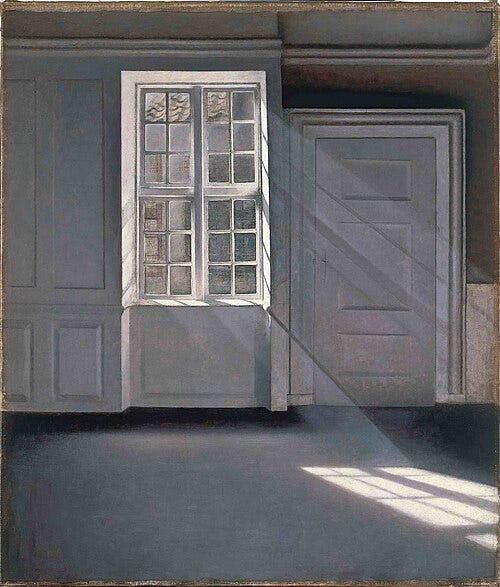
We’ve paired this piece with Vilhelm Hammershøi’s Dust Motes Dancing in the Sunbeams (1900)1. It’s an empty room. Bare panelled walls, a wooden floor, a single window on the left, a door on the right. Nothing has been brought into it, not a trace of furniture in or out, not even flowers…no attempt made to un-dull, so to speak, the greyness. Light comes through the window and lies on the floor like something solid, falling diagonally across the door. Ross spends her essay trying to make a dark hallway lovable by hanging clover and imagining mycelia strung up like night lights, and then the thing that actually works is something she’d overlooked for three years: she changes the bulbs. Light elevates without a third thing, and I find such simplicity to be a cooling splash of water in our modern, often cluttered spaces (online and, let’s face it, offline too).

Image: Dust Motes Dancing in the Sunbeams © Vilhelm Hammershøi. Used for editorial commentary purposes only. All rights reserved.
as usual for these - the interview with the writer is a good window into their mind
Very unique story Ailse. Paired with the Hammershøi painting I was pulled in by the mood of the piece right from the start. Thank you for sharing.