



Hello fellow strange pilgrims, tomorrow is the official first day of Spring and it feels fitting that we share this beautiful, heartbreaking short essay with you. Whether or not you’ve experienced what Jill delicately unfolds here, I promise you you’ll feel the weight of it. And the light.


Miscarriage (n): 1580s, “mistake, error, a going wrong”
At the first ultrasound the heartbeat was low. The doctor said, “Do not panic!” But she wanted to see me the next week. I made a mistake. I listened to her.
Miscarriage (n): 1610s, “misbehavior, wrong or perverse code of conduct”
At the second ultrasound, the heart rate was even lower. And I could hear it, too: an error in the heartbeat, one extra thump, repeating. The doctor said, “It’s not good news.” Her voice was very quiet. She did not give me the ultrasound picture. She said, “You can have the room as long as you need.” I did need.
When I finally made my way out of the exam room, I had to pass through the waiting room to leave. There was a very pregnant woman there, I guessed 8 or 9 months along. She looked pale and scared. I hated her.
Miscarry (v): 1300, “go astray”; mid 1400s, “come to harm; come to naught, perish.”
We just have to wait for the baby to die. My body still thinks I’m pregnant. Am I still pregnant? My brain does not know what to think. I am in my body and not. I move myself like a video game, step forward, sit, smile. I am standing in front of two paths: pregnant, not pregnant, and both dissolve in front of me. There is nowhere safe to step.
Miscarry (v): 1520s, “deliver an unviable fetus.”
All of the earlier meanings of miscarriage include the idea of failure, either the word itself (“fail to reach the intended result”) or implied. Everyone keeps saying “it’s not your fault.” I know it’s not. But I think about the word miscarry. I failed to carry them. Like, I dropped the baby. Or, I “lost” the baby. As if I left them somewhere and forgot. As if I would ever, could ever, forget.
It’s not my fault. Okay. Hurricanes, tornadoes, are not our fault—and yet, we always look for why. It feels better to have someone to blame, somewhere to put down the wrongness, the violence, the unfairness. It might as well be me. This is my job, I think, as a mother. To help carry my child’s pain.
There is no word that does not blame me. This is okay with me.
Abortion (n.): 1540s, “the expulsion of the fetus before it is viable,” originally both deliberate and unintentional.
We have a family vacation already scheduled so, with my doctor’s okay, we go anyway while we wait for our baby to die.
Every second I wonder if the baby is dead yet. I didn’t know miscarriages could be like this. I always assumed it would be like a car accident—blood, and then it would be over, sudden. But even car accidents are not car accidents.
I feel like a leper, a monster, a hearse, until my therapist tells me I am sitting vigil. “Vigil” comes from the Latin vigilia, originally a word for a soldier’s night watch. “Vigil” also has roots in “awake,” watchfulness. I am not a very good watchman. I cannot warn anyone when death is coming; I know it’s coming but I don’t know when. So instead, I’m sitting with the knowledge. All I have is the certainty of death. It’s not peaceful, exactly. But it is somewhat better to know how the story will end.
During a vigil, you sit beside a dying person and wait, watching, keeping them company. I sit next to, around, outside, inside my baby, with them while they die. It is an honor to watch this short life we wanted, to know it was here for a little while. I stay awake, so they can let go.
If you only had a week to live, what would you do? I take my dying baby on an airplane. I say, these are clouds! I take my dying baby to meet my family. I say, This is love! I take my dying baby swimming in the lake, playing with my older daughter. I say, This is fun; this is a sister! Dying baby, this is a s’more! Campfire! I breathe with my dying baby the bad air quality from Canadian wildfires, then the next night, clear air and stars. This is the world, I tell my dying baby.
Abortion (n.): 1540s, “the expulsion of the fetus before it is viable,” from the original Latin stem aboriri, used for deaths, miscarriages, and sunsets.
One night my cousin offers to take my older daughter for ice cream with her kids. It’s the first time I’ve let someone who isn’t my husband do this—take my daughter somewhere in a car—that isn’t school or home. I say yes, go.
My daughter leaves to eat bright rainbow ice cream with her cousins. Everyone else goes for a sunset boat ride, and I stay behind. I sit on the dock, alone, and think This is orange, pink, blue, sunset. I wait for one child to come home, and wait for two suns to set. My heart breaks. The light is spectacular, while it lasts.

Tell us your origin story as a writer. When did you begin? What first drew you to writing as an instrument for asking questions that can’t be explored any other way?
JILL KOLONGOWSKI: I’ve been writing since I was a kid! That sounds made up but it’s true for me. I used to love pecking away on our typewriter, and my parents very kindly bought me many blank hardcover books so I could handwrite stories and illustrate them inside (first book: The Cat’s Birthday). I don’t remember ever consciously making a choice; it’s just always been the way I thought through the world. My interior voice is very loud, very busy, and writing has always given me a way to allow it some room. On the other hand, I’ve never been a great journaler, but I’ve always written down snippets of life that struck me as odd or memorable or something I didn’t understand yet, and the writing always helps me understand. I feel the same way as Joan Didion, that “I write entirely to find out what I’m thinking, what I’m looking at, what I see and what it means.”
What does your writing routine look like? Do you thrive in structure or wildness? And when you begin a piece of writing, what tends to announce itself first: a voice, an image, an unease, a philosophical conundrum?
JK: I have two young children who I care for at home who always wake up at 6 or often earlier, so I do not have a routine. I’m by nature a very organized person, but having children has forced me to learn to be flexible. I write anywhere, anytime I can grab a spare hour or two: on my phone, on the back of a piece of paper in my purse, in my writing notebook. I cannot write at night anymore—my brain is cooked by then. But I do love a routine. When my older kid got past toddler age, I joined a wonderful community and coworking space in San Francisco, and I love going there for half of a day to do some deep work. If I’m writing a long first draft, or doing intense editing, I can’t do it at home, even with a dedicated workspace and a babysitter. My children are just little engines of noise and joy and I can’t disconnect from them if I’m home.
I write from sticky images. Even at my most tired and busy, I keep an eye out for things that surprise me, delight me, unnerve me, scare me, or confuse me, and I write them in my notes app. Sometimes those are generative enough that I jot down a quick paragraph right away that I can come back to later, and sometimes it’s just a word or a sentence or two, some sensory details. These are seeds that become essays later. Often, as I look through my notes, I find connections between things that seemed entirely separate, and a future essay can help me think through those connections. I love writing messy first drafts and first edits by hand; all the rest in old school Microsoft Word.
Most artists are preoccupied by certain obsessions: lust, longing, death, the self. What persistent preoccupation—emotional, intellectual, or spiritual—threads through your work? Are there motifs, themes, or impulses you’ve tried to abandon but that keep returning, insisting on their relevance?
JK: I’m always returning to the idea of what we do, and how we act when things go wrong. I love writing about disaster, large or small. But since having children, I discovered that my fascination with disaster was more of a form of anxiety, spinning tales of what could happen and how I might handle it. I am the primary caretaker for my children, and every month, I try to write something for my substack that is not focused on motherhood. Some kind of internalized misogyny makes me want to avoid even the word motherhood. I don’t even like writing it here. But that does my experience and my children’s lives a disservice. This is our life. It’s so much of my life right now. It’s worthy of telling.
If not a writer, who would you be?
JK: I’ve worn lots of hats, and I love so much about books that I think I could find a home in a lot of writing spaces. I also work as an English professor and as an editor, and I enjoy both of those things. I especially love introducing new writers to the magic of creative nonfiction. Outside of writing? I truly have no idea. A park ranger?
What’s the best piece of writing advice you’ve ever received? Alternatively/additionally, what’s something you’d like to offer as advice to emerging writers trying to make a mark?
JK: I’ve had so many excellent mentors, but the best piece of craft advice I ever got was from a visiting professor in graduate school, Susan Griffin. She said, “The problem with the writing is part of the story.” So, if you having difficulty writing a scene, make that difficulty part of the story itself. Are you avoiding writing it? Why? Is it painful? Is your memory unclear? Why might that be? At the time, I was workshopping an essay about a beloved aunt who died young, and I kept getting the feedback that readers wanted to see more of her, more clear memories. I hated hearing that, because while she felt (and still feels) very clear in my head, I found I had trouble articulating clear, full-scene memories of her. But thanks to Susan’s advice, the story of the essay became a story of memory—how I felt my brain hadn’t committed her to memory because I wasn’t ready for her to die.
One of my other favorites, one that I love to give to my own students, was not advice exactly, but feedback from my beloved MFA professor, the late Wesley Gibson. He once wrote on a final paragraph of mine: “I love this! But I don’t really know what it means.”
For new writers, my favorite piece of advice is that the only thing that all successful writers have in common is that they didn’t give up.
What are you working on now and how is it trying to ruin your life (in a good, necessary way, of course)?
JK: God, I’ve been working on my second book for over ten years now. It started as my master’s thesis, and because I’ve changed so much since then, the book keeps having to change with me. The core of the book—how women survive the anxiety of living—hasn’t changed, but the focus of the book and my skills have changed so much that I keep having to rewrite it. My agent and I tried to sell it some years ago, and we got lovely feedback, but it didn’t sell. I’m not giving up on it yet, though, and hope you can read it someday. (This is a very calm, falsely measured response to what has been heartbreaking, heart-fixing work.) My Substack (including the piece featured here) has been key in forming my new perspective and path forward with the book.
Who are the artists—writers, filmmakers, thinkers, internet oddities—that have shaped your sense of narrative? How have they rearranged the way you see the world on the page?
JK: I am a longtime Jo Ann Beard stan. To me, she is the master of specific detail. No one writes a scene like Jo Ann. Of the many things I’ve read, individual details from her work have lived rent-free in my head for years. I also love Lysley Tenorio’s and Ross Gay’s work—Lysley is a character-writing professional (again, his characters stay living in my mind), and Ross Gay is a sentence sculptor. Maybe it’s the season of life that I’m in, but I’m drawn to a lot of flash writing—to me it’s like looking at a fine still life, or a perfect miniature. Sarah Manguso and Beth Ann Fennelly are some of my most favorites. I work as an editor for YesYes Books and so I get to read so much fantastic poetry there that always rearranges my brain, and helps me think about the ways to break language to make what you want.
Please recommend a piece of art (a painting, a film, an album, anything that's not a piece of creative writing, really) that you love and would like everyone to experience.
JK: I’m obsessed with the TV show Alone. If you’re not familiar, it’s a reality-style show where contestants try to see who can survive alone the longest in really harsh environments. The difference is that they do not see another soul (except for periodic medical checks) and they are taught how to film themselves, so there is no production crew. I love thinking about what they choose to film and why, and at the same time think about what the producers must do with the hours and hours of footage they have. Most of it must be super boring, with moments of high-octane excitement (a storm, a predator, finally catching food, getting injured, finishing a project like a shelter or a fireplace, or lighting a fire altogether). To me it’s a beautiful insight into the ways we see ourselves, what we think is important, and how we like to tell our own stories. And I get to see lots of women being badasses with bows and arrows.
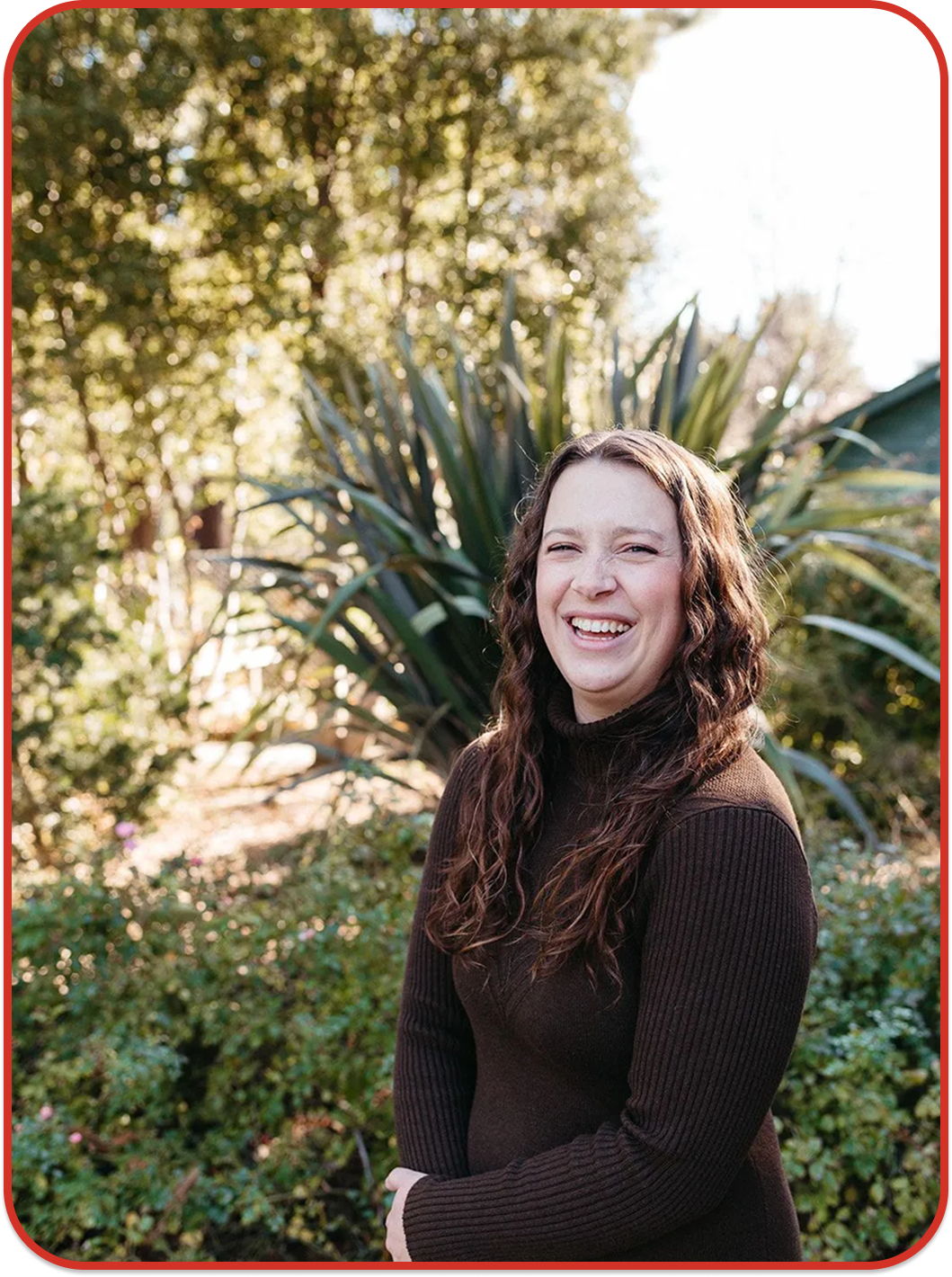
JILL KOLONGOWSKI always said she would never be a professor or live in California, and now she happily does both. She is the author of Life Lessons Harry Potter Taught Me (Ulysses Press, 2017), and you can read more of her work in The Sun, Electric Literature, the Los Angeles Review of Books, Brevity, and in her Substack Tiny True Stories.
Notes on Art
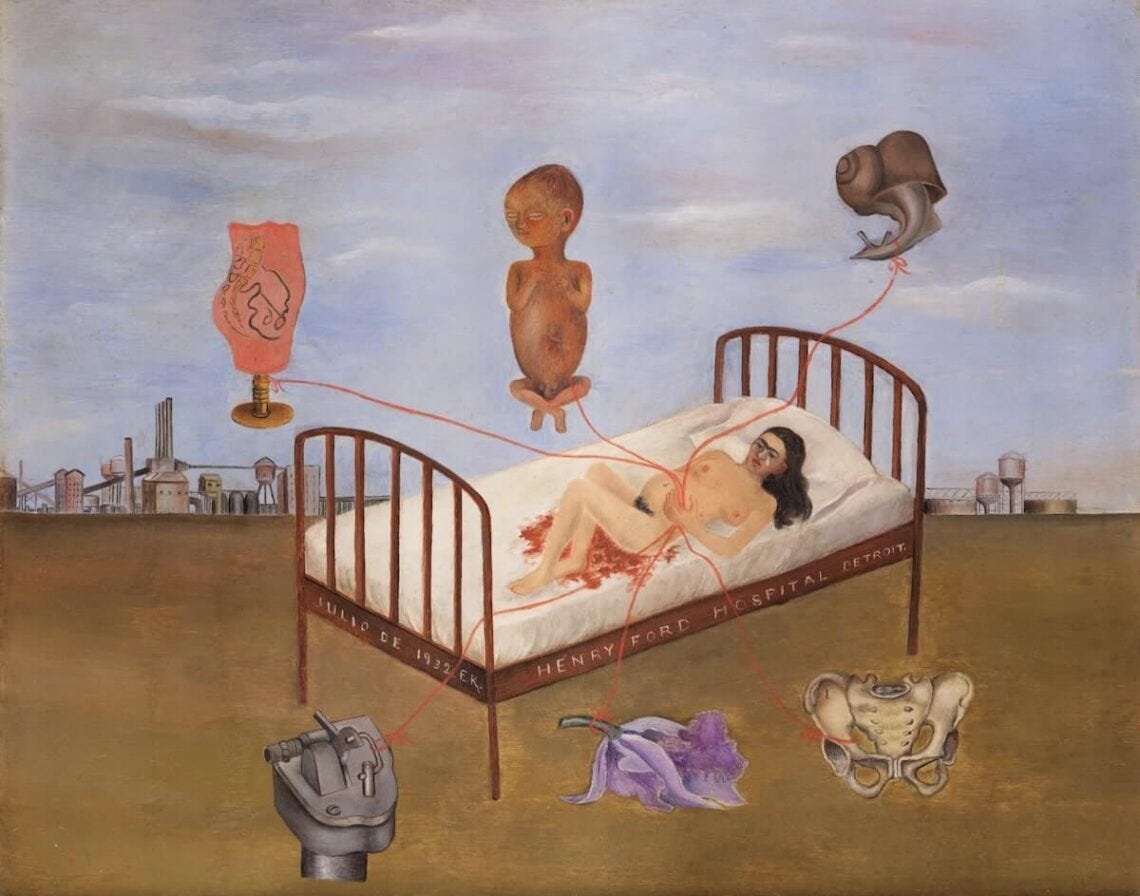
We’ve paired this piece with Frida Kahlo’s Henry Ford Hospital (1932)1, painted after her own miscarriage at Henry Ford Hospital in Detroit. Kahlo lies on the bed, tiny against white sheets, holding six red threads that connect her to the things she lost and the things that failed her — the fetus, a fractured pelvis, a flower, a snail. She arranged her grief into objects and gave each one a line. Kolongowski does the same thing with definitions. Every entry is a red thread tied to the same loss, held taut, kept in order. Both women know that structure won’t save them. They use it anyway.
Image: Henry Ford Hospital © Frida Kahlo. Used for editorial commentary purposes only. All rights reserved.

I so appreciate this essay and the fact that you were willing and able to share something so difficult. I had an experience somewhat similar to yours, and it did me good to connect through your words with someone who understands these things first-hand. I also think this is just a really good essay, distilling something more people do not experience into an experiential "reading moment." The use of the definition reminded me of the way I have sought some kind of control at difficult moments in the various labels we give to phenomena that ultimately don't ever fit very well in the frame. Thanks again for sharing this.
This broke my heart