



Hello fellow strange pilgrims, today’s beautiful flash fiction is written by the insanely versatile Aimee Wai. We’ve had the good fortune of publishing her poetry before at ONLY POEMS. Aimee has an enchanting style that both stuns and soothes…you’ll get what I mean once you read this! Aaaand if any of you are in Baltimore this week for AWP, come say hi to us at Booth #446!


One day, in the spring, I woke up, and was struck by all of these sudden dumb questions, like, how did we get here? and where do we go? I know it sounds vague, but that’s how it was. I couldn’t even define what I was asking. Let me put an ad in the paper, I thought, that’ll help me narrow it down. Then, like an idiot, I wrote, If Found Please Call, but wasn’t sure what to put after, so I attached a picture of a sunset, followed by a landline number that no longer works, and submitted it to my local tribune.
After that, I drove to a museum, because museums are full of questions and answers. I wandered around aimlessly, then stopped at an exhibition called Vacancy/No Vacancy but was ushered out for staring. It was actually just the restrooms. On my way out, a man approached me from across the street. Like a bad cartoon, he opened up his trench coat, and said, I have what you need, take a look. I lingered around his open breast until he admitted to his politeness, and said that he would have to kill me, if I didn’t just, please pick something, and exchange it with him for something of mine with a higher value. I gave away my watch for a few of his, and lost track of the following weeks.
I worked, I slept, I watched TV, and then it was summer, which made me angry. In a last stitch effort to reclaim my sanity, I extended an invitation of services to a doctor, a lawyer, and a specialized consultant. I asked them to consider my risks and liabilities, regarding these general inquiries. They didn’t know what to make of my existential blathering. My life coach suggested an intervention, a meeting of the minds, or something synergistic. Instead, I went to a pick-it-yourself farm in Michigan.
It was a farm close to The Great Lakes, close enough where lake-effect snow erases summer from winter annually. All around me were rows of cherry trees, and I ate myself sick beneath them. There were blackberries, raspberries, blueberries, and a local berry called the black cap, which the farmer had told me was too fragile to ever go to market. When the sun began to dip long and low across the rows of fruit, I panicked, thinking I may never be back there again, and put handfuls of black caps straight into my pockets, then ran to the car like an animal.
I spent the rest of the week at the lake, in my purpled pants, wondering about the geography of the Midwest, and what kinds of places across the planet shared the same climate, if you pulled the line of latitude across the globe. The way I figured, I could be in Eastern or Northern Europe and never know the difference. On the last day of my trip, I plucked the molten seeds from the pockets of my jeans, put them in a damp baggie, put the baggie in my suitcase, and put my suitcase on a flight back home. For three weeks, they sat in a junk drawer with open pens and too many gift cards because nobody knew what to buy me.
Soon it was the tail-end of August, and I was not any better. I had sunken myself into bottles of whiskey, rum, and gin. One night, when I was particularly lit, I went to the drawer and took out the seeds. I ventured out into an empty, muggy, midnight, crouched low to the ground, and pushed my fingers through an inch of soil. I planted those seeds into the void, then wiped my hands clean.
To my surprise, the next July, after a freak snowy winter, the seeds gave way to one-half pint of fruit. Which was not enough for jam, but I went to the store and bought other berries to make up the rest, because we live in the U.S., where more is always available. I followed an old recipe, using fire, sugar, and water, and sealed the jar tight. One week post canning, as if called by the strike of a gong, there was a knock at my door, and I acted like it wasn’t unusual for it to be you, standing there in the middle of my stupor, and for you to look so young. I had forgotten about all the people in my life in my personal quest for enlightenment. But you forgave me, because you had been away too, studying overseas, where you had learned new languages, danced with foreign men, and ate your fill of spiced cuisine. Yet you missed me. Although, you never said it aloud, only that you missed the old couch, which I had reupholstered after the estate sale.
When you walked in, the jam came out, and we spread it thick over bread that was dark with rye. It was just me in the kitchen, you at the counter, and a lack of shyness in the amount of bread, jam, and butter. Seeds got into our teeth, and there was a look in your eye that shined like the beginnings of a question. There was so much you could’ve asked about the time and space between us, like, where did you come from? or where will you go? But instead, you were quiet. I was quiet. All at once, I arrived at the question and its answer.

Tell us your origin story as a writer. When did you begin? What first drew you to writing as an instrument for asking questions that can’t be explored any other way?
Aimee Wai: Hello, and thanks for having me here! I'm so honored to be part of Strange Pilgrims and share my work with thoughtful readers.
Well, I guess I’ve been writing ever since I was little. I was a sponge-like kid and had a tendency to soak up too much, so I needed a way to wring it all out. I kind of view writing similar to exercise or drinking water, because my health starts to degrade if I don’t give myself space to work through my thoughts. Most of my writing is actually housed in volumes of personal diaries, where I just ramble about observations of self or the world, and it helps unravel my overactive brain. For a long period of my life, I got away from writing and pursued what feels like a fraudulent version of myself. This version of me was tied to logic and perceived control and was terrified of expression. But a life without expression, isn’t really a full one. So I’m thankful to be writing again because I feel adrift without it.

What does your writing routine look like? Do you thrive in structure or wildness? And when you begin a piece of writing, what tends to announce itself first: a voice, an image, an unease, a philosophical conundrum?
AW: Hmm great question. I don’t have a writing routine, although I’m hoping to create one. I would say that my focus right now is learning how to respect the craft. As I'm sure other writers can attest, creative energy can be hard to handle. Sometimes when I sit down to write, the sentences don’t finish themselves, words break off and float into outer space, and I’m just sitting here dumbfounded and trying to tether them back down to the page. In my mind’s eye, my narrative voice runs wild like a galloping horse. So like any wild animal, I’m learning a lot about myself as I build a relationship with it.
When I have an idea for a piece, it tends to hit me all at once. It’ll happen in the shower, or on the subway, or in the middle of a conversation with a friend, which is super of annoying in terms of practicality. Sometimes it feels like saying, “hey, I’m thirsty!” and then having a fire hydrant explode in your face.
Most artists are preoccupied by certain obsessions: lust, longing, death, the self. What persistent preoccupation—emotional, intellectual, or spiritual—threads through your work? Are there motifs, themes, or impulses you’ve tried to abandon but that keep returning, insisting on their relevance?
AW: Yes, lately I’ve been preoccupied with a feeling of homesickness and I’m not really sure where it comes from. I would like to think that homesickness comes out in this piece, For My Sister… that you've published, but it’s hard for me to see my own work. Readers will have to let me know :)
If not a writer, who would you be?
AW: Oof, hard question! Maybe I’d fancy being an architect. Or an anthropologist. Or a monk.
What’s the best piece of writing advice you’ve ever received? Alternatively/additionally, what’s something you’d like to offer as advice to emerging writers trying to make a mark?
AW: I’m not sure where I heard this, but I love the saying, "the work informs the work". Whenever I’m feeling stuck it’s usually because I’m resisting the work. Often when I just sit down and start writing, the next steps follow. It’s also good advice to lower any expectations, and just be yourself. Sometimes I find myself trying on other peoples shoes to see how they fit, but ultimately I know the ones I have fit me the best. Anytime my writing starts to sound less like me, I know I’ve gone wrong.
My advice for other artists is to allow themselves ample creative space to grow, without any expectations of the outcome. Value is inherent rather than created. It's less about making something from nothing, and more about discovering the something we've had all along.
What are you working on now and how is it trying to ruin your life (in a good, necessary way, of course)?
AW: I’m laughing at this question! Why are writers always in ruin? It’s true, I’m being destroyed by my first attempt to write a novel. It’s not any good so far, but I’m sticking with it because I want to learn how to hold a big project. It’s been fun and also terrible. I don’t know why we’re like this.
Who are the artists—writers, filmmakers, thinkers, internet oddities—that have shaped your sense of narrative? How have they rearranged the way you see the world on the page?
AW: My sense of narrative is always shifting and growing, but this past year I was obsessively reading Toni Morrison. She is a beautiful thinker, and I’m enchanted by the poetic quality in her prose, the way she writes about communities, and how she weaves the supernatural into her stories.
The film Spirited Away has a way of bringing me to tears, and it has changed meaning to me over time. When I saw it as a little girl, I was obsessed with its fantastical nature. When I watched it again recently, as an adult, I felt so heartbroken over the underlying story of diaspora. It is a truly beautiful and original film, and I can’t wait to watch it in another ten years to see how it’s changed again.
I’m also so inspired by the people all around me on the daily. I’m taking painting classes this year where I get to meet some amazing painters, and I also get to spend time in studio with my friend Jonathan Grado, who is getting back into his photography practice. It’s invigorating to be around artists in work. My favorite artists are the artist artists. Not sure if that makes any sense but it does in my head. I think when you meet one, you know.
Please recommend a piece of art (a painting, a film, an album, anything that's not a piece of creative writing, really) that you love and would like everyone to experience.
AW: One of my favorite sculptures is Bird in Space by Constantine Brancusci. This piece shows the trajectory of flight without all the feathers, and it’s been a focal point in my work for the past year or so. Check it out and let me know what you think! With love, Aimee Wai


AIMEE WAI is a writer whose work explores transformation, relationships, and emotional complexity through simple language. Her writing has appeared in Dialogist and OnlyPoems. Learn more at aimeewai.com.
Notes on Art
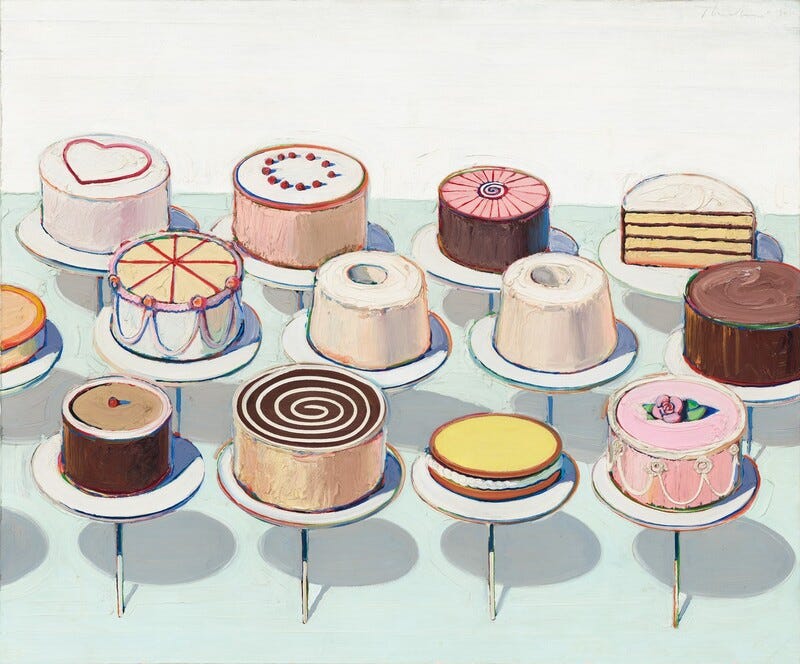
Wayne Thiebaud spent decades painting rows of pies, cakes1, and deli items with the kind of devotion most artists reserve for the human face. His cake paintings treat ordinary American abundance with total sincerity, deluctable thick impasto frosting rendered with as much care as a Vermeer highlight. There’s something almost stupid about how beautiful he makes a cafeteria dessert case, which is exactly the register of this essay: a woman who goes looking for enlightenment at museums and life coaches and pick-it-yourself farms, and finds it spreading jam on dark rye bread with her sister.

Image: Cakes © Wayne Thiebaud. Used for editorial commentary purposes only. All rights reserved.
thank you Strange Pilgrims for believing in my work 🤍🤍
I’m smitten with this piece and it serves as such a gorgeous model to follow your guidance around what Strange Pilgrims is looking for in stories. This is a story that many well-meaning workshops would deflate.