



Hello fellow strange pilgrims, today we present you a beautifully argued essay. I especially love the way Liza weaves reportage, personal reflection, and poetic engagement with grace and humility throughout the piece. I encourage you to experience it as a kind of meditation!


I am an unlikely science writer. My appreciation for science has always run deeper than my talent or skill level. I spent my high school years at a public magnet school for science and technology, and while I was interested in the broader questions of how and why we perceive the world the way we do, I couldn’t seem to get any of the details to stick. Diagrams and problem sets left my brain in tangles, and I dozed off during demonstrations of chemical reactions and lengthy descriptions of cell structure. Hands-on experiments only underscored my lack of ability—one misstep and my solution would turn pink when everyone else’s was blue. 10th grade chemistry, 11th grade physics, 12th grade probability and statistics: I hated it all.
In much of the public imagination, and to me for most of my life, the word science conjures images of people in white coats using inscrutable jargon, rather than the many tangible impacts of science on everyday life. I say “conjures,” as if it were magic. Science can feel like magic at times, at least from an outsider’s perspective, but in reality it is the opposite of that. It’s a process, one that’s often discouraging, frustrating, and difficult to explain. It involves plenty of failure, and even after years of labor it may not provide the results one would hope for. And yet, without it, human societies wouldn’t exist. Science is in our drugs, our food, our weather, our infrastructure. It’s in the air we breathe. And with ecosystems changing more rapidly each year, the planet’s food supply dwindling while the population grows, and more people getting sick, we can’t afford to ignore it.
It’s summer 2025, and I’ve been selected to spend a week at a writers’ residency at Cold Spring Harbor Laboratory (CSHL). Government funding cuts loom over the campus like the smoke currently drifting down from Canadian wildfires, and the entire community is reeling. We are still in the early days of an administration hostile to scientists and to science itself—an administration that, not content to defund necessary research by as much as one-third, compounds the problem by presenting stories that spread fear, panic, and disinformation. The purpose of my residency here is to build bridges between the scientific community and the general public, using art (in my case, poetry) as a medium. According to CSHL’s website, “Artists who can interpret scientific research elements into accessible works of art—paintings, novels, poetry, and more—will connect with CSHL scientists who can explain the significance of their research, lessening the prevailing distance between the public and science.” I wonder if I can live up to this, or if anyone is up to the task these days.
Cold Spring Harbor Laboratory was founded in 1890 and since then has become world-renowned among scientists, though it’s less known to the general public. It has been home to eight Nobel Prize winners and currently has 1,000 employees, in addition to the 12,000 scientists it hosts from all over the world through its Meetings & Courses Program, graduate school, and other educational outreach. It’s been the site of groundbreaking discoveries in cancer research, neuroscience, and plant biology, to name just a few areas. Uncomfortably, CSHL also provided a setting for a more sinister chapter in the history of “science,” namely the Eugenics Records Office, which was housed on campus between 1910 and 1939. CSHL makes its records of the eugenics movement, and its own role therein, available via an extensive website and archives collection, to anyone seeking to understand the catastrophic impact this had worldwide. This difficult history is hard to reconcile with the diverse and innovative scientific hub that exists at CSHL today, as is the case with so many prominent and powerful institutions in and outside of the United States.

The role of science is to investigate, to seek and find, to question and answer, but not necessarily to inform the public, let alone to persuade those who have already made up their minds. At the same time, people need—and deserve—to know about the work that is being done, not only to stay informed about their own health and that of their environment, but to appreciate the wonder and even the beauty inherent in science. Positive developments can provide reasons to maintain hope and resilience in dark times. In order for this to become a reality for more people, however, true stories about science need to be a greater part of the conversation, and they need to be presented in an approachable and less problematized way. This is where good storytelling comes in.
Think, for instance, of the Covid vaccine. Ian Oldenburg, a neuroscientist at Rutgers University, points out how utterly astounding it was that within the span of a few months, the world went from encountering a new disease we knew nothing at all about to having a completely new technology that saved thousands if not millions of lives and got us back to our jobs, our schools, our communities. It was nothing short of miraculous. Such a discovery should have prompted a renewed appreciation for the necessity of science and what it can accomplish in a relatively short amount of time. Instead, the vaccine was met with suspicion, refusal, and a distrust that lingers even today—and, tragically, countless more Covid cases and deaths that could have been prevented. Even as I type this essay, the news is breaking that Robert F. Kennedy Jr., the current secretary of health, is slashing funding for mRNA immunizations, including the Covid vaccine and a new one for avian flu.
Clearly, we need better stories. “Science doesn’t have a great PR department,” Oldenburg says. Right now, the public is in desperate need of stories that celebrate what science can do to change our lives for the better, that can give us reasons to persist in the face of such challenges as disease, hunger, and climate disaster, while acknowledging the untold damage false “science” has wrought historically. Stories as compelling as the ones being circulated on certain corners of social media, but without misleading or bending the truth. Stories that present information in a way that’s approachable without being condescending. It’s easy to slip into blame and frustration, to chalk people’s distrust of science up to ignorance. It’s tempting to rail against misinformation and those who spread it. But the truth is much more complicated than that, and complaining won’t resolve anything. Maybe scientists also need to do a better job of communicating.
It’s not hard to see where distrust of science stems from. In addition to the long and actual history of racists and ableists presenting themselves as “scientists,” fictionalized stories of scientists as villains are deeply embedded in our cultural mythology. Some of the most iconic villains in modern media are doctors or scientists—Dr. Octopus, Dr. Horrible, Dr. Frankenstein and his monster. Then there’s science itself, which by its very nature uncovers new truths that challenge previously held perceptions. Human beings are notoriously resistant to change. Even before the advent of modern science as we know it, Galileo was famously excommunicated from the Catholic Church (and wasn’t pardoned until more than 300 years after his death) for proving the earth revolved around the sun. Some people still believe the earth is flat, despite centuries of evidence to the contrary. It’s impossible to expect a new scientific discovery to change entire worldviews, embedded as they are in culture, media, religion, and individual psyches.
Then there are the very real stories of science’s dark undertones: the histories of eugenics and forced sterilization, and the theft of biological data from marginalized groups, whose impacts still reverberate in countless families and communities. For far too long, studies compromised by personal and cultural prejudices were passed off as “science,” costing millions of lives and the endangerment of entire languages and societies. Add to this the more recent stories of racism, sexism, and queerphobia within the scientific community, harms that persist not only in science but in every field, and it’s understandable why science cannot have unchecked power, why so many people fear and distrust it so deeply.
One scientist I talk to at CSHL says the blame rests not with science as a whole, but with the bad actions of individual scientists. I think the truth is more complicated than that. The concept of science, the desire to make sense of the world we live in and determination to uncover the truth, is what makes us uniquely human. Without it, we wouldn’t have much of what makes the world liveable today. But science as practiced by humans is inherently flawed, and contains all the shortcomings of human beings themselves. Take, for instance, the British doctor who published a now-discredited study erroneously linking the measles, mumps and rubella vaccine to autism. The paper was eventually retracted, and the doctor was de-licensed. Yet the myth that vaccines cause autism continues to be publicized—and believed—and children have become ill and even died as a result.
Individual stories that circulate about bad actors within science, within medicine, seem like isolated incidents, and they are. But it’s a flawed system that allows these things to happen in the first place, and lackluster communication methods that allow false rumors to spread while positive developments go relatively unnoticed. How, I wonder, can we imagine what an alternative model would look like?
On my first morning at CSHL, I speak with a bioinformatics expert, Hannah Meyer, who runs a lab on campus. “Scientists should become better at advertising what they do,” she says. She specializes in the immune system, and how the thymus gland teaches our T-cells which cells are healthy and which are infected. She says to think of the thymus as a school and T-cells as students. T-cells learn the skills they need from the thymus, even learning to specialize in treating different types of infections, the way an undergraduate student chooses a major. They leave the thymus, or “graduate,” when they have learned everything they need to fulfill their function.
T-cells specialize and serve different functions from one another, Meyer explains. She likens the T-cells to slices of Swiss cheese, layered on top of one another. Each individual slice has holes, but if you have an entire stack of Swiss cheese, the holes disappear. One slice picks up where another leaves off. It’s the same in the immune system: each T-cell has its own specialization; one’s weakness is another’s strength. I reflect on what this comparison says about community collaboration, how, in a thriving, well-functioning community, each member has different skills that are seen as valuable, and no one is labeled useless or left out. When someone isn’t able to perform, someone else is there to pick up the slack. Unfortunately, as in a society rife with divisions and inequalities, this is not always the case. Just as there are holes in the fabric of society, there are holes in the Swiss cheese stack of the immune system. This is why people get sick.
Meyer often speaks in metaphors like a poet. She is from a rural area of Germany, near the French border, and was the first in her family to attend college. She shares her personal background with students, and encourages other potential scientists who doubt their own abilities to “go for it.” Science, and scientists, have a good advocate and storyteller in Meyer. And we need better metaphors, better stories, when it comes to talking about science. Speaking with Meyer’s team, I reconsider the more commonly-used metaphor of the immune system as the body’s military force: in this framework, T-cells are “soldiers” who fight off “foreign invaders.” The language of military and policing is so overused in talking about health that it’s become cliché—and because I deal with autoimmunity myself, I’ve heard it ad nauseum. What if, instead of these stories, we told new ones?
I compare the violent portrayal of the immune system in the popular imagination to the way Meyer presents it: T-cells are not soldiers but students. They spend their time in the thymus learning, then work together for the body’s greater good. There is such humility in that metaphor, a recognition of the power of community, of individuals working together to improve the whole. If the stories we told about science were presented with warmth and understanding rather than violence and fear, would public perceptions of science change?
I am shy to share my personal history of autoimmune disease with Meyer. Instead, I ask if she’s ever encountered someone in her career who has personal experience with autoimmunity or cancer—two opposing examples of the immune system’s inability to function properly. She is very cautious, and doesn’t want to overstep her bounds. Meyer is not a clinician, and though her work is impactful in developing T-cell therapies, which are in turn impactful in clinical and pharmaceutical settings, she is “so far back on the chain,” she says, and doesn’t interface with the public the way a clinician would. But that’s just it. If we are to improve public health outcomes, we need doctors, pharmacists, scientists—we need everyone. There’s that Swiss cheese metaphor again. No one can be an expert in all of these fields, but together we can accomplish so much.
Maintaining a sense of metaphor and play, expanding the possibilities of what stories about science could be, making the abstract real in order to serve others and the community—these may seem trivial on the surface but are in fact necessary and undervalued. Such themes permeate the workplace culture in Meyer’s lab. On the way to lunch that day, Amitava Banerjee, a postdoctoral fellow, pulls a thymus plushy out of his bag. “I like to call it my emotional support thymus,” he says. I can’t help but burst out laughing. The actual thymus, an organ I didn’t even know I had until earlier this week, has a dull pink color, and is kind of bumpy and gross-looking to a squeamish non-scientist like me. Banerjee’s emotional support thymus, however, is bright yellow and smiling, with big googly eyes, rosy cheeks and a mischievous grin. It is wearing a BATMAN hat—a reference not to the superhero but to the database the team created containing over 22,000 interactions between peptides and T-cell receptors (BATCAVE, or Benchmark for Activation of T cells with Cross-reactive AVidity for Epitopes), and the AI model they developed to comb through it (BATMAN, or Bayesian inference of Activation of TCR by Mutant ANtigens). In this lab, even databases and AI models can be associated with a quirky name and a familiar face.
The emotional support thymus is more than four times the size of the real thymus, but that’s not the point. Almost all of the scientists I spend time with at CSHL are so good at making the conceptual tangible, presenting their work in a way that’s approachable, even exciting. Who wouldn’t want to hold a smiling, cuddly thymus, to cradle it in their arms like the adorable puppy they can’t wait to come home to? Going into this residency, I had expected to be intimidated or condescended to, thinking that maybe the selection committee had chosen the wrong Writer-in-Residence, that I was in over my head. But then it hit me that there is no “wrong” person. Science is for everyone. Or it should be. In a more just world, we would all have access to accurate information, thoughtfully told stories, and the positive changes good science can effect.
So where is the disconnect? Where is the breakdown in communication? Why are stories of fear and violence so much more powerful, more memorable, than ones of gratitude and community, humility and learning? Meyer tells me I will need a social scientist to answer that one.
As a poet, I wonder if poetry can be a medium with which to tell better stories. It is an unlikely tool, in the same way I am an unlikely science writer. But I feel some personal responsibility, too. The scientists I’ve talked to at CSHL have instilled that sense of responsibility in me. They’ve given me their time, treated me with interest and respect, and are spoken of highly by their grad students and those who work in their labs. In terms of communicating better stories about science, other forms of writing—campaign rhetoric, advertising, social media posts, and the like—haven’t worked out well. So why not poetry?
I have models in poets such as Andrea Werblin Reid and Joseph Osmundson, whose books tell stories of breakdowns in communication between the immune system and the body, and between the body and the stories the body tells itself—not unlike the breakdowns in communication between the scientific community and the rest of the public. Both poets, like the speakers in their books, like all of us, are living alongside the results of medical science, its breakthroughs, its promises, and its limitations.
Reid’s posthumous collection, To See Yourself As You Vanish, deals with the poet’s experience of ovarian cancer and acknowledgement of her own mortality. Like Meyer, Banerjee, and the other scientists I’ve spoken with at CSHL, Reid resists the use of militarized language to describe science and the human body. In one of the book’s earliest poems, “Language is a Virus,” the speaker criticizes others’ thoughtless use of war metaphors to discuss cancer:
[...] they say she lost her battle with—
Like it was a duel she entered at dawn, like she was ever
in possession of a pistol. there is no fight against.
there is live with, for as long as humanly possible.
How many times have we heard phrases such as “She lost her battle with,” or “He’s fighting cancer,” forgetting that no one ever agrees to this fight in the first place? The more I think about such metaphors, the more ludicrous they seem. No one gets to referee someone else’s illness, or to declare a winner. As Reid’s speaker points out, she never willingly donned armor and went into battle. By suggesting she did, we are not only making an unfair judgment; we are taking away her agency. Reid so brilliantly reclaims the voice and agency of those who are sick and dying, and are too often assumed not to have either.
Reid’s speaker allows herself a full range of emotion—envy, superiority, distaste, ill will—and grants herself the agency to resist and refuse. She is resistant to the judgment and isolation she receives even from those close to her, the “magic of the disappearing friends.” “[W]hen you say you’ll retire in Boca Raton/your backyard fat with the children of your children,” she admonishes, “know your audience.” So many of the speaker’s friends and loved ones are unable to hear stories like hers, or the privilege of health keeps them from listening. And that’s what health is: not a virtue, but a privilege. The same goes for access to affordable, high-quality health care and accurate scientific information. These privileges are not earned but granted randomly, unfairly, at the whims of the universe and not necessarily to the most deserving among us. Yet, Reid asserts, most people want to point to a specific and available cause of illness. That way, they can rationalize, it won’t happen to them. “[W]hen someone asks what it was, what caused it,” the speaker observes, what they’re really asking is, “what could they personally avoid not to get it themselves.” She responds, simply, “bad luck. avoid bad luck if you can, because that’s what it was/and that’s what it is and mostly nobody wants to hear that out loud.”
The way we talk about science, the way we talk about health, matters. These stories do not just stay within the lab; they flow through the membranes of the scientific community and spill out into our public and private conversations about health, illness, and those living with illness. This is exemplified in Reid’s work and in Capsid: A Love Song by Joseph Osmundson, who is both a scientist and a poet. Capsid: A Love Song deals with autoimmunity, specifically HIV, and explores viral transmission and replication as a metaphor for romantic and sexual relationships. As with virus and host, one partner can overwhelm and overtake the other, until it’s not clear where one begins and another ends. Balance, intimacy, and risk-taking, Osmundson’s speaker suggests, are inherent both in personal relationships and in having a human body that can get sick at any point. “All human bodies know disease,” his speaker points out. “All bodies take risks. It is just that some of us pay more dearly for ours.” Similar to Reid’s discussion of “bad luck,” Osmundson addresses the additional bad luck of being stigmatized, of having one’s needs ignored, and how this further complicates the effects of the disease itself.
Like Reid, Osmundson is critical of the language of war and capitalism as used to describe illness. In “IIa. Drugs/Small molecule inhibitors,” the speaker says, “this is where the war begins… I will gather my troops against you. 3TC. We will build a barrier, a wall, and you will lay siege.” Osmundson implicates both partners in the relationship, both host and virus, for the violence that results:
We made these soldiers. We built them together. They are made of our dead. They speak for the gone. We built them together, bodies and industry; capital and ash; activists and artists and scientists and doctors pushing and dying and pushing and dying and pushing and dying.
In war there is a clear “we,” those complicit in the violence, and a clear other—the nameless, countless dead whom “we” were willing to sacrifice in order to build our own soldiers. Like Reid, Osmundson ultimately rejects the language of war in favor of living with. In “IV. Latency,” he says: “We see people living with. Living in spite of. Living.”
Again, the stories we tell about illness, about bodies, about the human condition, reach well beyond science. Science comes with real human stories attached—stories of real people’s relationships and lived experience. “We are alive thanks to the stories we tell,” Osmundson asserts in “I. Fusion.” “We are alive because of the words we speak into silence.” Poetry recognizes this. Science needs to do the same.
Can storytelling be a way to build a better relationship between science and the communities it is inseparable from? It’s not easy to make stories about real science as alluring as the ones promoted by conspiracy theorists. Instant gratification is endemic to our culture, and science doesn’t work that way. Despite the popular myth of the “Eureka” moment, scientific breakthroughs take years or even decades to achieve, and most people don’t have the attention span for stories so long in the making. At the same time, the stakes are too high to give up. The mechanics of science can seem cold and abstract, but in fact they are part of our everyday lives: the food and medicine we rely on for survival, the weather forecasts we use to determine our safety, the technological tools we take for granted.
Science can be intimidating. Certainty, even false certainty, feels a lot safer. But it’s an illusion. It’s precisely because of uncertainty, because of the desire to know more about the world, that science exists. Science can be beautiful, life-changing, even joyful. Almost everyone I talked to at CSHL, scientists and non-scientists alike, said some version of the same thing: we need to tell better stories. So how do we get there? How can we tell stories about science that are compelling without being hyperbolic, that challenge misguided perceptions without threatening people into submission, that become widely discussed without causing widespread panic? It won’t be an easy task. But stories like these must be possible, because we cannot afford to live without them.

Tell us your origin story as a writer. When did you begin? What first drew you to writing as an instrument for asking questions that can’t be explored any other way?
LIZA KATZ DUNCAN: I think I was always writing in some capacity. I started writing poetry in earnest when I was about 13 and just never really stopped.

What does your writing routine look like? Do you thrive in structure or wildness? And when you begin a piece of writing, what tends to announce itself first: a voice, an image, an unease, a philosophical conundrum?
LKD: Fits and starts. I wish I had a regular writing practice and could stick to it, but my own practice is pretty chaotic, mostly dependent on my work schedule (I’m a teacher). I tend to write over long stretches of time, rather than short bursts here or there.
I’m often driven by a question—what can the environment in which we find ourselves, whether natural or social, teach us about what’s going on in our internal environment, or vice versa? The self being a microcosm of the world, and the worlds we contain, and so forth. Sometimes I start with a specific image or event and let the language itself lead me.
Most artists are preoccupied by certain obsessions: lust, longing, death, the self. What persistent preoccupation—emotional, intellectual, or spiritual—threads through your work? Are there motifs, themes, or impulses you’ve tried to abandon but that keep returning, insisting on their relevance?
LKD: Bodies of water. The Jersey Shore, where I’ve spent a lot of my life. The intersection between science and storytelling. The body and its depths. The more-than-human world.
If not a writer, who would you be?
LKD: Maybe a psychotherapist—I’m fascinated by the human experience in all its forms and constantly amazed by how the mind works. Or a science journalist, since I was terrible at science in school but would love to have the opportunity to see the natural world up close.
What’s the best piece of writing advice you’ve ever received? Alternatively/additionally, what’s something you’d like to offer as advice to emerging writers trying to make a mark?
LKD: To be fearless. To write what scares you or makes you uncomfortable, those topics you most want to avoid. To lean into your obsessions. To find your people—writing ancestors and writing community.
What are you working on now and how is it trying to ruin your life (in a good, necessary way, of course)?
LKD: I’m simultaneously working on a climate novel, a memoir-in-essays called Bodies of Water, and a collection of poems about grief, fields (physical and metaphysical), and the lunar maria. All three are ruining my life in that they’re consuming my mental space faster than I can write them.
Who are the artists—writers, filmmakers, thinkers, internet oddities—that have shaped your sense of narrative? How have they rearranged the way you see the world on the page?
LKD: Too many to name. But in terms of weaving together elements of place, science, and the body to create narratives that disrupt and surprise: Sy Montgomery, Susanne Antonetta, Robin Wall Kimmerer, Robert MacFarlane, Melissa Febos, Sabrina Imbler. Too many more to name.
Please recommend a piece of art (a painting, a film, an album, anything that's not a piece of creative writing, really) that you love and would like everyone to experience.
LKD: I’ve been relistening to Anaïs Mitchell’s Hadestown and reflecting on its lessons about past and present, life and death, human and more-than-human, and how these supposed “opposites” are more interconnected than those in power would have us believe.


LIZA KATZ DUNCAN is the author of Given (Autumn House Press, 2023), which received the Autumn House Press Rising Writer Award and the Laurel Prize for Best International First Collection, and Drought/Diagnosis (Southword Editions, 2025), which received the Fool for Poetry International Chapbook Prize. Her poems have appeared in the Common, the Kenyon Review, Poem-a-Day, Poetry, Poetry Daily, and elsewhere. A 2024-25 Climate Resiliency Fellow, she lives in New Jersey (Lenni-Lenape), USA, where she teaches multilingual learners.
Notes on Art
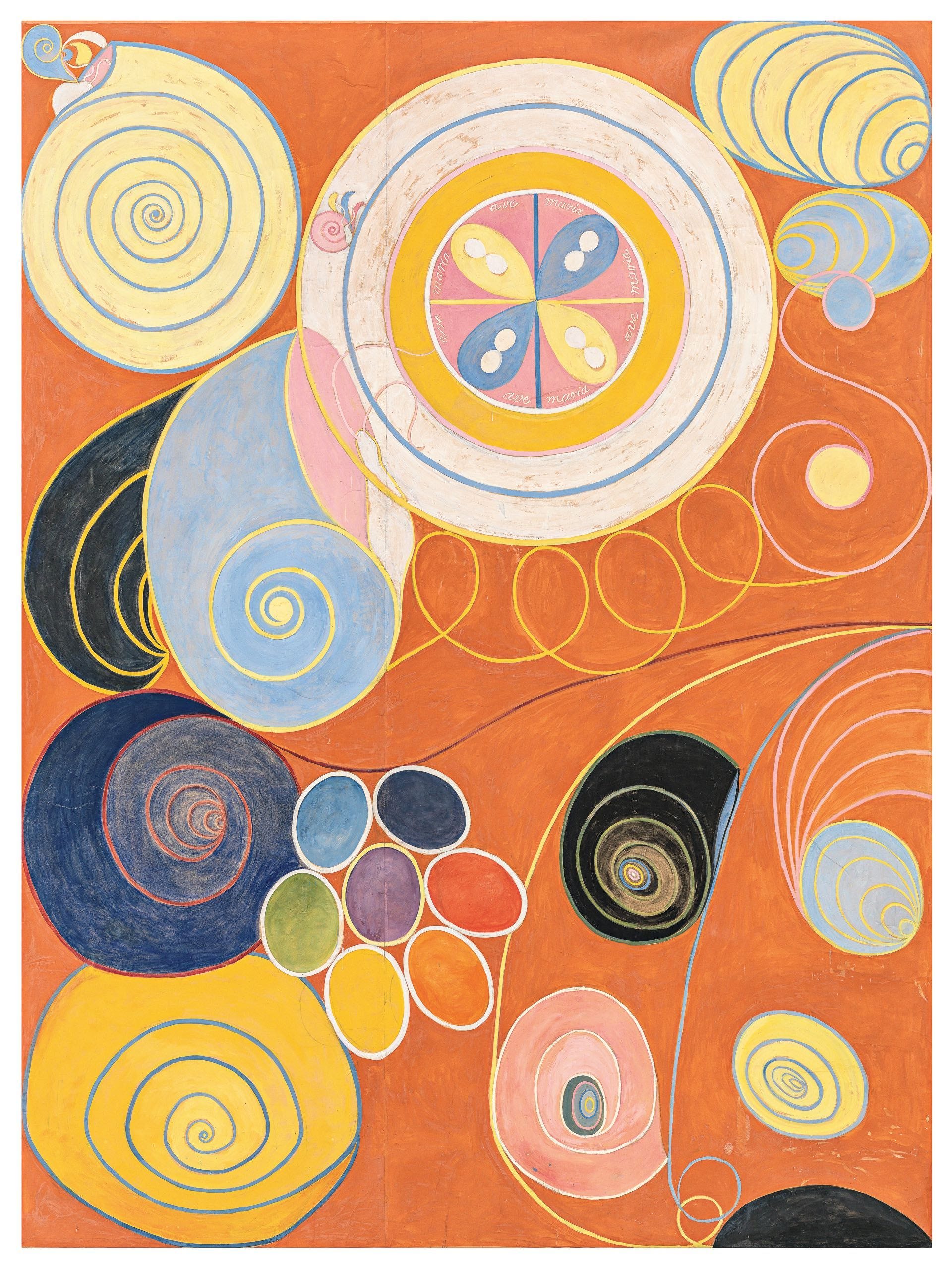
We paired this essay with Hilma af Klint’s Group IV, The Ten Largest, No. 3, Youth (1907)1 — orange ground, snail-shell spirals, a cluster of eggs in the middle that could be cells under a microscope or candies in a bowl. Af Klint trained as a botanical illustrator and spent her life trying to diagram the things science hadn’t yet found language for: how spirit moves, how matter coheres, how a body comes into being. There’s something of the same energy in this essay which often has to cadence of a fable, a story…and indeed, the best essays do!
Image: Group IV, The Ten Largest, No. 3, Youth © Hilma af Klint. Used for editorial commentary purposes only. All rights reserved.
This!! Yes!!! 🙌 sometimes it’s tricky sometimes with behavior science (behavior analysis) because of nuances with studies, privacy laws, etc., but it can be done! I try to soften behaviorism and behavior analysis across three publications. Great messages here! There’s so much good science has done, why do we only hear about the bad?