



Hello fellow strange pilgrims, when Shannan and I first read this story, we read it again together out-loud and though I know we were in our living room in front of a screen, I distinctly remember feeling transported right into the midst of this crazy dinner party. Now, we invite you to join in!



We found the lamp in Youngstown, Ohio.
We weren’t supposed to be in Youngstown, which was our childhood home. We’d made a list of what to avoid in our thirties, and it included Ohio. For a time we succeeded. We didn’t want the new build with a large lot or the long commute or school politics for five-year-olds. We didn’t believe in single-family neighborhoods. We didn’t want to live near her folks or my folks, and we also didn’t worship our careers. We despised anyone buying an SUV, but also anyone whose entire identity was their electric status on wheels. We didn’t want to be our older brothers and sisters even more than we didn’t want to be our parents: neither the right suburb with the dependable income and the blooming stomach, nor the wrong borough with the men wearing beanies in summer and everyone flaunting their jean shorts and bespoke tattoos. We didn’t need every restaurant to sell local ales, and we didn’t preen about liking bad beer as some sort of authenticity gambit. We didn’t visit coffee shops that thought every seat should be a kind of middle-finger to relaxing. Benches everywhere, and no cushions. We ordered these shops’ coffee to go.
We didn’t want the material of materialism or the trends of trendiness.
At first, we only wanted each other.
Then we had children. And we wanted them, too.
Now, tonight, we were going to have a dinner party.
“Huh,” said Melissa.
We were in the basement of our cul-de-sac home. Our two children were at my parents’.
“Huh,” Melissa repeated. “There’s a small door here.”
I disagreed. I said, “No, there isn’t.” This wasn’t my first trip to the basement.
“Look,” said Melissa, and pushed aside some boxes.
“Huh,” I said.
The door was square and wooden and barely tall enough to crawl into. It wasn’t locked.
“We have to,” said Melissa.
“We do,” I agreed.
She turned the old brass knob and pulled.
There wasn’t anything but a shelf. On the shelf was a lamp from ancient Persia.
“Peter is going to love this,” said Melissa.
“I love it,” I said.
We found the tablecloth we’d been searching for in the first place and brought it upstairs with the lamp. It was almost time for dinner.

“Okay, okay,” I said, above the noise of conversation. “Before dessert, we want everyone to see something.”
Melissa brought in the lamp on a platter and set it in the center of the table. The two couples present were also married with children.
“What is that?” asked Peter. “It looks like Aladdin’s lamp.”
“It might be!” said Melissa. “It just appeared in our basement.”
“You know how basements are,” I said, which made everyone laugh. I felt very good about getting this laugh and also about the lamp and my wife and the house we never wanted in a town I never thought I’d have to see again. I felt wonderful.
“Let’s try it,” said Sarah, who was married to Peter. “Or have you already tried it?”
“We were waiting,” I said.
“It’s a little small,” said Keeleigh.
“But beautiful,” said Brandon, her husband. “Who should try it first?”
“As hosts, we are happy to defer,” said Melissa. She was always proper.
“I think Peter is the oldest,” said Sarah.
“Age before beauty,” said Brandon. He beat me to it, but I laughed with everyone else all the same. I laughed the longest even.
Peter lifted the lamp from the center of the table and examined it. He bumped his glasses up his forehead even though he wasn’t a professor or anything. He was an internal auditor. But he was one of those guys, very into history and reading and so on. Always a new documentary he wanted to discuss.
With the handle in his left hand, he rubbed the lamp in a counterclockwise motion.
“Counterclockwise?” I asked.
“Maybe you’re right,” said Peter, when nothing happened. He rubbed it again, this time in a clockwise direction.
A clockwise direction. A clock. A wise direction. A navel is not a tick but tap I went in the center.
“Ah!” we all shouted. Not screamed.
“Honey,” said Melissa, a wife. My wife. “Honey,” she said. “Quit rubbing your tummy.”
“Stomach,” I said. I didn’t like baby talk when the children were away.
Tap, I went. Tap on the belly button, I went. I went—
“What, um,” I said, “what the hell is happening?”
The lamp released vapor and hissed when Peter had rubbed the way that was correct, the wise clock’s way as Ah said—I mean as I said. The vapor? Hence our almost shouting. But tap, I went. Hop on one foot I went. The words, my thought-words, they word thought me order out of, but wrong. “Hell is what?” I said.
“Other people!” said Brandon, triumphant.
“What did you do, darling?” asked Sarah, Peter’s wife.
“Nothing! I didn’t even get to make a wish.”
My tapping stopped.
“Thar wastrel,” I spake, as like the pirate as a pea to its pod-mate. “Ye had me as a fool in yer foul melon.”
I was a-foot and steady, and if I but made constant in my deployment of the buccaneer swag, I could set each sail of the mind to wind and fare forth in good thought. F— me, methinks. It bespooked me. I groaned as the wee man Brandon and his knave, the man-jack wish-caster, also took to feet, though Brandon could nay demand equal ground, being always an easy miss of the cutlass should one swipe at arm’s height. Whoosh. Him ye must stoop at before ye behead.
“Get him some water.”
“Something stronger, surely.”
“Have a seat,” one or the other, twin blanks both of them, said, misfiring and misfiring.
Peter put the lamp down and my thoughts snapped into place.
“Jiminy Cricket,” I said. “That was worse than being drunk.”
“I certainly didn’t wish for that.”
“Yeah, we’ve all seen you drunk,” said Brandon, stealing more of the night’s laughs.
“Well something happened,” said Sarah, picking up the lamp.
“Yes,” said Peter. “But I was only rubbing and thinking, you know, just thinking, and I didn’t even know what I wanted to wish.”
“What were you thinking?” asked Melissa.
“Truthfully?” Peter glanced at me. “I was having trouble focusing.”
“You felt foolish, maybe?” I said. I was determined to be clinical and not take any personal offense.
“Not quite. But I didn’t want to look foolish, no. I suppose I never do.”
We all hmmed at each other. Melissa brought more wine and Keeleigh, who’d been the quietest, rose to use the restroom. “But wait for me!” she said. “I don’t want to miss anything.” Her lovely, if diminutive, form fled the table. The luck of Brandon was unavoidable tonight. My wife watched Keeleigh round the corner as well, and we both gave inaudible sighs. We didn’t want to care about unattainable beauty, yet here we were.
“What’s the most interesting conversation you’ve had since children?” Sarah asked. She was still holding the lamp.
“That assumes we used to have them,” I answered. Some chuckles. Not laughs.
“I read a lot, is what I mean,” said Sarah, “and Peter reads a lot, but we care about different things. I feel like we can talk about work and the kids and every now and then summarize what we’ve been reading or whatever, but we don’t actually get into the details of anything.”
“I’m in a book club,” Melissa offered. “It’s pretty much all novels, though. I think our favorite was probably about a podcaster who gets caught up in a local murder. One of the gals knew a lot about, like, old-timey radio and said podcasts were a funny way of going back to, you know, the 1930s and such. That was interesting to me.”
I beamed at my wife.
“I feel like I only ever get into it when I’m smoking,” said Brandon. I didn’t know he smoked. Tobacco or something more than tobacco? He never invited me. “I dunno why,” he continued, “but a friend and I were discussing Kierkegaard the other week, just bullshitting while we smoked out back. Neither of us had read anything since college. But I really think Kierkegaard was a prophet of mass media, like he was against it, I mean. And my friend insisted that was a really stupid thing to focus on for the guy who gave us Fear and Trembling. We didn’t really make sense, but I definitely felt alive, you know? We both went totally overboard, like real undergraduates again.”
Keeleigh returned to us and was told the prompt. “Oh,” she said. “We’re done with the lamp?”
Sarah was still in possession.
“Brandon and I have been discussing a book of letters from World War II,” said Keeleigh. “We both love art, as well, especially the pre-Raphaelite cult. I mean they weren’t a cult, but they were a bit of a blip, you know?”
Only Brandon nodded. There was a Teenage Mutant Ninja Turtles joke somewhere in what Keeleigh was saying. But it escaped me. It slithered away from me. Post-Leonardo. I stayed silent. Of course I did. An ignoramus. A moron. There it was, myself, spread about an inch thick on the ground. Puddle-deep piece of shit. We all said nothing.
Sarah coughed. “Well,” she said, “I might give it a little rub myself.”
“Not-the-first-time-you’ve-heard-those-words-huh-Peter?” I said. My quick draw was vicious. More chuckles. Brandon nodded in admiration. He’d opened his mouth only a fraction after me.
Closing her eyes and gathering a thought in her mind, almost as if she were obeying birthday rules, Sarah began rubbing the lamp. Her brow scrunched. Her hands tightened.
“Oh crap,” said Peter.
“Uh oh,” said Keeleigh.
“For real?” said Brandon.
“What?” I said.
Sarah was gripping the lamp with one hand and the edge of the table with the other and her eyes were still closed. We didn’t exist to her anymore. Lucky Sarah. She was somewhere else and I couldn’t tell if she was in pain or in ecstasy, and I didn’t know why my wife was nudging me in the side with her elbow. It was strange! It was exactly the sort of escape from this moment—this dinner party which was not going how I thought, yet which was going to provide memory fodder for my guests and for myself for months and maybe years to come—it was exactly fit for this moment, or maybe any moment.
Oh, I realized. Sarah was having an orgasm.
She didn’t make any noise but her lap seemed to press deeper into her own seat and her hands gripped both the lamp and the table.
“Please stop looking at my wife,” said Peter.
“First-time-you’ve-seen-that-in-a-while,” I said, but I shouldn’t have. No one laughed.
Besides, Sarah had the right idea. We did look away, or at least we tried. Peter couldn’t, and we were all looking at Peter, which made us want to look at Sarah. This was only a matter of seconds, we’re talking. The depths of sex cannot be overstated in this neighborhood, which has nothing animal left inside its walls. Our grandfathers hunted and we never wanted to hunt, and neither did most of our fathers. Some of our uncles and aunts still shot geese in the fall, but we didn’t want that. We wanted dogs who could be caressed into plush toys.
Sarah was caught in a deep wanting that was under whatever conscious thought she held in her mind. She undulated a little bit, but nothing too indecorous. A firm and quiet and passionate woman. God, I hated myself.
Peter was talking to her.
“Baby, put the lamp down. You gotta put the lamp down, okay?”
He was reaching for the lamp. How could she acquiesce? Saint Sarah, lost in the one intersection of our lowest and highest instincts. We didn’t want to be beasts and we didn’t want to be angels.
“Here we go,” said Peter, and finally pried the lamp from her hand.
“Oh my god,” she said. “I was here the whole time?”
“Yes,” said Melissa.
“I tried wishing for the power of flight. That’s what I was thinking, I mean.”
“You are one lucky guy,” Brandon told Peter. Everyone guffawed as a way to break the tension, and Sarah blushed. But a happy blush. Her pale neck was still flushed.
“It’s like the only tether, sometimes, sex,” said Keeleigh. Her beautiful, petite form pulsed a bit with the word sex. I was staring very hard at her cheekbones. “It’s one of the continuities, you know?”
“I need some water,” said Sarah.
“We didn’t have sex until we got married,” said Peter. “We’ve only known each other, you know?”
Keeleigh nodded. “I remember Sarah saying that. It’s amazing to me. Beautiful, really.”
“Like meeting a woolly mammoth in person,” said Brandon. “Aren’t your kind extinct?”
“It’s something sacred to us, even now I mean,” said Peter. “I remember my college roommate, very much not a woolly mammoth, tried to explain to me how there was sex and there was making love. It was a very young idea, and he was pretty new to his own sexual adventures. But he was right, of course. Everyone knows the difference.”
“He’s going to say something about Saint Augustine,” I said. “He’s told me this.”
“I am going to say something about Saint Augustine.”
“I don’t even really know who Saint Augustine is, and he loves telling me this.”
“Maybe it was Saint Aquinas?” said Sarah, returning with her water.
“One of the big guys,” said Peter, “makes it clear that sex has to arise—”
Brandon and I opened our mouths.
“—from the love.”
We agreed to a silent truce.
“The spouse can become an object if you’re not careful.”
“Have you been careful?” asked Keeleigh. “Do you use each other as objects?”
Sarah shrugged. “Sometimes. But we try not to.”
Keeleigh nodded. “I sometimes feel like the bedroom, with the kids asleep and Brandon very obviously horny, is the only retreat from our current life. It’s this little tent, this time machine tent, we can enter or leave. It exists within our current life, but remains apart, too.”
“An oasis,” said Peter.
“Yes. An oasis. I had to read the Song of Solomon for a poetry class, and I remember that, Peter. An oasis.” She didn’t blink. The two of them watched each other.
“What the fuck are we talking about?” asked Melissa.
No one was sure.
“Let’s try rubbing the lamp together,” said Keeleigh to her small husband, Brandon. The short wit. Brevity is the soul of—. Well, he was beautiful, too. Compact.
Their left hands overlapped on the handle of the lamp, and their right hands, his fingers in between her own, began rubbing.
Not much happened. Nothing was happening. Our children were playing in the room next door. Sarah was undressing in front of Peter.
“Don’t look at my wife,” said Peter.
Melissa was getting drunk. Or getting me drunk. I was drunk. People kept drunking me.
Keeleigh and Brandon were in their nice dinner clothes and not wine-bibbled and not undressing, although she was on his lap now.
“Do you want me to undress?” Keeleigh asked my wife.
Melissa made a face. She could take it or leave it.
I realized it wasn’t only our children, it was everyone’s children in the next room. All the children. Peter and Sarah’s three kids and Brandon and Keeleigh’s one child were playing with our two girls. The odd one out was Sarah and Peter’s youngest, a toddler. But they were playing so nicely.
“We’re all playing so nicely,” said Brandon. They kept think-ripping me. Ripping my thinks. My thought cords, pulled.
“Yank,” said Brandon, and winked at me.
But we were also having a lively, robust conversation.
As if mid-dialogue, Keeleigh was saying, “Peter and Sarah, now, they think abortion is wrong.”
“Sure,” said Peter, his wife still undressing.
“Yes,” said Sarah.
“And Brandon and I, we’ve paid for an abortion.”
“Of course,” I said.
“But we’re all together and happy and friends. Which calls into question the moral case for abortion, doesn’t it?”
Brandon was watching his child, a son, play in the next room. Our two daughters were matched by Peter and Sarah’s older two. There was a little plastic slide and many cars and some dolls getting their hair braided and a coloring pad being abused by the toddler, who was told, “Oh, I like that picture so much!” by one of the girls every few minutes.
But we were also talking.
“I think, actually,” said Peter, his wife’s areolas entering the air, “that our instinct not to bring up abortion calls into question how much we underestimate the need for socializing. We take the moral heft of getting along too lightly, maybe.”
“You’re not getting an abortion right now,” said Sarah.
“I love when they play like that,” said Brandon, watching our children.
“I don’t take socializing lightly,” said Keeleigh.
“I feel awful,” said Melissa. “I don’t want to talk about abortion. You’re making me feel horrible.” But she kept drinking.
“I think maintaining the social fabric is a vital cause,” said Keeleigh. “It’s not a slight or superficial idea at all. But still, if you think I’m a murderer, shouldn’t that come up now and then?”
“Good sharing!” Brandon shouted at the other room.
“But we’re friends,” said Sarah.
“Exactly!” said Peter and Keeleigh at the same time, not agreeing, both of them watching Sarah begin to pull at the waistline of her husband’s jeans.
“Give me that!” said Melissa, and she took the lamp.
The children were gone. The clothes were replaced. I was un-drunked again, and so was Melissa. She held the lamp high, brandishing it at the room.
“Oh, man,” I said. “I wish the girls actually were here. I didn’t expect that.”
“I wish,” said Melissa, out loud, and she began rubbing the lamp. But she didn’t have a chance to voice the thought.
Had she been wishing? She kept the lamp in her lap, and we continued the dinner chatter we’d all been enjoying.
“So you’d go to Crete?” Keeleigh asked Sarah.
The question was: what vacation would you repeat if you could only travel somewhere you’d already been? We’d been discussing the question for, oh, the whole night I should say.
For some reason, though, I missed our daughters. I won’t tell you their names. We don’t post their likenesses anywhere online. Just the backs of their heads. We don’t want the wrong kind of exposure for them. From our feeds you’d think we wanted to be somewhere in the mountains or near the ocean or out beneath the stars, just me and Melissa like old times, with two castoff shadows and silhouettes, at best, dragged along. But that was only digital security. We wanted to watch the girls experience the mountains, the beach, the stars, more than we wanted to experience the mountains and the beach and the stars ourselves. We wanted for them and through them, but not in the way our parents did. Not vicarious vampirism. We wanted them around, and wanted them to want to be around. And they did! For now.
“Where would you go?” Brandon asked me.
“I’d like a chance at the lamp,” I said.
“I thought we weren’t doing that tonight,” said Sarah.
“We all passed,” said Peter.
“Babe,” said Melissa. “Let’s try it another night.” It was sitting in her hands atop her blue skirt, the one with pleats which was somehow very attractive and very old-fashioned at the same time.
But I wanted to hold the lamp.
“Let’s just see,” I said, smiling as widely as possible. “One of us should try it.”
I took the lamp from her hands, and she let me.
We all remembered at the same moment.
“Your wife has exquisite breasts,” said Keeleigh.
“Stop,” Melissa said. “Stop ruining this!”
The lamp was lighter than I’d hoped. Almost cheap.
“What’s in your heart, do you think?” Brandon asked me. The competition.
“I’m sorry, Melissa,” Keeleigh was saying. “I was just joking.”
“Honestly, I don’t feel as much shame as I would’ve expected,” said Sarah.
Peter guffawed. “I do.”
“It happened to me, I mean, the same as it happened to all of you.”
I was centralizing a thought in my head. Or trying.
Gripping the lamp’s handle, I began to rub at its middle, clockwise as any sane person would do.
A gun appeared in my hand.
The lamp in one, the pistol in the other.
“Honey,” said Melissa.
“Whoa. What the hell?” said anyone. Take your pick.
“I’ve never held a gun before,” I said.
“Next!” said Brandon. “Do not cross start, do not collect two hundred dollars.”
“You know,” I said. “Our life here is very full. Everyone told me it would be empty, the suburban deadness and all that, but it’s not. It’s very full. I thought I’d hate it, but I don’t. I don’t even love the wrong parts of it. I think.”
“Let’s be done with the lamp,” said Peter. “I want to hear more. But without the lamp.”
“Or the gun,” said Keeleigh.
“But he wants to die,” said Melissa. “I’m not surprised. He wants to die.”
I smiled. “I think a loft in exactly the right city and without the wrong job would solve everything.”
Peter reached for the gun. “Here. You can give it to me. I’ll take it.”
“What I wished,” I said, “or what I wanted to ask for, I mean, was the ability to stop time.”
Brandon nodded. “For yourself? Or for everyone?”
“I dunno. For myself, I guess. Or maybe everyone would stop around me, and I could exist in a little bubble of time. Or maybe the effects of living would stall for a bit. No aging for a day or a week or a year, or something. Maybe that’s all time is, a kind of decay. I dunno. But I wanted to be able to stop time.”
“Here,” said Peter. “I love what you’re saying, but just hand that here, yeah?”
“That’s like dying,” said Melissa. “Stopping time, I mean. I’m not surprised. It’s not an escape hatch. It’s negation. Erasure.”
I shrugged. “It’s the only real choice. A realist deals with reality. You choose to accept life as it’s piped into you or you choose to die. Once you realize those are the options, well, it becomes an option.”
“But do you want to die?” said Brandon.
Keeleigh touched his wrist. “I think Peter’s right. This is a genuinely interesting conversation. It just needs one less gun for us to have it.”
“Wanting is downstream of reality, I think.” I was enjoying the weight of the pistol. I didn’t know it’d be so solid, so exquisite as a creation. “What can be wanted, you know, it dictates the desires. You can want to receive, or you can want to die.”
Melissa was staring at the table. “We should have had a family party. We should be in the backyard with the kids, all the kids. We should be getting interrupted.”
“But if life is a disappointment,” said Sarah, whom I’d seen topless, “like if you find the bad parts of life overwhelming your desire to keep living, that can only flow, you know, from life being good. Right? Life is good, otherwise it wouldn’t matter when it’s not.”
“I didn’t say I was being logical.”
“We all think we’re logical,” said Peter. “We all think we’re realists.”
“You can’t be so disgusted by life—”
“I’m not disgusted!”
“—that you want to kill yourself, without first believing life is good at the most basic level. That’s the seed of all our desire. We want more of the good.”
“Just give Peter the gun,” said Keeleigh. “We’ll all feel better. Just give him the gun.”
“No gun for you!” tried Brandon.
“Keep talking,” said Peter. “Keep talking. Just let me see that.”
“You don’t want this,” said Sarah. “You don’t actually want this.”
Melissa shook her head, but kept staring at the table.
I put the gun to my temple. Everyone made a lot of noise, but no one was quick enough to stop me. I pulled the trigger.
It hurt. It sparked and boomed.
But it was a blank.
“Ha!” I laughed. “Ha! Ha! Ha!”
What a wonderful joke.

Tell us your origin story as a writer. When did you begin? What first drew you to writing as an instrument for asking questions that can’t be explored any other way?
JOEL CUTHBERTSON: I’ve always lived in my head too much. I believe my most entertaining stories were written between third and fifth grade, when I spent every afternoon jumping on a rusted trampoline a neighbor gave us, entering whatever worlds appeared that day. I tried to be a screenwriter and a playwright in college, but I guess I’m drawn to ideas that need both a larger and a more intimate canvas. There’s no world too big for a novel, and yet no medium is as well-suited to explore interiority.

What does your writing routine look like? Do you thrive in structure or wildness? And when you begin a piece of writing, what tends to announce itself first: a voice, an image, an unease, a philosophical conundrum?
JC: I am firmly in the “stealing time” phase of life. I write during breaks at work, in the mornings if a larger project has possessed me, and sometimes at night. Most pieces begin with an opening line; usually some kind of perspective is already half-sensed. But any strong impression will do: a character that leaps out of life, a paradox I continue to injure my brain on, or a place I love and can’t explain why.
Most artists are preoccupied by certain obsessions: lust, longing, death, the self. What persistent preoccupation—emotional, intellectual, or spiritual—threads through your work? Are there motifs, themes, or impulses you’ve tried to abandon but that keep returning, insisting on their relevance?
JC: Fatherhood seems dominant at the moment. But I think the strain of connection generally appears in my work. Also, if I straighten my invisible bow tie and adjust my glasses with the right sort of intellection, I might say that the problem of evil, which is sometimes a very funny problem, seems to insert itself into everything.
If not a writer, who would you be?
JC: Many things are possible. I might be a marketing drudge or a dedicated high school English teacher or even an emergency room doctor. I suppose the most likely outcome is that I’d be marvelously rich, probably a rock star, and that I’d have really defined abs. Damn you, fiction!
What’s the best piece of writing advice you’ve ever received? Alternatively/additionally, what’s something you’d like to offer as advice to emerging writers trying to make a mark?
JC: Two pieces of advice stand out.
The first, which I cribbed from George Saunders, is to justify your excesses. Can you parse what this advice means? Can you feel its weight in your mouth when reading your work aloud for revision? It appears like a revelation, at some point, if you internalize the phrase. “Justify your excesses.”
The second is to touch the work every day. I stole this one as well, from Dana Spiotta this time. It can be ten minutes, five minutes, or less. Sometimes you’re editing a lot because that’s an easier lift in between feeding the children and feeding the loan officers. That counts. It all counts. Stay in contact, if you can.
What are you working on now and how is it trying to ruin your life (in a good, necessary way, of course)?
JC: A nonfiction work of book length—of novella length at least—has entered my life. I’m still trying to scribble out stories as much as possible, but I never thought I’d be this distracted by something that puts on reportorial airs. I won’t say more than that it’s called Animal Life, is memoir-ish in a diet Annie Dillard kind of way, and should be finished in the next several months.
Who are the artists—writers, filmmakers, thinkers, internet oddities—that have shaped your sense of narrative? How have they rearranged the way you see the world on the page?
JC: Some authors and storytellers that give me permission—another stolen line, this time from Jenny Offill—are Mikhail Bulgakov, Penelope Fitzgerald, Muriel Spark, Terrence Malick, David Lynch, Gene Wolfe, Dave Malloy, Ella Fitzgerald, Diana Wynne Jones, Jane Greer, Zadie Smith, and Joy Williams.
Gene Wolfe in particular is an author who’s reminded me to add, to enlarge, to find annexes as part of the editing process. Bedazzling is sometimes more necessary than the Lishian cutting I practiced and was pointed to in earlier years. Maybe your narrative is too small rather than your language not being sharp enough. Once the voice and technique find their balance, you’ve still gotta let it rip sometimes.
Please recommend a piece of art (a painting, a film, an album, anything that's not a piece of creative writing, really) that you love and would like everyone to experience.
JC: I’ve been listening to Ella Fitzgerald Sings the Cole Porter Songbook on and off for weeks now. Go forth and do likewise!


JOEL CUTHBERTSON is a writer and librarian from Denver. His short stories and essays have appeared in the New England Review, Electric Literature, Joyland Magazine, LitHub, the Los Angeles Review of Books, and more. He received his MFA in Fiction from Syracuse University.

Notes on Art
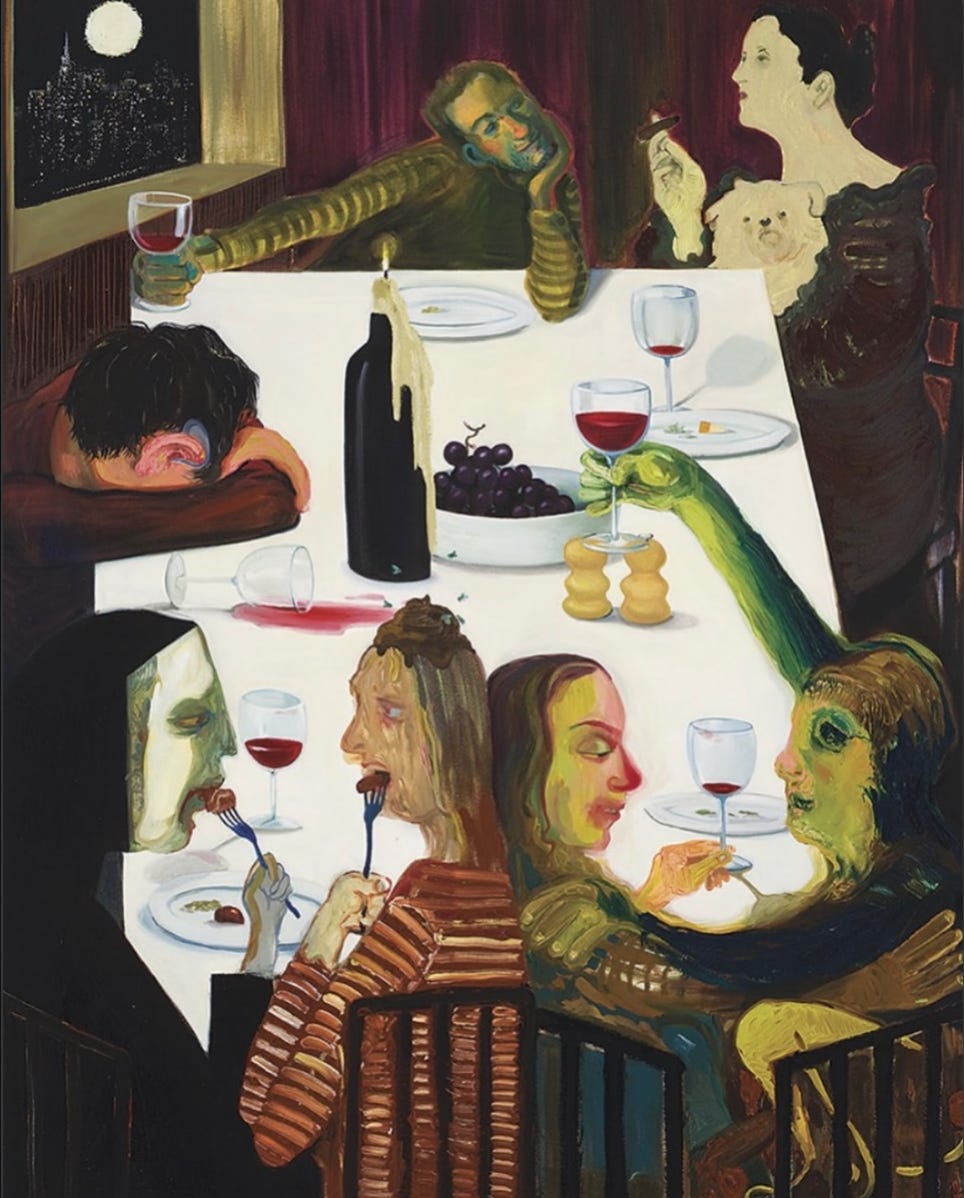
We paired this story with Nicole Eisenman’s Winter Solstice 2012 Dinner Party (2009)1 — six figures around a candlelit table, wine half-drunk, plates barely touched, everyone slumping or staring or somewhere else entirely. Eisenman paints social gatherings the way they actually feel after enough hours and enough wine: the bodies are still at the table but the minds have wandered into private, ungovernable places. Her figures are together and alone at the same time, and the paint itself can’t decide how real anyone is. Cuthbertson’s dinner party works the same way — a place of reckoning and magic and chaos where truth and fiction tango together until the very end.

Image: Winter Solstice 2012 Dinner Party © Nicole Eisenman. Used for editorial commentary purposes only. All rights reserved.
this was amazing to read. i love how the lamp was the vessel that revealed their desires, their subconscious, their inner selves. i will be thinking about this one for a while.
I greatly enjoyed this. It's the kind of piece in which I'll discover something new during a reread. Saved!