



Hello fellow strange pilgrims, today we’ve got an essay that could be a short story or a dreamy sweet forest-drenched fever dream, or an ode to bears, and it’s probably all of that—dive in!


I. Bear is a form, Bear is form
I consider their noun-y-ness, their letters and rhyming potential, how they hold space between the roof of my mouth and my tongue. When I call to them, my lips begin pressed together with a certain expectation, so I can really pop that b. I open to let the vowels out until my lips curl back for a consonant that might linger as long as you’d like it to. They sound like what we breathe. They end with a softness like fur we might wrap ourselves in. Though they never needed us to call to them to know they are there, that they are real.
I. 1. Bear as animal
Before human, before our language, there is fur and maw. Fifty-five million years ago, a dog becomes heavy-set (I get it), their teeth blunted. They remain small until they do not. Sun and sloth rise. The giant-short-faced bear towers. Brown and black, panda and polar, spectacled, too, all become. They are them long before we are us.
I. 2. Bear as noun
We begin to make them ours, as we try to do to everything, language being a certain kind of possession. In Old English, we name them bera. In Proto-Germanic, we name them bero—literally, the brown (one). RuPaul might quip, Why they gotta be brown? And he’d be right. They don’t, Ru. They really don’t. If you’re feeling thirsty, Middle Dutch and Dutch have you covered: from bere to beer, respectively. Some German, too: Bär. I’m parched. Let’s go! Apologies, I can’t help myself. I’m drunk on an idea and its evolution, just not quenched, not sated. Will I/we ever be?
I. 3. Bear as myth(ology)
Where there’s a little flesh and some mystery, there’s a narrative waiting to write itself out of hibernation. Somewhere, lonely in the woods, they lumber, and we begin to imagine them. We make them like us, our creations intertwined.
I.3.a. The Mother Bear
There are so many versions. A girl lost in the forest is forced to wed a bear and have his bear-children. Yikes! In another, the young woman consents to marry the bear, becoming one herself by story’s end. Callisto is tricked raped by a god and then turned into a bear by another one. (It gets worse.) More recently, her porridge is too cold and her bed too soft for a curious young girl lost in the woods. (So many forests of narrative so full of lost girls.) In all of these stories, a mother fiercely protects her cubs. Some instincts defy the boundaries we draw with words like animal, species, human. I see a velvet sack on my father’s mantle, understanding who fills it. She wanted a girl, and she got me. Close enough we might giggle together now, if she weren’t quiet as ash. I am not a girl, but I am lost.
I.3.b. beast of the “frontier”
We come for them—their ears and their maws, their pelts and their claws. Men who look like me, we name them grisly and grizzly, make a monster of a thing which we only desire in parts: skin and head on the wall, a story of slaughter shared over whiskey and firelight, a product sold to a customer. Even their excess becomes a commodity. Fat rendered into oil; we call it bear grease. We cook with it. We waterproof with it. We lubricate. We use it to repel insects. So many pests in this wilderness, so many instructions. You will not encounter a bear, but you will carry the bear spray. Call out to them to alert them to your presence.“Hey bear” meaning “away beast.” When you see them at a distance, do not lose them. Maintain your distance. When the bear is thirty feet away, deploy the bear spray.
I. 4. Bear as sacred
It is not always this way; there is not always a monster to excuse a violence. What one might see as a threat or a means, another understands as a symbol for something beyond themselves, of something greater. We might call this spiritual or sacred. We might call this a different epistemology towards bear altogether. I sit in the car with a poet who identifies as Iñupiak-Inuit, and we gab over our respective adoration of bear. When I mention the attempts to loosen restrictions on hunting grizzlies in the West, she says, We do not kill bears.
I. 5. Bear as river
In Utah, they flow like a jagged U around the northern edge of the Wasatch Range. They lumber towards a death—an ancient sea made more ancient by each growing season. A man once saw them there fishing in the river, so what we named them, he named the water. Now they make a valley fertile. They seep into the earth so hay and alfalfa might rise into the mouths of hungry even-toed ungulates. The cow moos and the sheep bleats so pastorally after they are fed by the bear. To reach this verdant pasture, the river is not lost; it is taken.
I. 6. Bear as human
Jane Bennett once said a “touch of anthropomorphism” is okay, so let’s lean into that for a moment, shall we? I’ll try to put my finger on it—not the animals themselves (risky business!), but that line we draw between us. Like how when we kill them, we call it hunting, and when they kill us, we call it tragedy. Like when I button up my costume all billowy and soft in the late October chill, I remain a man merely wanting. Some love might call out to me Hey, bear!, and I’ll come running. Some child might ask for candy, and all I have are fresh berries dying my hands like a sweet bruise.
I.6.a. an unbearable human
The paradox here is not lost on me, and they are beginning to pile up with so many meanings, so much signification percolating around here like salmon bones in peak hyperphagia. Here, a human kills the vibe, flies into a rage, is so uncouth and ill-kept one names them truly feral with our four precious letters. I shudder at this misappropriation; I render it obsolete. Take that! I don’t mean to be difficult or moody or unpleasant, but linguistics can really get me going. We can spare the animal here and name a miserable man what they are.
I.6.b. a sizeable, cumbersome man
We are getting closer to my sweet spot with this one. Maybe there’s even some honey in our future. I drizzle it in my oats each night and look forward to the work it does in the morning. The oats, the milk pressed from soy beans, perhaps each fed by that river or some other source. I mix them all together here in my bowl. They enter my body, the bear and his decadent resonances. I once watched a lumberjack competition on television (don’t ask), and all I could see was bear. Bear with axe. Bear in flannel and tight denim. Bear with chainsaw. Let me tell you, these men loved wood, but perhaps not as much as those who follow.
I.6.c. a burly, hairy gay man
We love a belly! We love fur! We love bear all burly with his bodacious biceps and beard. Just seeing one in the wild is a balm, a blessing, and becoming one, too. I’m bumbling towards a brutish beauty. Call it my bearing. I read james mckenna’s poem “signify me, daddy,” and daddy is a bear in my unbearable mind. Not a fist, but a paw. Not a mouth, but a maw.
I. 7. Bear as form
I am meandering with a purpose, I promise. We have so much ground to cover here, and an essay (or a collection of them) seems as apt a space as any. See, bear is not territorial. This home range is shared between me and you and you. And though we can’t see one another right now, I’m not avoiding you, as bear might another bear with whom they share their range. But I might be avoiding something, refusing something. We’re just going to amble and lumber for a bit, taking care not to miss an arousing scent, a memory, or the ghosts that fill every absence. There is a velvet sack on a mantle, a face that changes shape in the mirror.
II. Bear is action, Bear is performance
If you’ve been feeling a little reverb from these noun-al dissonances, I get that. What I offer you now is straight all verb because, when we bear, we are doing. We are occurring. We are in the predicate, and thus, we are predicated. How do we make these four letters do; when do we make them occur?
II.1. Bear becomes verb
Much like their noun-y counterpart, bear’s action is of an English Old—beran. Even then, the verb was so vers: to carry, bring; bring forth, give birth to, produce; endure without resistance; to support, hold up, sustain; to wear. Bear has so much possibility, they’re always doing what they’re doing in one kind of drag or another. Even the sounds of this etymology are ironic, paradoxical. The Dutch beren, the Old High German beran, the Gothic bairan, and, of course, the Old English beran all in such close proximity to today’s barren (bear, too, if I’m being honest) that one might suspect to find this as the punchline of the cruelest and most misogynistic of a centuries-long joke. A homophone that means its antonym, only a man could have conjured such nonsense. It appears as though he was French, and Old.
II.2. Bear carries
a history and a load (many loads), even clothes. Sometimes that history is not true; sometimes I misremember you. I conjure Teddy Roosevelt and the toy stitched in honor of him, of his refusal to kill a snared cub. Another myth(ology) emerges here, right on the surface, in these lines. We dress him as a war hero so tidily: that hat, those gloves, those boots to boot, and all that tan fabric. I’m dressing this bear in words so I won’t forget the bloodied cub that did not survive. On my feed (lol), a bear carries her cub in her mouth across a two-lane highway in Yellowstone, drops him (presumably) on the other side of a concrete barrier, then climbs over herself. Watching this, I see a boy dragging a brown stuffed animal across the beige living room carpet. There’s a woman in the doorway saying, It’s time to go.
II.3. Bear gives birth
to a child. I am my mother’s son, though come early. I do not lie on her chest after they pull me from the cut through her abdomen into her uterus. They take me away to the incubator where I stay. I do not see her dirty blond curls, not freshly permed but not too stale either, on the other side of the acrylic compartment. I imagine her hands reaching through the openings for me, touching my smallness, my not-ready-ness—the first tenderness I’ll never know. This is not a memory, only having been relayed to me later when I might understand. But my father remembers what happens days later when the insurance no longer covers my mother’s room and bed, and so she goes home that night, but returns each day. She was so angry. She was so pissed, he says. Bear remains with her cub until he is ready. She brings me home, my name in her mouth, my body in her arms.
II.4. Bear possesses inherently
even when that is an impossibility. Another paradox. Another essential characteristic. There are so many of me here: the I these hands construct who takes us through the chaos, the you I once was before a fracture, the you I imagine I might become, and me here now in these fleeting moments, embodied. What might be inherent to all of me? A hyper-awareness, an anxiety. All my selves abject, narrative as they may be. Don’t get me started on the land, honey. Don’t let me drift to the culture. So many ideas we want to make ours and ours alone in this our shared range. A man once tried to possess my body, brutalized it like an animal or the land he claimed as his own. Even that summer afternoon did not last, and I learned how
II.5. bear sustains
even when it seems dire. The long months without light, without nourishment—the heart slowing lonely and quiet in some cavern or on some hospital bed brought into a home, into a bedroom. Even this feels unsustainable, this bear as form, these words like cancer that refuse to stay in one place; they just grow and grow and go where they don’t belong. A disease that does have an appetite for a pancreas, for the land because, if I don’t live there, no one must. What we can’t sustain, what we lose in winter (or on October 4, 2012), we try to restore when we wake from our comatose. Sometimes restoration is just another hunger. Sometimes restoration is impossible. Sometimes all we have left is language.
II.6. Bear endures
my melodrama and the caricatures. Winnie’s got his hand in the honeypot again. Smokey’s all about prevention, and not just forest fires anymore, birth control, too. A child is not a fire, but he can be flaming. Even before he’s there, before he’s him. We love a gender reveal party. No, we don’t. See, I caught you there. Some things are ridiculous, especially when they make the world burn. He’s chewing on rainbow gummy bears because he loves every color, especially when they’re fruity. Though he’s no bear yet, he’s still consuming himself, a version of him consolidated in high fructose corn syrup. But I’m worried for bear and what I’m doing to them here. Can they bear their bigness, their sprawl, what so many of us admire in them, and what we take from them?
II.7. Bear has a relation
to something else. A likeness, really. Some might call this relationship figurative, but that doesn’t mean it’s not real, honey. When I worry this becomes all about language and not what it possesses represents, I cry out write, Metonymize me, Mommy! Synecdochize, Daddy! Because, I’m silly. Because, in so many ways, this is really about the simultaneous, the polytonal. Bear becomes so much to so many. Even as I must choose line-by-line, image-by-image, story-by-story, bear does not. Bear is bear. When I write I am bearish, I mean it. Still in my mother’s maw, she carries me across any road to anytime but now. Here I am eating bear-caught salmon off a chipped plate with a fleur-de-lys that I won’t relinquish because of who gave it to me. I feel like the river’s skeleton picked clean.
III. Bear is large, Bear contains multitudes
My obsession with bear is figurative and literal, etymological and animal, noun and verb, queer and unqueer. Do I contradict myself? Very well, I contradict myself. I’m hardly the first to try to extract meaning from these four letters. The Oxford English Dictionary offers 67 definitions for bear as verb and 21 definitions for bear as noun. Of these, 16 are labelled obsolete. How dare they!
III.1. Bear as vers(e)
Bear is top and bottom, so as a piece of language, we might call them decidedly vers. Certainly, one of the vers-iest words out there. For a lover of puns and play, the profusion of bear affords a frontier an orgy of linguistic possibility. A poet might consider their layered meanings and call them poetic. A non-poet might read their wistful lumbering, their quiet winter as prosaic. (Hopefully lyric at the very least). A question of genre and aesthetics. They are all the things. Some stories begin to sound like song, and a poem might be an exercise in syntax. That lineation is feeling bearish, sweetie. Meaning ferocious. Meaning hungry for some fruity enjambement.
III.2. Bear as epistemology
One of those things being understanding. I think of the social—human and more-than—how so much triangulates through bear. Perhaps then, they become a space where knowledge and empathy are shared between us and not taken (for granted). We might each sit by the river and think of it differently—its coldness and its histories, what it grows and where it ends. We might all of us gaze at the animal lumbering across the ridge parched golden in the later afternoon light and all of us misunderstand bear.
III.3. Bear as multiplicity
I want so many things. They are so many things. So then, don’t I want them? But this isn’t all about me; I’m not the only one to see bear and swoon, to become bear and wonder. If Whitman contained multitudes, bear is those unceasing multitudes. Not everything, but an abundance to a lot of beings—human and more-than-. A furry container of rhizomes touching one another, bear refuses any singular position, any teleological definition or purpose. The matrices they foster bring not just me, but all of us, towards some notion of our (deconstructed) interconnectivity. I love bear for this queerness. Bear, too, is this love—the obsession I endure carry abide by, my intentions naked as letters on the page or how a word rhymes in the mouth with care.
References
“Bear, n.1 Meanings, Etymology and More.” Oxford English Dictionary, www.oed.com/dictionary/bear_n1?tab=etymology&tl=true.
“Bear, v.1 Meanings, Etymology and More,” Oxford English Dictionary, www.oed.com/dictionary/bear_v1?tl=true.
Bennet, Jane. Vibrant Matter: A Political Ecology of Things. Durham: Duke UP, 2010.
Mckenna, James. “signify me, daddy.” Quarterly West, Issue 104. Online.

Tell us your origin story as a writer. When did you begin? What first drew you to writing as an instrument for asking questions that can’t be explored any other way?
MATTY LAYNE GLASGOW: I suppose I’ve been drawn to language as a means of play, performance, and refuge since I was a child, figuring things out as they say. I journaled intermittently throughout childhood but always jotted down ironies or observations that felt meaningful. My parents were quite funny, often biting in their humor, so I feel like our discourse as a family informs my tone and playfulness in much of my work. While I enjoyed writing poems, short stories, and some essays in my high school and undergrad eras, I don’t think I began “identifying” as a writer until later in my twenties after some of the events alluded to in this essay transpired—the passing of my mother and an experience of violence, in particular. At that point, writing was more of an outlet to keep me well, to grapple with grief, to think about my own relationship to the world around me a bit more critically. I still remember a digital storytelling workshop a poet and friend Sara Cooper facilitated in Houston in 2014. That was a profound experience for me, and the community she fostered for us made we want to create across genres and mediums as a more committed practice.
What does your writing routine look like? Do you thrive in structure or wildness? And when you begin a piece of writing, what tends to announce itself first: a voice, an image, an unease, a philosophical conundrum?
MLG: As an August Virgo, this is such a challenge for me. I do desire some structure and regular writing rituals; alas, my routines themselves tend to be more feral and less domesticated. I do write alongside my students during the semester when we practice in-class activities or immersions across campus, and I think that’s important to maintain my relationship to language. Those little bursts often arise from an observation, an irony, or a tension that’s lingering. A good friend Jess Tanck often organizes 30/30 Writing Challenges in June and December when many of us have a reprieve from the academic calendar, and those have been vital for me since finishing my PhD program. I’ll often build out those shorter exercises into drafts. Voice and tone are very important to me, and I’m frequently trying to negotiate various tones in poems and essays, so in those months I can spend a bit more time in a project, I’m thinking through how those tones work alongside one another (or don’t) and any productive frictions they might generate—sonically and theoretically.
Most artists are preoccupied by certain obsessions: lust, longing, death, the self. What persistent preoccupation—emotional, intellectual, or spiritual—threads through your work? Are there motifs, themes, or impulses you’ve tried to abandon but that keep returning, insisting on their relevance?
MLG: I do think the various constructions of “the self,” especially how those dynamics shift across genre with the speaker in a poem or the narrator and characters in prose, has been an interest and preoccupation I just can’t quit, try as I might. I remember telling myself after my first book that I needed a break from writing so personally for my own well-being, and here I am. Now, I think, regardless of the perceived content or subject of the project, what I ultimately write about is going to be inherently personal because I’m not going to put work and time into something that isn’t meaningful to me—though the depth of that commitment certainly has its ebbs and flows. Queerness, desire, and environment seem to always be lurking in my work. And harnesses of late. I adore a fetching harness snatching myself or my partner at the nexus of queer domestication and ferality.
If not a writer, who would you be?
MLG: I am a teacher, and I’d want to do that even if I wasn’t getting to teach creative writing. I taught high school math briefly as well, to the horror of those students and many of my friends. In an entirely different life, I think I’d find joy in curating the craft services table on film sets, or happy hour spreads more broadly. One of my friends in grad school, in addition to writing multiple beautiful novels, made the most decadent charcuterie boards for us all to enjoy and pretend like we weren’t struggling through existential writing and financial crises daily. I’d love to shepherd production assistants and actors and whomever through their own existential crises by providing them with homemade sourdough, a thoughtful balance of hard and soft cheeses, and an aesthetically pleasing array of fresh fruits, vegetables, and sweets. I’ve also learned how to shuck oysters, so we can bring that and a fierce mignonette game to the table, too.
What’s the best piece of writing advice you’ve ever received? Alternatively/additionally, what’s something you’d like to offer as advice to emerging writers trying to make a mark?
MLG: One of my beloved mentors during my MFA, Deb Marquart, explained to me early on that writer’s block does not, in fact, exist. I found this quite compelling, and I think it has lowered the stakes for me quite a bit in just trying to get words down on the page when I make the time and have the opportunity. I’m not scared of a shitty draft. If I were, I’d be living in an endless horror series given that I’ve written plenty of them. I fear not putting enough work in after the draft or getting so comfortable in revision I never imagine the piece moving forward, which is another kind of block that inhibits growth. I’m always thinking about that balance and getting the piece to an iteration that excites me. I think writing fearlessly and being willing to take risks—whether those be formal or otherwise—are vital for any writer, emerging or otherwise. Paisley Rekdal is another truly inspiring mentor on every level—as an artist, as a human, through her activism and community engagement. Making a mark beyond the writing itself is vital for me, and I think it’s important for emerging writers to understand the breadth of opportunity to contribute to our literary community and our culture’s well-being.
What are you working on now and how is it trying to ruin your life (in a good, necessary way, of course)?
MLG: I am currently attempting to revise and refine a collection of lyric essays in which “Etymology of a Bear” plays a central role. It was my dissertation, but it’s evolving since my emergence from doctoral hibernation. I am hopeful, but I’m certainly navigating a tension between desired experimentation and a palatable reading experience. I do not want my potential reader to be miserable, I promise. I’m excited about some research I’ll be doing for my next project this summer, which is thinking about the mythologizing of queer bodies and a re-telling of Narcissus through the lens of consent. I fear Freud might have been a touch harsh in his pathologizing of his character, so I’m hoping to offer one of our OG twinks a more nuanced literary experience.
Who are the artists—writers, filmmakers, thinkers, internet oddities—that have shaped your sense of narrative? How have they rearranged the way you see the world on the page?
MLG: Lindsey Drager’s The Avian Hourglass is stunning. Both her writing and mentorship while I was in Utah changed my understanding of what prose can do—the mimetic possibilities, how we conceive of fabula and story, to what extent we must privilege narrative in any form we navigate. Renee Gladman’s work has also been transformative for me recently, and my students and I have been reading Plans for Sentences this semester as part of a more expansive understanding of the relationship between language and art in the practice of ekphrasis. There’s a fascinating resilience to the repetition and texture of linguistic architectures. I think queer theory has also recalibrated my relationship to time, space, and taxonomies (including genre and narrative). Foucault, Butler, Deleuze and Guattari, Stockton, Muñoz, Halberstam, and many others tend to make me question any fixed or normalized structures and expectations. I don’t see myself as particularly narrative-driven in most of my prose (though I enjoy reading narrative!). I’m interested in the lyric fissures that manifest on the page from the pressure we’ve put on genre distinctions for so long.
Please recommend a piece of art (a painting, a film, an album, anything that's not a piece of creative writing, really) that you love and would like everyone to experience.
MLG: I love the artist Yescka, the public-facing nature of his work in Oaxaca, and the timeliness and tonal variety of his imagery that critiques fascism, capitalist corruption, and violence in its many forms. I also admire Maria Britton’s textile-based works, which she calls “Draperies.” There’s an intriguing tension between the softness of the materials and its layering rather than patchwork that interrogates the domestic space, labor, gender, and environmental toxicities. And while Golden Hour might be the most-acclaimed album by Kacey Musgraves, I do think the camp and quirkiness of her sophomore project Pageant Material offers a light-hearted, yet genuine irreverence I aspire to on my better days.


MATTY LAYNE GLASGOW is the author of deciduous qween (Red Hen Press, 2019), winner of the Benjamin Saltman Award. His poems and essays appear in AGNI, Copper Nickel, Ecotone, Kenyon Review, Southeast Review, Strange Hymnal, and elsewhere. He’s an Assistant Professor of English at the College of Charleston where he’s the CNF Editor for swamp pink.
Notes on Art
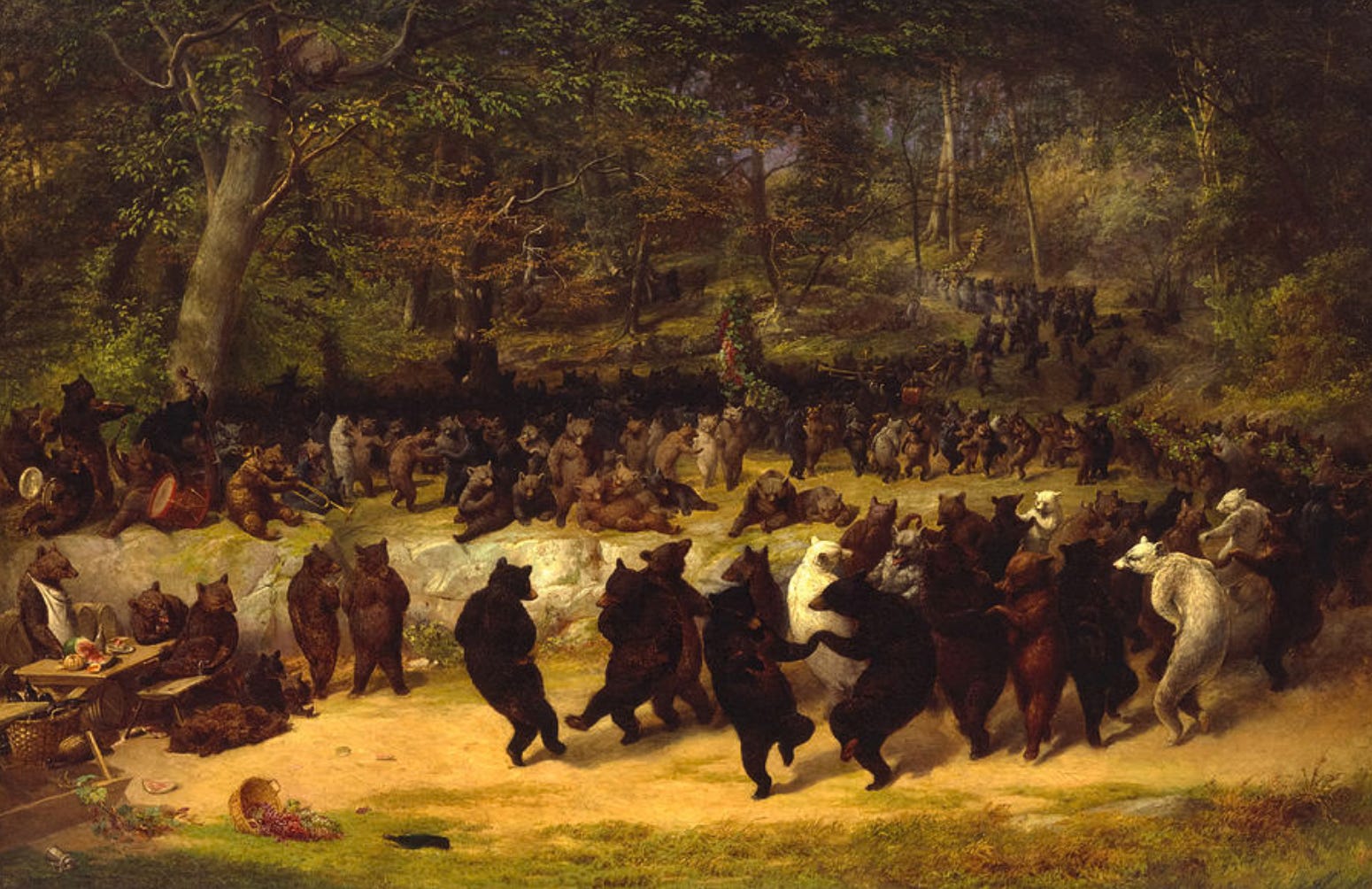
We paired this piece with The Bear Dance by William Holbrook Beard1, a wild painting depicting bears at a picnic dancing in a circle as some of them play instruments while others watch from trees or just…be bears. I love art like this because it feels so sweetly ridiculous and sincere at the same time. And that I think is the same spirit in which in which Glasgow’s essay ought to be held and read. This lush fixation, a lush fixation, a gathering of everything bear can hold, come alive through language and the ineluctable attempt to define and understand.
Image: The Bear Dance © William Holbrook Beard. Used for editorial commentary purposes only. All rights reserved.
"Still in my mother’s maw, she carries me across any road to anytime but now. Here I am eating bear-caught salmon off a chipped plate with a fleur-de-lys that I won’t relinquish because of who gave it to me. I feel like the river’s skeleton picked clean."
Bearing witness to the gems that can be discovered on Substack when you are not seeking or expecting them.
Bear with axe, bear in flannel and tight denim made me laugh (out loud, mind you.) and then somehow two lines later I was fully gone over river skeletons and chipped plates and mothers carrying what they can...