



Hello fellow strange pilgrims, I hope you’re having a calming week and there is both the warmth of Summer and its stillness too. Do take some time out in your evenings or mornings to read this week’s piece (and/or listen to Amanda’s wonderful recording of it). I’m sure it’ll transport you across worlds like it did us but also shake you up in the soul (we can all use that here and again).



As the cicadas moved north, so too did humanity. Every channel in every country played the same images on a loop, the same thirty seconds of footage caught by a drone humming iridescently over the destruction. The road clogged with cars, the vast roiled sea formerly known as the South’s most populous city, the roof eaves poking out of the murk like tentative frogs. And not one county over that swatch of cracked earth, colorless and sighing, trees sapped. It was an incongruous patchwork. It was a time thick with mosquitoes and dread. A state of emergency had been declared, but who was left to heed the warnings? Everyone agreed, flood or drought, the South was uninhabitably hot. Migration was all the rage. Surely the seasons had lost their train of thought.
The North didn’t know what to think about this sudden influx. They were used to living in close quarters, huddled for warmth in palimpsest cities that creaked with history. But this was a bridge too far. Some said let the newcomers try our winter on for size. And laughed. Others remembered the terrible years, they shuddered to name them, the crisis was too newly buried. But the mere mention was wreathed in bitterness. The aura of irony shimmered. Hadn’t the South sent the North its migrants, poor souls fleeing their own varieties of calamity even farther south? Hadn’t the South then invaded the North under the guise of border protection, terrorizing everyone regardless of status? Never mind, never mind. Let the textbooks make of those years what they will.
Now, though, it was summer and the cicadas were making a racket. The Mogul wouldn’t stand for being upstaged by an insect. It was horrible. No one had ever been treated so unfairly. The Mogul pitched his voice to carry above the clamor. It was horrible, all these big beautiful cities overrun with migrants, who were really good people, really fine people, but these cities, all that crime, the homelessness and overcrowding, they’d become shitholes, they had no stores, you couldn’t even go out to eat at the restaurants, he proclaimed he would build a building, a big beautiful building, he was a builder, he built things, tremendous things, people were always coming up to him, tears in their eyes, they said no one built buildings as big and beautiful as he did, he said with that voice like a street at winter’s end, all salt-encrusted and pitted with potholes, that he alone could fix the mess these cities of the North were in, he would build a building bigger and more beautiful than any other building in the world, the tallest, it would house the entire population of migrants from the South, they were such fine people, they deserved the best, they didn’t want to live in these run-down remnants of the past, let the Northerners have their rowhouses and old gnarled trees and crumbling brick streets, his building would be tall and beautiful and it would be made of smooth marble and gleam gold, bring back the sun these poor souls had left behind in the South, because they were, in fact, really fine people, it would be the tallest and most beautiful building in the world, he vowed. Somewhere in the distance a cicada screamed.
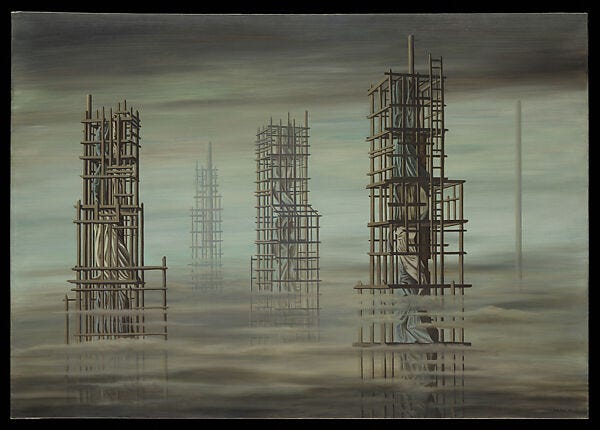
For a year, the crane became a fixture of the skyline. Its etched silhouette had a vague, unreachable appearance, especially at sunset. A steel volcano crooked over the city and presiding. The construction crews worked day and night. They wielded tools that spit comet tails. Soldering day and night together they made a racket that rivaled the cicadas’ urgent whine. The protesters gathered around the base of the crane wielded cardboard signs and thumped on drums. In contrast with the crane, they had a fluid presence but abiding as a river. Various members of the throng came and went chanting down-with-tyranny, the-water-is-rising-and-so-are-we, tax-the-rich, and other indecipherable demands. Still, the tower kept growing, spiraling toward the unreachable crane. The sidewalk thickened with skirmishes: Between the protesters and police. Between the protesters and counter-protesters. Between the counter-protesters and police. And then, eventually, between the police and disinterested bystanders just waiting for the bus. There was a persistent cloud of tear gas. Reporters ignored the skirmishes and announced the tower’s current height nightly on the news, but every channel reported a different figure. No one noticed the precise day language was lost. Or if they did, they didn’t have the words to record the event. It was a strange and unprecedented Tower of Babel. A confusion born not of languages multiplying but of one language bled dry. Words weaponized until exhausted of all meaning. Without a common understanding, truth took on the jaundiced cast of tear gas. Reality felt nebulous and burned the eyes.
The Mayor thought that what her city desperately needed was empathy. But she lacked the higher authority of dictionaries and wasn’t sure what she meant by that. Empathy, she decided, had gone the way of the rotary telephone. The now-completed tower had hallowed out. People who’d flocked to it and plunked down sky-high down payments wanted nothing to do with the place. Wars raged in every corner of its marble-clad halls. This is how one of these skirmishes might start: At 3:45 in the morning, one resident would bang on his neighbor’s door. Keep it down, I’m trying to sleep. The neighbor, let’s call her Neighbor B, would blink her eyes uncomprehendingly. I’m just living my life, you’re the one who’s banging on the door, what about your TV blasting at all hours of the day, I can’t hear myself think, haven’t slept a wink since you moved in, and she’d slam the door in his face. Slam drawers and doors, just to make her point. Neighbor A would respond in kind, until eventually, an arms race of noise erupted. No pair of apartments was spared. The Mayor, who lived on the tenth floor, couldn’t get the word empathy out of her head. She thought that empathy could save them all, if only they hadn’t lost the meaning humming inside words that made the empathy possible.
Now, though, it was summer and the cicadas were making a racket. The Translator was attuned to their rhythms, both the frayed throb of their so-called song (it was, after all, just that one gnawing note) and their annual cycle of emergence and death. And she orchestrated her life accordingly. Each year, the avant-garde cicada would rustle out of its subterranean darkness to test the waters. To the Translator, that first corrosive wail always sounded like a question mark: anybody there? But it was her cue to scurry underground. She’d made her peace with the centripetal force the seasons exerted on her body. She saw poetry in it. How the wheel of the seasons mirrored her brain’s currents, whirlpools really, which the doctors had pronounced…diseased? defective? disabled? The words gnawed like the cicada’s song. She imagined fractals, submerged and flaring iridescently. All she knew was that certain sounds took a roundabout route through her neural pathways, looping instead of subsiding. The so-called song, for example. She heard it throbbing in her ears during the still of day, would lose her own whereabouts for a time. The Translator adapted by migrating down into her basement where she couldn’t hear much of anything. Like some antipodean cicada, if such a thing existed.
At first, this forced migration made her lonely, every time the Translator told someone I can’t, I have to disappear for the summer, she felt the fist of isolation closing. Until she tried saying it like this: It’s summer, and I’m going underground. And then she felt revolutionary. The Translator was attuned to words, to their rhythms and stories and textures, she thought words and cicadas were at once heavy and insignificant, awesome and terrifying, she liked the way you could string words together, make them sing sigh grate rustle gnaw wail burble plop explode. The word revolutionary, for example. The lilt of its vaulting vowels, its submerged history. Originally referring to the orbital movements of the heavens, but the word, a stone in rushing water, had been worn by the centuries and polished smooth. The Translator preferred this original meaning, she saw poetry in it, perhaps she’d even been forged in its likeness, her brain full of repetitions and seasons and celestial bodies orbiting, and she spoke the syllables as though in possession of a secret. But in a leap of association, she said it’s summer, and I’m going underground, and in the political sense this, too, was revolutionary. Like the Dostoevsky story. If all around her was noise, of towers spiraling skyward, of tools spitting comet tails, of neighbors on marble-clad floors above the clouds slamming doors, then going underground was a subversive act.
Above-ground the so-called song billowed, becoming hard and knotted as a tree trunk. The Mayor still couldn’t get the word empathy out of her head. It, and not the cicadas, kept her up at night. The tower had toppled into all-out war, its battles had spilled into the streets. On the sidewalks battle lines bled together, protesters counter-protesters police residents bystanders coalesced into one incomprehensible cacophony. Slowly the waters parted, North versus South. A fierce clamoring for resources which the newspapers might have called a housing crisis, if they weren’t all defunct. At midnight, as the roar down below crested, the Mayor got out of bed, opened her computer and, in the flash of aurora borealis across her face, typed empathy into the search engine. Her finger hovered over the Enter key, her eyes perched on the Translate function. A translator, of course, now that was what her city desperately needed. Someone to translate the word empathy. To unearth meaning, that yearning between battle lines. Someone to carry across.
The Translator received the Mayor’s email on one of her difficult days. She mustered a brief but earnest reply: Come. You are welcome down here. On the agreed-upon day, the Mayor stood on the Translator’s doorstep, a little bungalow veiled with shade trees. The door was opened to silence, the Translator gesturing and a staircase stretching down. Only when the two had reached the basement did the Translator urge the Mayor on with her eyes, kind eyes disinclined to make excuses or offer explanations but grateful for the visit. The Mayor launched into the events that had brought her here, and as she spoke she felt a burden uncoiling. She finished in a rush, exhaling a question she hadn’t thought to ask before she’d come: Will you, can you, restore the language we’ve lost? The Translator’s head dipped thoughtfully, her hands cupped in her lap. Instead of answering the question she looked up and spoke of her disability, her voice took its time, like a fresh breeze blowing, grave but vulnerable, accepting. She said: I cannot but hear. She said hearing, for me, is painful and also beautiful. She said language is like that. She said to restore language, you must create a new language, a language that returns to sound, circling back, like the seasons, like the cicadas, circling in order to be reborn. She said words are bodies, you have to listen to every creak and shudder, listen with your ears and then with your body, listen to the repetitions. You will discern patterns there.
When the Mayor emerged, she discovered she heard more acutely. Standing on the Translator’s doorstep, her chest rising and falling in the key of C Major. Sheer, hushed, breath rushing in, out. Gusts of blush-colored wind rushing in, out, and brushing the hairs on her arm. And the cicadas droning wha-wha-what did the Translator mean, she wondered iridescently. Standing on the Translator’s doorstep, bereft and beginning again, wha-wha-what does it all mean? She didn’t know, was beginning to know. Crunch, took one step forward. Crunch, then another. Crunch, her soles sliding on gravel. The strap of her bag dug into her knotted shoulder. Just then the bus sailed up on a puff and a gust, smudgy gray urgency. She felt that too, the diesel scream, key of C Minor? She heard the rattle of diesel and metal in her chest, in the knots in her neck. Taut thud of thunder, doors urgently opened. Wha-wha-was beginning to understand. Laughing, whose laughter, hers or the passengers’ spilling out of the bus? The Mayor laughed, the passengers laughed, the bus laughed, haaaaaah, deep diesel exhale and thud, doors closed. With a shriek and a groan, the bus pulled away. The Mayor walked, just walked, step crunch step crunch. Past mowers moaning, rattle of metal and diesel. Past angle grinders wailing, their syncopated sparks singed the hairs on her neck. The hiccup of a basketball trailing down the sidewalk. The Mayor surrendered to its rhythm. The Mayor was a totality of taut strings. The Mayor breathed aloud, now I understand, and laughed. As she reached the tower door, she felt the shiver of an idea forming. Somewhere in the distance, the last cicada trailed off. She looked up and noticed the leaves beginning to turn.
The following summer, the crane appeared once more on the skyline, mobilized this time to demolish. As it peeled off the layers of steel, clawed through marble-clad floors, and wrenched the gold filigree from the moldings and fixtures, the crane assumed the pose of a praying mantis, hungry and skeletal and whipping around ready to strike. The entire city suffered from a ringing in the ears. Of cicadas gnawing, of cranes gnawing and grating at steel, of angle grinders grating and spitting sparks. At the Mayor’s urging, the cranes had multiplied, buildings sprang up like saplings, tall but modest, aspiring only to prominence, nothing more. It turned out the tower’s capacity had been wildly exaggerated. But the new edifices, smaller yet legion, overshadowed their predecessor, housing among them the whole of the migrant population and then some. The housing crisis was at an end. The trick, the Mayor had revealed when announcing her plan, was to build up as ambitiously as they burrowed down. “Go underground” transformed into revolutionary slogan, plastered on billboards and trumpeted on TV commercials, and everyone understood the meaning bristling inside those two words, grasped the repudiation of the tower and everything it stood for. Architects bent heads and conferred, drafting new building codes to accomplish the Mayor’s plan. She’d insisted on rigorous soundproofing. Make the apartments as snug as cicadas in winter, both above-ground and below, she was heard to demand. So often that all of city government had cicadas on the brain.
Now, in the spring, the sidewalk is thinning of protesters. The Translator awakens in her two-floor apartment that straddles ground level, one floor up, one floor down. She peers out the window in the whisper of silence just before the cranes awaken. And in that silence, she discerns a fluttering in her chest that hems and hums and she’s certain there must be a word for that sensation but can’t seem to grab hold of one. Never mind, she will invent it, she thinks. And listens.

1.
Tell us your origin story as a writer. When did you begin? What first drew you to writing as an instrument for asking questions that can’t be explored any other way?
AMANDA SARASIEN: I began writing from a young age, shortly after learning to read, so I can’t quite remember what drew me to this form of expression other than a burning desire to answer the books I’d read and loved, as though we were in conversation. While I do practice other visual art forms, I think I’ve always been innately verbal. Much of my work, though, is an attempt to push at boundaries – between mediums, between genres, between languages. I’m not sure I do find that writing asks questions that can’t be explored any other way; I simply gravitate more toward text, sound, syntax, and I’m always thinking about how to make the structures of language do more, spill into other sensory possibilities.
As a pre-teen, I started to teach myself foreign languages to enhance the realism of my writing. I never set out to be a writer, or at least not a published writer, which is what I understood the word to mean. But after studying languages in college, I went on to work in international manufacturing, still writing in my free time. An acquired disability took me out of that career path and into literary translation. It’s only through literary translation that I feel I really became a writer, much in the way Walter Benjamin argues that a translation creates its original.

2.
What does your writing routine look like? Do you thrive in structure or wildness? And when you begin a piece of writing, what tends to announce itself first: a voice, an image, an unease, a philosophical conundrum?
AS: I may start with a first line that materializes so clearly in my mind that everything else forms around it. Or it may be an unease, yes, a feeling of the uncanny in the world around me that I can only put my finger on through writing. Or, in the case of my nonfiction writing, I may just have something to say, an idea I need to take for an essayistic walk, like my beagle, her nose to the ground, or it will just keep circling inside my head, clamoring for attention.
I usually spend weeks or months filling notebooks with impressions, story arcs, character flaws, questions. I like to write them by hand, intelligible only to me, but lately I’ve taken to putting them in my phone just to capture the thought before it flees. I won’t start writing until the notes become so urgent and overwhelming that I have a visceral sense it’s going to come pouring out of me. Especially if what announces itself is a first line, I feel I need to put fingers to keyboard just to free myself of the burden of the ideas. From there, I tend to have a bit more structured approach, counting words, editing as I go along, pushing myself to keep writing each day so I don’t lose the thread. Deadlines are a constraint that I sometimes use to great effect.
3.
Most artists are preoccupied by certain obsessions: lust, longing, death, the self. What persistent preoccupation—emotional, intellectual, or spiritual—threads through your work? Are there motifs, themes, or impulses you’ve tried to abandon but that keep returning, insisting on their relevance?
AS: I’m interested in language itself: how identity shapes the way we use and understand language, how the language we use and understand shapes identity. Especially language as an embodied form, capable of being experienced as a rhythm, a texture, an image, an architecture. And because language is so intimately bound up in embodiment, I’m also fascinated by its limitations to convey things like pain or individual sensory perception - the isolation wrought by language - and yet without language, we would be more isolated, wordless worldless silent selves. I’ve been told there’s an electric current of aloneness running through all my work.
4.
If not a writer, who would you be?
AS: I’m many other things besides a writer: I’m a translator, an editor, an artist, an interpreter. But would I be any of those things without writing? Probably not.
Perhaps I would be an archaeologist. I’ve always had a fascination with layers and palimpsest and transporting myself into lost or distant worlds. But archaeology, too, is narrative.
5.
What’s the best piece of writing advice you’ve ever received? Alternatively/additionally, what’s something you’d like to offer as advice to emerging writers trying to make a mark?
AS: It may sound a bit trite, but read. Read widely, read in translation because it exposes you to the bristling possibilities of difference, read until you develop a certain muscle memory for the acrobatics of a sentence.
6.
What are you working on now and how is it trying to ruin your life (in a good, necessary way, of course)?
AS: At the moment I’m in that amorphous note-taking stage I described earlier, for a domestic gothic novel set in a multi-family building. I don’t know much more than that except that I want to explore the uncanny psychogeography of urban life, the way it throws us together with complete strangers who, paradoxically, we come to know better than our closest friends and family, even as they remain ominously alien to us.
Translation, meanwhile, is my daily writing practice. I’ve got several projects at various stages of completion while I pitch them to publishers, including a French New Wave novel brimming with slang, wordplay, and invented etymologies; and a Brazilian novel that weaves together historical fiction and magical realism, about a rape survivor coming of age during the military dictatorship, who goes on fantastic adventures with a mystical black horse.
7.
Who are the artists—writers, filmmakers, thinkers, internet oddities—that have shaped your sense of narrative? How have they rearranged the way you see the world on the page?
AS: I’d be hard-pressed to choose even a handful; really I take something from every piece of art I’m exposed to, whether consciously or unconsciously. A sense of narrative is to my mind something that grows out of a compendium of all the reading, writing, film-watching, music-listening, art-viewing, theater-going, storytelling work a person does over their entire lifetime.
8.
Please recommend a piece of art (a painting, a film, an album, anything that’s not a piece of creative writing, really) that you love and would like everyone to experience.
AS: One of the paintings I used to love getting lost in at the Indianapolis Museum of Art was Odilon Redon’s The Yellow Sail. I think they’ve since taken it off view, but I could recommend any of Odilon Redon’s boat paintings. They’re mysterious and transportive, and I love the way the artist depicts faces wrenched with emotion despite, or perhaps because of, their blurred, anonymous outlines.
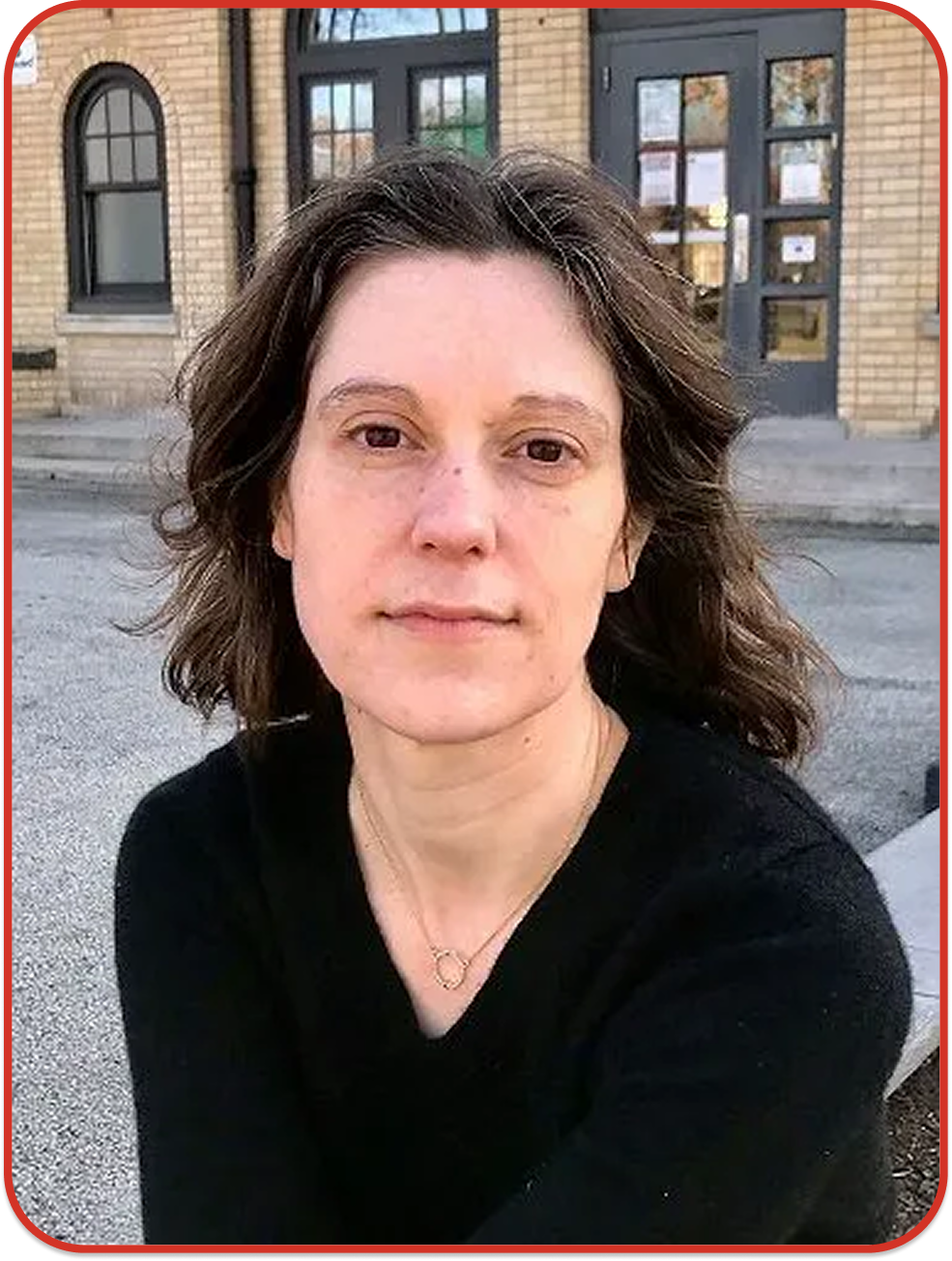
AMANDA SARASIEN is a writer and literary translator working from French and Portuguese into English. A recipient of a 2022 National Endowment for the Arts Translation Fellowship, her work has appeared in The Common, The Massachusetts Review, West Branch, Chicago Review of Books, Electric Literature, and elsewhere. Her translation of Brazilian author Állex Leilla’s novel Springtime in the Bones was published in spring 2026. She is past co-chair of the PEN America Translation Committee and lives in Chicago.
Gorgeous writing, from a bright (BRIGHT:) mind playing with words, worlds, sounds, cadences, and connotations - a joy to read. The author interview at the end, also deliciously thoughtful. Found Amanda Sarasien's website and subscribed.
What an astounding piece of writing. Woven motifs, contemporary relevance, gorgeous and experimental prose. I could see this being studied in classes alongside stories like “There Will Come Soft Rains” and “Twilight of Superheroes.”