Hello fellow strange pilgrims, thank you for taking some time out of your busy lives for loving literature, and not just literature of the past that has survived the decades and centuries, but literature being created and written today, literature that is staggering in its beauty just as and sometimes more than the classics (gasps all around, yes).
I love the classics, I love fairytales, I love good books of yore or even a few years or decades past. And yet, isn’t there a special kind of beauty and wonder that comes with engaging with minds alive right now, their stories born of experiences that you too might have brushed up against?
I welcome you to dive into Margaret’s beautiful story, one that blends time and narrative seamlessly and invites you in from the very first line. Do remember that we have audio that accompanies most of our fiction and nonfiction here and usually in the author’s own voice, as today! Enjoy, dear ones!



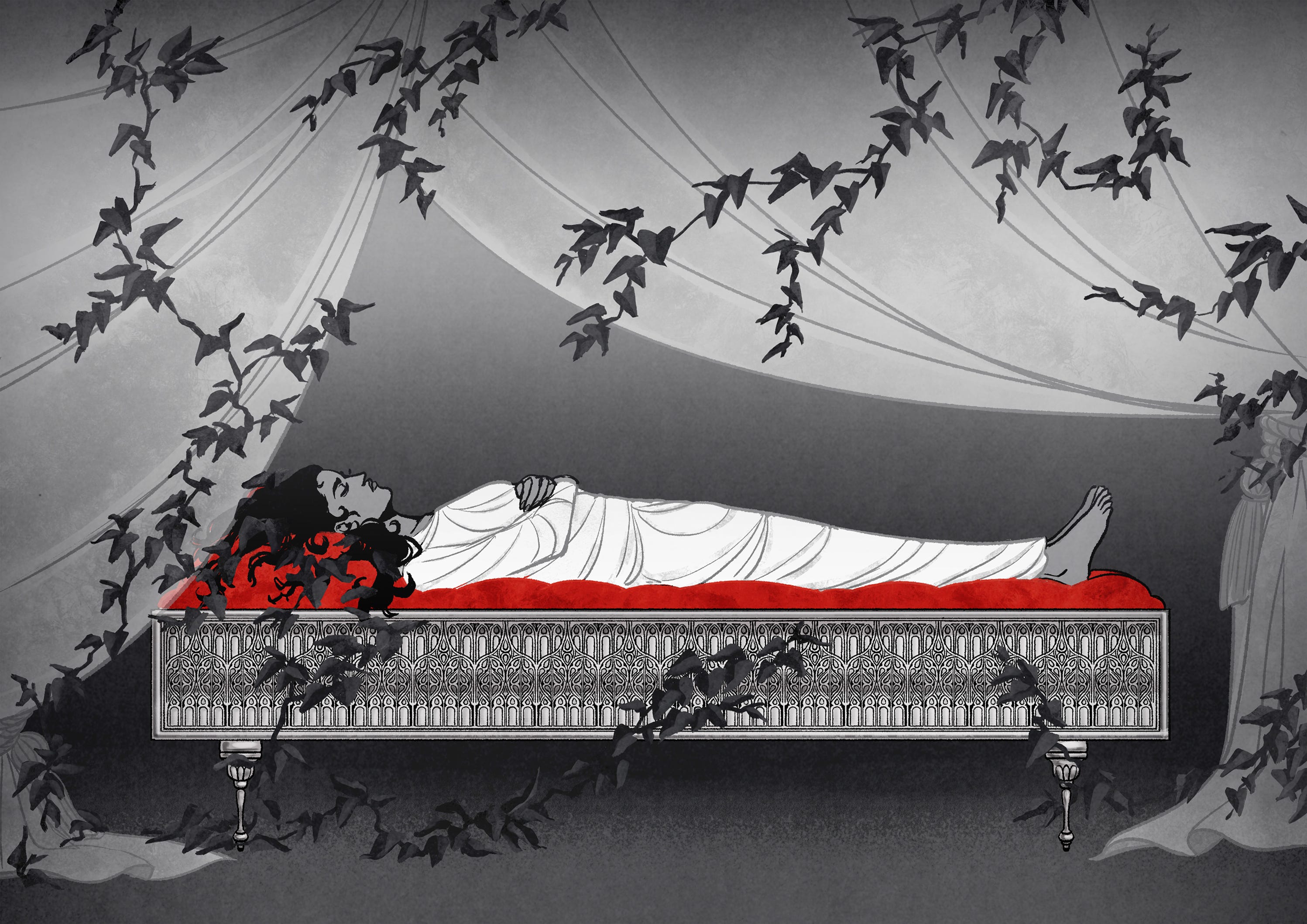
Time bends when the princess pricks her finger. Suddenly overcome, she lays down on the bed of cool silver. As she falls into slumber, time slows to a still. Yet for the realm, it accelerates. Before her blood dries on the spindle, the ocean begins to boil. A great wave rises. It shatters ships, smashing hulls against the shore. Seawalls crumble. Fields turn into rivers. But the princess’s tower stands strong. And soon the destruction ends. The water recedes and life sparks. Saplings rise to giants—pines, elms, oaks—with branches so thick they block the sun. Plumes of aspergillus and bristly creeper vines climb to the tower’s highest windows and cluster in the tree canopy, surging to catch the last glimmer of light as the forest enshrouds the lonely spire.
Years pass and singers and travelers carry word of the enchanted damsel to every corner of the land. Upon hearing the tale, many a knight swears he will hack through the woods, scale the ramparts, and save the princess, lifting the curse with a kiss. But none can penetrate the wilderness. A thousand try and a thousand die. The growing darkness lusts for blood. Diamond-sharp thorns pierce armor, bore into flesh. Creepers strangle throats until twisted necks snap.
Seasons cycle, dynasties decay, kingdoms fall. The stories stiffen into legend, told by winter fires. Whispered horrors breed nightmares—grave beetles swarming over rusted remains, helmets rattling faceless skulls, eaten to bone by time.
The princess has no control, the spell sets the parameters—the start, the end. Who knows if the break will come after a hundred years? It might spin for a thousand centuries more. She could wake to see the stars have shifted, the moon has shrunk like soap. For though she is bound to the planet, to the berth within the vaulted chamber, she is unbound by time, caught in the short-circuit of a night’s dream.

Lori knew she was not a princess, though she lived on the Paradise Coast of the Sunshine State and slept in a turret, with a fairytale castle nightlight, which cast orbits of suns and moons above her bed. She knew the stories her mother told did not follow the words in her picturebooks. She knew too that something was wrong with Mom, and it had to do with story-time getting shorter each night. Lori could beg to hear more, but her mother would not finish the tale of the sleeping princess. Because Mom had a new rule. Never speak the words THE END.
Lori’s father did not respect this rule. He objected so strongly that when he joined them for dinner, the rule was the subject of great argument.
“Don’t tell me I can’t say it’s the end!” he shouted.
“We have a child!” her mother shouted back.
“I’m not talking about her. Lori is separate.”
“You can’t separate Lori. And you can’t separate what’s happening to me.”
Lori felt she existed already in a separate world, since her parents acted like she was invisible. Though she was sitting right there, in the middle chair along the ocean-view side of the long dining table, while they yelled from opposite extremes.
At least there were advantages to not being seen. When Dad pulled out his phone, said he’d just be a minute and tried to sneak out to the beach, only to be blocked by Mom, Lori scurried upstairs to her turret. No one noticed she’d left and hadn’t touched her food.
There were disadvantages too. Either her parents weren’t aware or they didn’t care that their voices soared to the ceiling beams, ricocheting off the shiny steel appliances and sharp-edged granite countertops. Mashing a pillow over her ears couldn’t muffle the sound.
Late into the night, she heard her mother plead, “You know what the doctors said. I need you, we need you. Here.”
“I’m here as much as I can,” her father answered. Then came the slam of the front door and the screech of his sports car peeling out of the driveway.
Mom broke into sobs, stepped out of her heels and shuffled down the hallway to the oversized bedroom that was never intended for a single adult. Not to sleep, but to lose herself in workout videos, travel shows. The pounding of her feet and the bass-heavy soundtracks rumbled through the house until dawn.
Then it was finally safe for Lori to sink into dreamland. But before she did, she slipped out of bed and looked down from the railing outside her room. The rosy light coming through the clerestory windows gave the pendant lamps hanging below an electric pink sheen, the same color as her walls. And beneath them, on the dining table, the remains of their meal seemed suspended in time—forks stood in humps of steak, a serving spoon crusted in the risotto. The table was driftwood. Sanded and polished, it’d once been the side of a fishing boat wrecked in a storm. That was her father’s story. Her mother’s version: Long ago it was a Spanish Galleon, a section of the hull. The ship sank to the bottom of the sea, weighted with stolen gold.
One night the yelling stopped yet the front door did not slam. Curious, Lori padded down the floating stairs. Guided by moonlight from the high windows and static sparks from her socks on the carpet, she crept along the hall. The door of her parents’ room was ajar. An amber shaft lit the toothed leaves and fishtail patterns at the rug’s edges. Unlike other investigations she’d conducted when Dad followed Mom into the room, she heard no thumps from lofted shoes or phones. Could they be asleep?
There were murmurs. Gasps. She scratched on the door. Were they hurt? The noises were so strange, she couldn’t tell. Snorts. squeals. She scraped louder, expecting an angry hiss: Go back to bed! But instead she heard a whelp. Then a howl.
Lori had to know. Were they cries of pain? Crunching her hands into fists, she looked. Sheets, clothes, pillows had been flung to the walls, and on the platform bed were arching, clawing beasts. Not her parents. Not anymore. The man-monster’s ears were tipped, erect, covered with black hair. Grinding snarls slipped through his long, glinting teeth. Smoke coiled from the woman-creature’s gaping mouth, and when her eyes flicked open, unseeing, Lori saw luminous yellow. Slit pupils glistened. Snake-like.
Lori ran so fast she almost fell. But she made it to her room. With the door closed, panting, she curled under her blanket, too scared to sleep. Then she felt a queer caress. She sensed channels opening. In her mind. Glowing filaments pushed up from the floorboards, swarmed over the sheets. They licked her ears and cheeks. A thousand soft-tongued mouths told her to go back downstairs. Not to spy on her parents. To escape.
Only snores came from the hallway. Lori felt no fear crossing the kitchen to slide open the glass doors to the deck. Under the gibbous moon, she hopped from paver to paver, dashed through the gate, and out onto the beach. On her back, in the wet sand, sea foam lapping at her toes, she giggled while papillae poked up around her. Silver strands rose from the lazy waves and glinted in the pale light as they stretched to carve grooves in her ears. So she could understand the secret languages. A sacred quiet settled as the tendrils worked into her brain, weaving patterns in the sclera of her eyes—spells and formulae. Suddenly, she could touch the peaks and valleys of the moon, hear the strum of the stars. She dropped from the ground and fell into a fathomless darkness.
A period of peace spread out for the family. They ordered pizza and watched TV. Then Mom and Dad went to bed early to transform, and slept, even her mother, till noon. In fact, Mom never quite seemed awake, just stumbled in a dreamy stupor. Lori was grateful for this calm, for it allowed her new desire to grow. The desire to steal time. The tendrils sang: Steal the night while others slumber. For only in the dark will you see the true shape of things.
Looking back when she was older, Lori wondered how long the peace lasted. A month, maybe. Long enough for her to feel buoyed by hope. In school, she stepped out of her usual sleepwalk and volunteered answers, even demonstrated on the whiteboard how to solve a multiplication problem involving fractions that stumped the other students. But soon arguments at home erupted again. More violent than ever. Mom yanked a hot dish of lasagna from the oven, whirled toward Dad and threw it at his feet. He jumped in time to save his toes. “This is the end,” he said. Then he got in his sports car, drove away, and did not return the following day.
After that, there was no more quiet, at night or at any time. Mom had entirely lost the ability to sleep. This meant the TV blaring 24/7 with ice-skating competitions, cooking shows, and rom-coms. Mom shouting and cursing at them. Lori returned from her last day of third grade to find half-eaten tubs of pistachio gelato melting on the countertops as Mom screamed at her phone and threw it against the glass doors over and over, until a long crack split the view of the sunset over the sea.
Strangely, the crack released something. That night was magical, the best time the two ever had. Lori wanted it to last forever. They ate twenty-seven cupcakes with silver sprinkles. They watched nine princess movies—with Mom live-altering, rescripting every scene. They swam in the surf and danced on the beach, then made sand angels while they sang to the stars and counted as the dawn pinched out each one. Only when the sun burned high did Lori finally fall asleep.
She thought she woke up wrong, or in the wrong world. In the searing light, her father held her tight to his chest as he carried her up the driveway. He put her down gently on the lip of the sidewalk, and when he was sure she could stand on her own, rested his arm like a mantle on her shoulders. It took a minute for her eyes to focus. She saw spinning red lights but it wasn’t until she heard screams slurring into gurgles that Lori understood her mother was strapped to a gurney and being loaded into an ambulance. Dad told her the proteins in Mom’s brain were folding wrong, the result of a genetic jinx. There was no cure and her treatment was no longer working. “It’s a blessing she had the stroke.” He smoothed Lori’s hair. “We need to let her sleep.”
On the drive along the causeway to the island where Dad and Evil Stepmother lived, Lori tried to blind herself to the glittering sand and white-capped turquoise sea. The mirrored lenses she pressed to her eyes were the darkest they had in the pro shop. (Stepmother demanded they stop there to buy Lori clothes and equipment for Tennis Camp.) Lori wanted protection from the brightness because it brought her back to the hospital, to the body that had been her mother. Swollen from sepsis, mucus-yellow vines encoiled its arms, accordion-ridged snakes bore into its throat and mouth. Blips from the hyper-bright LEDs overhead shone in its sightless, staring eyes.
Lori’s new room, a former attic storage space, was on the top floor. She was happy about that. It was what she was used to. But she didn’t like the flat ceiling. It wasn’t a cone like her turret, so her nightlight’s moons and suns didn’t spiral into infinity anymore, just shifted from left to right. And she loathed the color. Instead of the electric pink she’d requested, it was painted a pasty grayish-blue. The same as the waiting area in the hospital.
“It’s more calming,” said Stepmother. “So you can fall asleep.” But Lori couldn’t sleep at night, even when dinners ended with fresh mango sprinkled with pomegranate seeds and Dad tucked her in. Even when Stepmother set the climate control in the attic for sixty-six degrees (though it was summer and the air outside a humid ninety-two). Stepmother’s goal was clear. Lori must be shut in a low-ceilinged refrigerator and weighted down with quilts and comforters so Stepmother could impress her will. Shape the wild girl into the young lady she should want to be.
Lori resented this, yet she might have surrendered had she not snuck out and seen the mangroves. Through the late hours they shimmered with bioluminous plankton while night-fishing pelicans beat the air with heavy wings. Not even the rising tide of mosquitos made Lori turn back inside. She watched until shining fingers tore through purple clouds and let loose the sun. Then her eyelids unfurled like petals, and she slipped into golden slumber.
Stepmother found her asleep on the beach, in only a t-shirt and underwear, tangled hair filthy with seaweed and sand. Stepmother’s face tightened and reddened. She shouted that it was Day One of Tennis Camp and Lori must be washed and dressed and delivered on time.
Nicholas, the houseman, delivered her. Late. That day and the next. Which made Stepmother late for barre class and lunch and appointments with dermatologists and decorators. As weeks went by, Stepmother was late planning menus and writing grocery lists for Nicholas, who was often himself detained since the girl now required constant supervision, lest she wander into Pine Island Sound and drown. (Lori had been expelled from camp on Day Three, after she dropped her racket mid-serve and passed-out dead asleep on the court.) Dad complained that cocktails and appetizers weren’t ready when he got home. One terrible night, dinner wasn’t served until nine.
Most importantly, Stepmother was not getting her beauty sleep. Her job was to be beautiful and to create a beautiful life for Lori’s father, which necessitated eight hours rest. Lori hated Stepmother’s beauty, her large eyes and long dark hair. Hair like her mother’s, in an old photo Lori remembered, with Dad’s arms around Mom and her arms around a baby Lori. The picture was lost, Lori had looked everywhere. Stepmother must have tossed it into the sea, to join Mom’s ashes. Lori could have eventually forgiven Stepmother for that (there was no proof) but she could never forgive Stepmom for being what she was: a younger, skinnier, dumber replacement for her mother.
Years later, Lori felt more sympathy. She imagined her stepmother could see how Lori saw her. And Lori’s refusal to go to bed meant she had no respite from judgement. Dad was upset about the situation too. He couldn’t perform well at work if routines were disturbed. “At least it’s still summer. We’ve got time to fix this before school starts,” he said.
So the family went to see Dr. Sandford, who locked Lori in a bright room where women with latex gloves strapped her to a high-backed chair, snipped with cold scissors and shaved with an angry electric razor until all her long dark hair snaked around the base on the plastic-protected floor. Then they took Lori to a white-violet room and sat her on a paper-lined platform while they drew dots on her scalp. Shivering, kicking her legs, Lori tried not to cry. Sandford entered with a black plastic cap that had wires and sensors inside. “This might itch,” he said as he pulled it over her scalp and forehead, almost to her eyes.
Lori felt biting teeth. Then Sandford blocked her sight with a blind-visor and put headphones on her ears. “Listen,” he instructed, guiding her to lie back. A noise hive rose. “Let yourself float away,” he commanded before closing the door. Lori stayed docked and did not float away. The visor baked her eyes, the noise burned her ears. Five minutes was more than she could take. She ripped off the visor and the headphones and tore the electrodes from her skin. She got up and tried the cold, brushed-silver knob. It was unlocked.
Supporting shaky legs by feeling the walls, she turned a blue-white corner and heard Dr. Sandford explaining to Dad and Stepmother that if they gave in to Lori’s demands, let her sleep and wake whenever she liked, the girl would be doomed to an unproductive, asynchronous future. Sleep patterns corrupted in childhood result in deviant rhythms as an adult, and crucially, an inability to conform to the Hours of Business. Lori’s life and career choices would be limited, which typically led to mental illness and premature death. Sandford prescribed pediatric zolpidem and when it had no effect, Dad held her head as Stepmother clamped one nostril shut and shot chloral hydrate up her nose.
But before blackness swallowed her, Lori saw a glimmer, a tiny iris. Rising and falling chords streamed through, harmony, dissonance. The singing tongues would save her, a concert of demon frequencies. Wave after wave. Her neurons thrummed, seeding kerneled spells. Powerful geometries took root. Progressions of the number three.
Lori didn’t realize how strong the curse would be. It was August first, her ninth birthday, which was also Dad and Stepmother’s third anniversary. (The number of years added a sting, for they revealed the length of her father’s betrayal.) The two had plans to drive to the mainland for a performance of Macbeth followed by dinner at Chez Aurore. Stepmother had been a theater major and played Lady Macbeth herself. And though Lori did get to blow out nine candles on her high-protein, low-carb waffle at breakfast, there was no promise of a cake. Her one present: green silk pajamas identical at smaller scale to Stepmom’s.
A moment occurred that might have saved them. Dad mentioned Hurricane Trey, the possibility it could hit that night. But Stepmother checked her phone and stated confidently the storm wouldn’t arrive until morning. And no matter what, Stepmother wouldn’t let anything spoil their date. Lori rushed to hug her father before they left. He laughed and ran a hand over her fuzzy head but didn’t pick her up or extend the embrace. “What’s all this?” he asked, straightening. “We’ll see you in a couple hours, darlin’.”
Promptly at eight-thirty, Nicholas escorted Lori from the downstairs computer room, where she’d been tracking weather predictions, up to the attic to commence Sandford’s prescribed nightly regime. Teeth-brushing, face-washing complete, Lori dutifully opened her mouth and Nicholas placed a pastel blue pill with the letter S (for Silenda Pharmaceuticals) on her tongue. Lori sipped from the water glass he handed her, appeared to swallow, then climbed into bed, rising up partially so he could secure the electrode cap that connected her to the doctor’s neurofeedback device—the Generative Encephalography Module or GEM. After Nicholas had closed the door behind him and left her in darkness, apart from the glow of her fairytale castle nightlight and the dimmed display of the humming GEM unit, Lori turned to her side and spat out the pill.
The tongues branched through her brain. She’d learned to use them in new ways, her knowledge enlarged from the internet, the ultimate grimoire. Specifically, she found out that to conjure an entity, you must know the spirit’s true name and purpose. And she learned GEM was not just the name of a machine, it was the root of Gemory, the Queen of the Great Abyss, a time demon who could speed or halt events: slow or quicken a woman’s womb, bring late or early death, spin winds faster or clear the skies. Nine, ten, eleven o’clock passed. Lori’s alpha and beta brainwaves dispersed as massive theta waves crested. Like the sea in San Carlos Bay.
Lori watched dark wings spread across the sky. She heard cracked voices call upon thunder, lighting, and rain. Power over Winds and Seas coursed through her small limbs as she conjured devastating rotations. Seventy-five, eighty, ninety miles an hour churned the depths. At two minutes to midnight, Dad and Evil Stepmother sped along the causeway, returning home from Chez Aurore. The lone sports car battled walls of water, towering vortices. Lori took Gemory’s silver-fingernailed hand and the gloved hand of a figure clothed in mist and the three stirred the void. An onyx mountain surged up from the pitch. It crashed down on the span. Obliteration. No! Lori cried out. The realization stabbed. Her father too, was doomed.
In mid August, before the start of the school year, Lori moved to New York to live on Roosevelt Island with her godmother. “You want to stay up all night?” Godmother asked, her stiletto heels ticking on the parquet floor. Lori nodded. “Fine,” said Godmother, as she flung back a swoop of her hair that had fallen out of place. “I don’t care. You don’t want to go to school. Fine. But I’m not teaching you. You figure it out. Get me whatever forms the Education Department needs. Tell me where to sign.”
Lori understood this was a rare chance at freedom. So, instead of demonology, she turned her mind toward deciphering the Department of Education website. She quickly discovered how to acquire a three-month absence authorization for family tragedy. But getting approval to virtually attend a school in another time zone was more involved.
She prepared the forms and printed them out, but it took a week of pestering to get busy Godmother to sign. When Lori looked, she saw she had only an hour until the twelve a.m. postmark deadline. This did not discourage her. At five after eleven she boarded the tram across the Queensboro Bridge, then transferred to the Downtown N, got off at Herald Square, and ran to the twenty-four-hour main post office branch on Eighth Avenue and 33rd Street. She stepped up to the window and handed the woman with green glasses the envelope and exactly three dollars and sixty-five cents (for return receipt). It was 11:51. Outside under the streetlamps, urine, pizza, and something smoky yet sweet hung in the air. The smells added to her exaltation. No one had questioned her, or tried to stop her. The people of this city respected responsible nine-year-olds who understood postal rates and transit systems. “I love this place!” she shouted, and heard an unseen “Fuck yeah!” in response.
Staring out the scratched windows of the tram heading back over the East River, Lori gazed at an inverted sky. Along the striped water, the lights of the buildings looked like clustered stars. Godmother returned home from an event minutes after her. “Congratulations,” she said when Lori related her success. “You want some food? Some cheese? I’m having wine…Wait! I have gelato. Pistachio. You like that?”
Lori enrolled in remote classes at a middle school in Makawao on the island of Maui in Hawaii. She was years younger than the rest of the students, having tested out of fourth and fifth grades, but this didn’t bother her. Attending from eight a.m. until two in the afternoon HST was a comfortable two p.m. to eight in the evening in New York. Godmother enjoyed explaining to her friends that Lori was “on Hawaiian time. Fits with my schedule. We have dinner at nine. She helps me clean up, then works in her room all night. Some kind of neural engineering project. I don’t know much about it, but it’s serious. She even has an advisor, this professor at City U, name is Koshmar.”
Lori continued to sleep with the cap connected to GEM, until her hair grew and the strands got caught in the sensors and the connection stopped.
The two lived happily for many years. Then Godmother’s concerns that the sea would overwhelm the city spurred her to move to Denver. “They’re detonating bombs under the polar ice shelf. To get the oil and gas and precious whatever-the-fuck else. It’s bringing down the glaciers even faster. And that tsunami system they set up is ridiculous. By the time it goes off, it’ll be way too late. Come to Denver with me.” Lori declined but gratefully accepted ownership of the lease for the apartment.
Despite the threat of a titanic wave, all seemed well until Lori’s twenty-seventh birthday. It was the age her mother was when the prionic disease was first detected (though she would not fully succumb for another six years). Godmother had explained the onset was marked by a small stroke—“She never could sleep at night. But after she had you, she tried to change. Started therapy and took pills. Which she suspected caused the first hemorrhage. It was minor, she recovered. Then she got the diagnosis. That made her really scared to sleep. Afraid she’d never wake up again.”
Lori’s mom had a mutation at codon 178 (D178N) in the PRNP gene. But this abnormality alone wouldn’t have caused her disintegration. It was the mutation combined with the wrong amino acid—methionine instead of valine at codon 129. Lori reminded herself the methionine made all the difference. Because she had inherited the same mutation—D178N on the PRNP—but did not have the corollary. Lori had safe, nurturing valine at codon number 129. Lacking this second key, the prionic monster could not break in. Yet fear remained that a distortion, a shift in genetic expression could occur. Lori felt there was no worse fate than being seized in the in-between, neither in somnus nor awake.
On Lori’s birthday, the chime on her phone woke her up, like usual, in her bed. But she found she couldn’t move. She wasn’t actually awake. She told herself she was dreaming and this would normally wake her up—a technique called rescripting. It didn’t work. She fell back into darkness and tried to claw open her eyes from within. But her lids were steel gates, rolled down, padlocked to pavement. She could not move them or open her mouth. Her panic became a soundless scream. She sensed her dead mother shaking her sleeping-child-self.
Finally, gripping the sheets, she force-ejected and jerked awake. Still rattled, she showered, brushed her teeth, got dressed, grabbed her jacket and keys. Only as she locked the door of the apartment and turned to walk to the elevator did she notice something seeping through the trim along the floor. Pushing and pulsing. Growing up and out. Mushroom gills in accelerated time. She reached for the wall to steady herself. Her fingers sunk into soft stickiness. Pulling her hand back she sniffed. Rot. She was not awake. She was trapped.
A velvet density crushed her. She felt herself shrinking, smaller and smaller until she was just a tiny, miniature Lori. Half the size of a footlight. She strained, pushing up with her back against an enormous curtain. The fabric was so heavy. But she would not be smothered. She turned and gripped it with her fingers. For days, weeks, months, using every muscle, every ounce of strength, she could barely budge it a centimeter. At last it flew up, weightless, and she woke, sweat-drenched.
She wouldn’t risk falling asleep again. But even if she hadn’t been so determined, her anxiety and tolerance for medications had risen so high that a coma-inducing knock-out might not have kept her under. She had to conquer sleep. And her old professor, Dr. Koshmar, was going to help. Koshmar was now the Head of Research for the Silenda Corporation. The company had expanded beyond pharmaceuticals to the forefront of neural adaptation and suspended animation. Moved by her proposal, Koshmar gave Lori unlimited funds to construct a lab on the 99th floor of the Silenda Building at the corner of Fifth Avenue and Central Park South. Using the structure’s solar capture cells and network of wind vacuoles, Lori powered neural processing drives, hyper-gravity centrifuges, and incubators for mycelium lines. She had everything necessary to build a revolutionary stasis capsule.
Lori took Provigil and shaved her head so she could connect with a new neural-interface modeled after Sandford’s GEM. Far more sophisticated, this GEM enabled fluid coupling on all levels of consciousness, allowing Lori’s brain to run theta and delta wave sequences that mimicked the regenerative processes of sleep and dreaming. And she refashioned the electrode-net into a sculpted jewel which showed off the contours of her skull.
As the suspension chamber neared completion, Lori never needed to descend to the city streets. She showered in the lab’s compact bathroom and sustained herself with the mycelium lines she’d cultured. Even kicked back the occasional vodka with cubes from the ice-maker. Regularly each day she spent a sleepless forty-five minutes in the suspended animation pod to make sure the interior conformed precisely to her dimensions.
Koshmar received her reports with exclamations of enthusiasm. But as the weeks passed, the reports failed to disclose the full truth. Lori’s perception was out of control. She tasted streptococci on her tongue, rothia mucilaginosa clusters coating her cheeks and festering in the crevices of her gums. Each breath brought sulfurous staph and methanethiol. She cold-showered, sucked on ice. There was no relief. Her eardrums rang and pulsed. Her heart pounded faster and faster. Then one stormy evening, every nerve shrieked.
Suddenly she realized what she was sensing. High-frequency oscillations. Precursor waves. The kind that herald a Leviathan. She checked her phone. No signal, only an emergency alert from hours earlier—WARNING: TSUNAMI. Looking out the windows, she saw nothing. Just black. A vein of lightning revealed the cityscape she knew so well, but only for an instant. Then, gone. All of Manhattan was dark. No power.
No problem. The 99th floor was sustained by its own independent supply. Lori fitted the last crome panels of the pod in place. It was beautiful, shining, the culmination of all her ambitions and desires. She could survive the deluge. She just had to fall asleep. Which would be difficult, but she had prepared. She knew she couldn’t resist forever. Now was the time. She muscle-injected midazolam, then gulped three diazepams with a beaker of vodka. Breathing deep, she pulled on the shimmering interface. Fully integrated with GEM, she no longer smelled or tasted rot. A blood release was required for activation. Lori pricked her finger, heard the chime that signaled initiation, and lay in the bed of her design. A perfect fit.
Let us travel forward.
The magic that suspends the sleeper seems ever powerful. The living cells surrounding the silver vessel divide furiously, forcing the spell to comb out sinister curls, lest a chaos of mutation be unleashed. Hyphae overbraid the mortar, stretching ever upward to bloom galaxies of spores. But, eventually, growth slows. Sunlight cracks the canopy, a ray shoots through a high window and shines into an open eye.
You’re awake, comes a voice.
A woman with long black hair and glittering cybernetic eyes the color of the night sky over the sea looks down at the sleeper. The woman is stately, a queen. Every gesture is made with purpose. The queen says she only found the chamber by chance. She was on horse, cantering by with no objective, when the wilderness parted. Vines blossomed or withered at her touch. Branches swung aside revealing a door.
“I think I’ve been asleep a long time,” says the sleeper softly, a beat between each word. As she grips the sides of the capsule and struggles to rise, awareness takes hold. Everyone and everything she knew must be long, long gone. With one possible exception. “My name is Lori.” Speaking is difficult, but Lori must ask, “Do I know you?”
I knew one named Lori. The queen’s dark eyes flash white. A thousand centuries ago. The white glow breaks into glimmers. Sparks of recognition. You are she. The queen gently grasps Lori’s wrists with silver-nailed fingers. You have not changed.
“The world has changed,” Lori says, feeling strength returning as the chamber fills with light.
It has. Come with me. I’ll show you.

1.
Tell us your origin story as a writer. When did you begin? What first drew you to writing as an instrument for asking questions that can’t be explored any other way?
MARGARET JAMESON: I liked writing long before I enjoyed reading. As a child I had problems learning to read. Letters rotated and bled into colors, sounds, and textures. Sentences only started to make sense when I realized I could use the clumps of symbols to write my own stories. In part because I read so slowly (I’d get impatient), I had little interest in the fiction I was assigned in school. Also, I didn’t feel much for the characters: so much time spent on people who seemed little more than names. No smell, no weight, no spark. I did read myths, folktales, and fairy tales voraciously though. I loved the speed and density of them, the way they presented entire life arcs in a few pages, and how quickly fortunes shifted. I studied music and acting and art and if I thought of myself as a writer, it was as a playwright (at the time plays were more fun and easier to read). I wrote and directed weird, surreal one-act plays in my Northern Virginia high school—Christopher Durang, Maya Deren, and Eugène Ionesco were major influences—then I moved to NYC to attend NYU and study film. I worked in the film industry and was a professional musician and did a lot of other stuff. Then my father suffered a stroke and was being shuttled around the D.C. metro-area from one ICU bed to another. I spent months commuting from Brooklyn, spending days in whichever hospital he happened to be in, and nights in the spare room at my parents’ home in the Virginia exurbs. Unable to sleep, I started writing a science fiction novel. The early parts were narrow and spare, like a railroad apartment—base paint on the walls, no details, just a plot to carry you through from one end to the other. Then the chapters grew longer and stranger. Hallways stretched in all directions, doors opened to grander, weirder scenes. I heard my characters speak, and soon I felt like I lived in that elastic space, even when I wasn’t writing. I was there while I watched my father’s oxygenation levels rise and fall. Everything I experienced I stored in the house in my head. I’ve continued to live in that space ever since.

2.
What does your writing routine look like? Do you thrive in structure or wildness? And when you begin a piece of writing, what tends to announce itself first: a voice, an image, an unease, a philosophical conundrum?
MJ: I’ll start with the last part. “Somniphobia,” like many of my stories, began with a dream—a recurring one, related to sleep paralysis and lucid dreaming—where I’m certain I’m awake, getting out of bed, doing normal routine stuff and then things get really weird. I realize I’m still asleep and go back to bed (in the dream) and then wake up in another dream that feels real. Layers of this continue (the whole time I’m scared I’m experiencing a stroke) until finally I exert extreme effort and somehow wrench myself awake. So dreams are a big source. But also obsessions that go back to childhood. I’ve always been obsessed with how Sleeping Beauty sleeps for a century. She’s a time-traveler. When she wakes up everything and everyone she knew is gone. There’s probably been a political or at least economic revolution—her kingdom’s collapsed, factories have replaced tenant farms, etc.. “Somniphobia” is a mash of nightmare and longtime fixation. Also, ideas and inversions of pre-existing narratives spark stories: What if I tell a Stepford Wives type story from the POV of the replacement wife-bot? And combine it with du Maurier’s Rebecca & Atwood’s Handmaid's Tale and set it three hundred years in the future? This was the concept that led to my first published piece, “The Wife of Abel Grace.” In terms of structure vs. wildness, I have delayed sleep phase disorder (DSPD), meaning I am a total night owl, approaching vampire-level aversion to mornings. I cannot function well in the morning. Daylight makes me sleepy. Ideal days for me start at around ten a.m., I drink a lot of tea and sometime between noon and two p.m. the gears start whirring and I can work all night until dawn. What this means is I have to set aside whole days to do nothing but write. So I do 12-15 hour ‘sprints’ two to three days a week, then deal with the rest of my life the rest of the time. So a structured wildness, I guess.
3.
Most artists are preoccupied by certain obsessions: lust, longing, death, the self. What persistent preoccupation—emotional, intellectual, or spiritual—threads through your work? Are there motifs, themes, or impulses you’ve tried to abandon but that keep returning, insisting on their relevance?
MJ: The self, consciousness, how we construct ourselves, our internal narratives and realities, our identities both socially and philosophically are foundational elements in all my work. Twins, doubles, doppelgängers, parallels, etc. of some kind always appear. I’ve come to be at peace with that. I also find that I inevitably use one or more of the three ‘core questions’ of science fiction: What-if? If-only, and If-this-goes-on…as scaffolding to construct my narratives.
4.
If not a writer, who would you be?
MJ: I’ve been a lot of things: retail worker, film production coordinator, production manager, commercial and music video director, post-production supervisor, video and audio editor, vocalist, music producer, recording and performing artist, sound artist, gallery assistant, managing director for a fashion designer, literary magazine editor, creative writing teacher…So, any one of those.
5.
What’s the best piece of writing advice you’ve ever received? Alternatively/additionally, what’s something you’d like to offer as advice to emerging writers trying to make a mark?
MJ: Two seemingly contradictory pieces of advice I think are hugely helpful for any creative endeavor: 1. There are no rules. 2. Learn the rules before you break them. Together they mean: Learn from the artists who precede you. Study the craft of their work so you can understand how they do what they do. Then use that foundational knowledge to be fearless and take risks with your own work. Because really there are no rules in art. Creativity is antithetical to strict adherence to conventions and limitations. This is the fundamental difference between Art and Science.
6.
What are you working on now and how is it trying to ruin your life (in a good, necessary way, of course)?
MJ: I’ve been trying to work exclusively on a novel for the past year and a half. I love this project and I’m three-quarters of the way through. But I increasingly became obsessed with two short story ideas that grew from extremely vivid dreams (one led to “Somniphobia”) and they interrupted the process. I’m really happy about this though. The sense of completion you get from publishing short fiction is so motivating and validating for writers. I think I needed to complete these pieces and put them out there in order to finish the novel the way I want to, to help me take the risks I need to allow the novel to be all I want it to be.
7.
Who are the artists—writers, filmmakers, thinkers, internet oddities—that have shaped your sense of narrative? How have they rearranged the way you see the world on the page?
MJ: Originally, I was going to answer this question with a list of all the authors and artists who have influenced my work generally. But so many of them are people everyone reading this already knows about. So perhaps it’ll be more interesting if I mention some of the short stories that inspired this piece. Tanith Lee’s “When the Clock Strikes” is a dark retelling of “Cinderella.” Lee delves into the fairy tale’s 17th century Italian roots to tell a crackling, scary story about the fall of a great noble house which leads to revenge on a generational-ruin-scale. Angela Carter’s “The Company of Wolves,” inspired by “Little Red Riding Hood”—I read it in high school and it was one of the first works of short fiction that not only grabbed me while reading it, but haunted my thoughts. Two more: Carmen Maria Machado’s “The Husband Stitch”—love how she explores and expands the folktale / urban myth of “The Green Ribbon”—and Kelly Link’s “Origin Story,” which pulls apart and reassembles superhero tropes and characters from The Wizard of Oz. In my opinion, “Origin Story” is one of the best, most fascinating, and hilarious high-school-relationship-evolves-over-time stories.
8.
Please recommend a piece of art (a painting, a film, an album, anything that’s not a piece of creative writing, really) that you love and would like everyone to experience.
MJ: I hope it’s okay if instead of a single work, I recommend an artist and their body of work. Satoshi Kon is one of my all-time favorite artists. All of his films are worth watching over and over. Maybe start with Millennium Actress or Tokyo Godfathers, though Paprika is amazing and very influential too. Sadly, Kon’s career was cut short when died at forty-six.

MARGARET JAMESON is a Shirley Jackson Award finalist. She has an MFA from the Creative Writing Program at NYU where she was Fiction Editor for Washington Square Review. Margaret has been awarded a creative residency from the Hambidge Arts Center, a New York State Summer Writers Institute Merit Scholarship, the New York Science Fiction Society’s Wollheim Memorial Scholarship to attend the Clarion Science Fiction & Fantasy Writers’ Workshop, and was recently a writer-in-residence at The Mount, the home of Edith Wharton, in Lenox, Massachusetts. She lives and writes in Brooklyn, New York.