



Hello fellow strange pilgrims, below we have a propulsive genre-bendy and beautiful new flash piece from the wildly talented JoAnna Novak. Read it one go and then read it many times again, each re-read is more rewarding than the last.


She devised the system without telling anyone, and so when she shared it with the man, she knew that she had forsaken herself and that she had forsaken the system, too, since the system functioned only when she honored it with commitment and privacy, as though the system were not merely a system but a secret, one that’s survival depended on the fat energy of concealment, an energy which—if she were honest with herself—she had long been forsaking, in microcaloric offerings to the man, so month upon year upon month upon year she had sustained fewer secrets, though perhaps she would’ve sustained other systems, had she not been so impinged; she had devised few programs—pneumonic, schedule, diet—but systems? This one involved a mirroring of metal, knives and spoons and forks, objects she touched constantly, gladly, without reprobation throughout a day, and because she had not as yet encountered criticism for her contact with the knives and spoons and forks, and because she was proud of the mirror trick, which really might save her hours over the course of her life, many hours and even days, if she lived a long life, and though she had gone from believing she wouldn’t see sixteen to believing she’d easily see one hundred to believing any day now could be her last, she kept this worry over her longevity a secret because the man had steps, he had optimism, he had a life untarnished by resentment, and he had an unafflicted mother, a mother who, the man told her, had already devised the system with the mirror trick, though knowing the man’s mother, her system would not have been devised but innocuously offered, hatched, devising itself being a dark art, and what could be dark about the man’s mother, with her knives and spoons and forks? Yes, the woman expressed delight, voice mylar with joy, delight and joy at sharing this system with the man’s mother, thinking perhaps this common ground would encourage the man to bestow upon her some respect, even equilibrizing the energy lost with revealing this secret—but, no, the man, apprised of the system, ignored it, flouting the mirror trick, mixing knives and spoons and forks, and his ignoring and flouting and mixing so injured her that without doing anything the woman lost five pounds in a weekend and for once in her shambolic, overt life did not celebrate and shop.

Tell us your origin story as a writer. When did you begin? What first drew you to writing as an instrument for asking questions that can’t be explored any other way?
JoAnna Novak: In sixth grade, I wrote a very long short story about a glamorous ballerina who's being stalked and, ultimately, uses a stiletto heel to end her assailant. My life did not involve being stalked, attending rigorous ballet practices, or dressing up in skyscraper pumps, so writing was like a pastiche of what I read--Harper's Bazaar and Mary Higgins Clark thrillers--a way to catapult myself into what seemed like adulthood, with all its accoutrements. But really, it was two years later, writing a poem about anorexia that placed in a state writing contest, when I realized I could do exactly what you've said--ask questions that couldn't be asked another way. Ask questions that, thankfully, didn't come with easy answers. Or any answers. Ask questions to flout their unanswerability. Ask questions to take pleasure in the cadence of the interrogative. Ask questions to enact a voice or strike a pose.

What does your writing routine look like? Do you thrive in structure or wildness? And when you begin a piece of writing, what tends to announce itself first: a voice, an image, an unease, a philosophical conundrum?
JN: I've grown less fixated on routines, the longer I've written. Being a parent also helps with that. The days of 4am wake-ups, not talking to my husband until the clock struck 7am, are gone, and I'm fine with that. Now my writing routine varies based on the project I'm working on. Last year, drafting a novel, I wrote every day, in my office at home. Wifi switched off, phone in another room (specifically, on a shelf in the kitchen, in an empty ceramic pot that was supposed to house a succulent). Right now, I'm working on shorter, stand-alone work, and so my routine is even less routine. I'll write for several hours (3-4) and then repeat that the next day or a couple days later.
A voice clearly articulating an especially inevitable-sounding sentence or first line usually compels me to begin.
Most artists are preoccupied by certain obsessions: lust, longing, death, the self. What persistent preoccupation—emotional, intellectual, or spiritual—threads through your work? Are there motifs, themes, or impulses you’ve tried to abandon but that keep returning, insisting on their relevance?
JN: Death and appetite. The desire to create and transform, the desire to annihilate and disappear. Tensions between visibility and invisibility. Love and cruelty as two sides of the relational coin.
I come to writing and art to hang out with these obsessions. I'm grateful to the big questions and obsessions that impel my work. I don't try to abandon them.
If not a writer, who would you be?
JN: My first take on this is in the occupational sense––pastry chef or counselor/therapist working with folks with eating disorders or a visual artist working in colored pencil. But maybe you mean in a broader sense? Like what kind of person would I be if I weren't a writer? That's impossible for me to say because being a writer is completely intrinsic to my identity, to how I move through and make sense of the world, to how I relate to other people and beings, to how I understand or try to understand the paradox of existence.
What’s the best piece of writing advice you’ve ever received? Alternatively/additionally, what’s something you’d like to offer as advice to emerging writers trying to make a mark?
JN: In grad school, my professor Kathryn Davis explained her method for revision: After marking up a first draft manuscript, retype it in a new document. This lets you reenter the expansive, generative headspace of drafting, rather than getting trapped in the rote task-work of cutting paragraphs or tweaking verbs. I still do this, whether I'm rewriting a 70-word poem or a 70,000 word novel. This semester, I've been talking with my creative writing students about drafting by hand. The lovely freedom it affords you. The gift of getting to type that handwritten draft before workshop, thus building in a preliminary revision.
Advice? Approach life with the curiosity you had during the happiest, wildest periods of your childhood. Practice "free and easy wandering," what Agnes Martin called the ideal state of the artist, whether that's in how you experience nature or how you browse the library stacks or how you lose yourself in a museum. Read more than you think is possible. Get off social media; don't dignify AI with your energy or time.
What are you working on now and how is it trying to ruin your life (in a good, necessary way, of course)?
JN: I'm writing essays about the intersection of culture and parenting. Writing never tries to ruin my life, and this writing certainly hasn't!
Who are the artists—writers, filmmakers, thinkers, internet oddities—that have shaped your sense of narrative? How have they rearranged the way you see the world on the page?
JN: Agnes Martin, Andy Kaufman, David Lynch, Leonora Carrington, Spike Lee, Garielle Lutz, Nicholson Baker, Anaïs Nin, Hervé Guibert, John Cage, John Waters, Vladimir Nabokov, Michael Jordan, Claude Monet, Eileen Myles, Bernadette Mayer, Richard Pryor, Larry David, Caroline Knapp, Roger Ebert, Anna Banti, MFK Fisher––
Please recommend a piece of art (a painting, a film, an album, anything that's not a piece of creative writing, really) that you love and would like everyone to experience.
JN: Everyone should watch Věra Chytilová's 1967 film Daisies––think of it as the insouciant, anarchistic love child of Jean Luc Goddard's Pierrot Le Fou and Sofia Coppola's Marie Antoinette.


JOANNA NOVAK is the author of seven books, most recently, DOMESTIREXIA: Poems (Soft Skull 2024) and the memoir Contradiction Days: An Artist on the Verge of Motherhood (Catapult 2023). Her work has appeared in the New Yorker, the Paris Review, the New York Times, Conjunctions, and other publications. She writes a weekly newsletter about culture and parenting, How To Watch TV With Your Kid.
Notes on Art
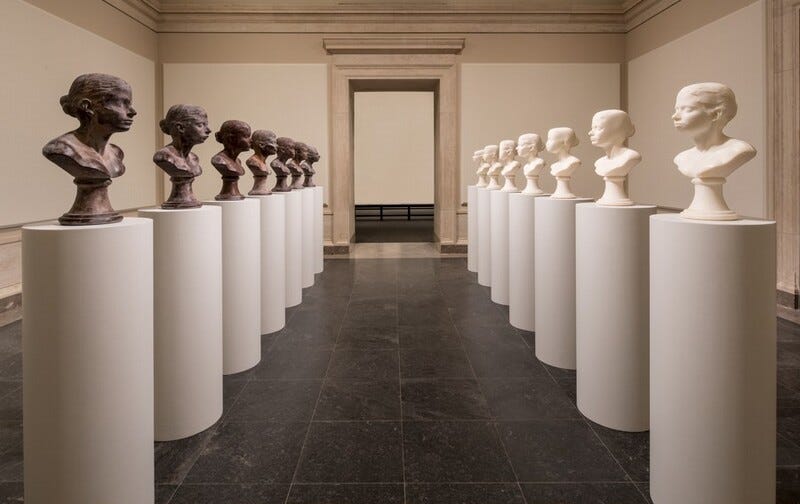
We paired this piece with Janine Antoni’s Lick and Lather1 — 14 self-portrait busts: seven made of chocolate and seven out of soap. Antoni licked the chocolate ones and bathed with the soap ones until her own face’s likenesses wore down to almost nothing. I love how surreal and yet…real it is (aha, yes I did use our mag’s tagline here). Novak’s essay burns with that same tension — erosion so careful you could mistake it for a kind of maintenance.

Image: Lick and Lather © Janine Antoni. Used for editorial commentary purposes only. All rights reserved.
What an extraordinary piece of flash! It certainly does need to be read many times over. 🤓
Lovely story! And love the writing advice of drafting by hand first and then typing it out, I always do some version of this.