



Hello fellow strange pilgrims, I hope you’re all settled in for the evening because below I’m sharing with you a new kickass brilliant story by the award-winning writer Isabel J. Kim. I first discovered her work in Clarkesworld, when I all but fell outta my chair because her story was unlike anything I’d ever read. I hope that you all too fall out of your chairs after reading “Nomenclature”, then, in the best way possible ofc!



So God looks down from heaven and says to Cain, “You have to invent murder.”
Cain looks up from the field and says, “OK, you got it, God. What’s murder?”
And God says, “Murder is when you kill someone with intent, so you’re going to kill your brother.”
And Cain says, “What’s a brother?”
And God says, “You’re going to have to invent that first, actually.”

Sanctuary puts his armor on from the bottom up. Greaves, breastplate, gloves, helmet. Identification taught him that, before Identification was blown up in a drone strike.
“You need your hands free for as long as possible,” Ident told him, back when Sanct had just been decanted. “The buckles on the breastplate are a bitch, and after you get it on, it’s hard as fuck to bend over.”
Sanct had nodded, uncertain. He hadn’t known enough about the world to disagree with Ident. And anyway, Ident was his squad leader, so he was in charge of Sanct, and Sanct was six hours old, his brain pre-loaded with the Basic Bio™ package and the Standard Movement™ package and a handful of trade secret combat sims. Sanct didn’t know anything much about anything, other than that he was a soldier and he had been born to fight and die. So, he was imprinting hard on Ident.
“This is where you can make a joke about copulation,” Indent had said, kindly. “It makes the commanders feel more comfortable, if you do things like that.”
“What’s copulation?”
“It’s how people are made. Not us. People. You and I and all the other pieces of meat are made in the vats, but the commanders and the civvies at home are made by a male and a female copulating. The male inserts his penis into the female’s vagina. Or so I’m told. I’ve never seen a female. You won’t either. But the commanders are people, so they like to imagine we’re people too.”
“Okay, so copulation,” Sanct had said. “And my armor on from the bottom up.”
“Quick study, Sanct,” Ident had said.
Two months later, he’d be dead. Drone strike. Death from above, Ident’s limbs flying and his red Blood™ leaking out onto the desert rock. Sanct would have a perfect visual of Ident getting blown to high heaven.
“What do we do,” Sanct would whisper, shocked by the sight. This wasn’t the first time someone had died on the battlefield, but it was the first time his squad leader would have died, and he would feel something sharp and terrible in his chest. Not a physical feeling, but something else.
“Nothing,” Feign would say, before hustling Sanct and Copyright and Passage back into their vehicle and driving them back to base like a maniac while arguing with the commander over the comms, even though Sanct was supposed to be driving. And then Feign would be the new squad leader. And they wouldn’t talk about Ident again. The same way they didn’t talk about Clay and Endure and all the others who had been downed, in the two months since Sanct had been decanted.
Things that exist so far: light, darkness, life, death, mothers, fathers, god, satan, all the animals, shame, the wasteland, the garden, snakes.
Things that don’t yet exist: murder, brothers, your mother weeping, your father moaning, the act of putting the rock against the head and bashing it open.
The pieces of meat are similar to human beings in that they’re derived from a single, legally acquired pool of human DNA, although the meat’s formulation has been substantially improved on through clever technological enhancements. The meat has limbs that are swappable and more durable, their blood is Blood™, and they’re stronger, overall, with improved eyesight. The meat is decanted and is ready to go after a single week of conditioning. The pieces of meat don’t have names. They only have randomly-assigned callsigns.
Sanct doesn’t know how many conflicts the meat is deployed for. He only knows that he has been decanted into a rocky desert, where the sun is hot and it never rains and they have to slather their exposed flesh with a thick white goo before going outside, to protect them from the UV rays.
There were rumors and conspiracy theories among Sanct’s squad, that they haven’t been deployed in the Middle East or Africa or the American Southwest, that they’re on an entire planet entirely. There’s no way to know. None of them knew that much about earth, other than what was included in the Basic Bio™ package. Being on another planet would explain why they rarely saw commanders, but that fact could also have been explained by the fact that most warfare has been automated. In some ways, the meat’s presence is anachronistic.
“They lost their taste for dying,” Right had said. “But they didn’t lose their taste for killing. And you wanna hear my theories?”
Copyright knew more about what was going on than anyone else, because Right had an in with a commander who called on the off-hours. Sanct and the others figured it was probably some sort of strange romance, although romance was maybe the wrong word. Right and the Commander mostly had long, secret conversations over the comms, and occasionally Right was called in for a special mission that he would return from, tight-lipped.
Sanct never asked about what happened with the commander. They all had topics they didn’t want to touch. Right’s commander, Feign’s soap carvings, Sanct’s reaction to Ident’s death.
“Sure,” Sanct said.
“The civvies like to watch. Nah. Like’s not the right word. We look like them, right? They can….what’s the word, empathize, with us dying. And other than us, it’s all machines and code and shit. It doesn’t feel like a fight, a real fight with stakes, if you cripple a landship or a drone. But us, we’re full of Blood-Tee-Em. We’re a good watch. You can feel like your team’s really winning, when we take a base. And when we die, you can feel sorry for us.”
Sanct considered this. It would explain why they were issued rifles, instead of ion cannons and beamers. It would explain why they existed at all.
“If they felt so sorry about us, they shouldn’t have us out here,” Sanct said, and it came out wistful because even Sanct, less than four months old, understood that it was their lot to fight and die. If they weren’t made for this, they wouldn’t have been made for anything at all.
And despite everything, Sanct is glad to have been decanted.
Cain goes home after God’s command. He eats dinner with his mother and his father. Abel is somewhere in the hills and valleys, with his flock, and won’t be home until dark.
And Eve says, “You look tired, Cain. Are you alright?”
And Cain says, “God asked me to do some stuff, and I don’t know about it.”
And Eve says, “Oh that guy.”
And Cain doesn’t ask her to elaborate, because his mother is using that tone she uses when she talks about the cows having escaped the pasture, the rain having ruined the drying laundry, the dog having shit inside. Which is to say, when she talks about a natural phenomenon that she can’t argue with, only able to deal with in the aftermath.
And Cain eats his dinner and thinks about Abel. His father doesn’t say anything. For the entirety of Cain’s life, Adam has seemed a little defeated.
Sanct’s life is split into downtime and uptime. Downtime is for sleep, showers, eating real food, watching propaganda, playing card games with increasingly complex rules. Uptime is for digesting mandates from the commanders and piling into vehicles and driving out to combat zones, for readying their rifles, for shooting. It’s for planning maneuvers with landships and drones and readying traps and strike points. It’s for trying to recover territory. It’s for sitting behind a brick wall, three in the morning, heart in Sanct’s mouth while he hears shelling in the distance.
By month eleven, Sanct’s the second-oldest member of his squad. He no longer drives the vehicle—the honor of the safest seat is reserved for the youngest piece of meat. Instead, Sanct runs comms and tactics, which should be Right’s job, but Right’s their gunner, since he’s shit at reading. Probably there was something wrong with his Basic Bio™ download.
But it works out okay, because Right’s a good shot.
Today they’re being deployed for a longer mission—a week, trying to recapture a supply depot that command thinks has been abandoned. Right’s late, though, which is aggravating. Sanct just grits his teeth and flips through the maps and the mission briefing, because realistically, it doesn’t matter if they’re half an hour late getting out. They’ll drive a little faster and it’ll be fine.
Right finally jogs over.
“Sorry, my commander called,” he says, swinging over the side of the vehicle and getting cozy up next to Sanct and the gun mounted on the open back of their ride. “Start the car, Popular!”
Pop starts the vehicle, arcing them out of the hanger and into the burning desert. Sanct stashes his papers and glances at Right.
“Your commander give you anything useful?”
“Nah. Just wanted some attention before I headed out.”
“Hm,” Sanct says. They’re eating ground fast, but it would still be a long drive. He was sore, still, from the last deployment. He had gotten a real bad full-body bruise from when half a building had fallen on him. Right had risked his life dragging him out of that situation. They’re the two oldest in their squad, now. They’ve known each other for the entirety of Sanct’s life. “Why’s he like you, anyway?”
Right shrugs. Folds his legs, wincing as he changes position.
“It’s not romantic. Sorry if that loses you any bets.”
“Oh yeah?” Sanct says, his interest piqued.
“He just likes to talk. I apparently look exactly like his dead son,” Right says. “Fucked, right?”
“Yeah,” Sanct says, for lack of anything else he can say. The wind whistles around them. They have to lean close together to speak.
“He says he wants to get me out of here,” Right says, quietly, against Sanct’s cheek. “But I’m pretty sure he’s full of shit. I bet he’s said that to dozens of guys that have my face. His son’s face. Whatever.”
“Could all have been you,” Sanct says.
“You know I don’t believe that stuff,” Right says, and then the wind picks up, and it’s too loud to talk anymore, so they don’t.
A lot of the meat believes in reincarnation. They say that the stuff that makes you you is still in the gene pool, and eventually your combination will be reassembled, and then you’ll get printed and decanted again.
They say that unlike everything else in the universe, the meat is destined to come around again. There’s only so many neural patterns and body types that have been preprogrammed into the vats, and eventually, something exactly like you will be printed, and it will be the perfect shape for your soul to re-inhabit.
There’s guys that get really spiritual about it. There’s a smuggled book on Buddhism that gets passed around the barracks. A Bible, too, and a book of Norse mythology.
Sanct read them all, but he doesn’t know if he believes in any of it.
After dinner, Cain sits on a bale of hay and looks at the fields and the orchards and the great velvet sky above the basin of the valley that his brother is herding sheep in, and he sees the speck of his brother among the sheep and he can faintly imagine that he hears his brother singing.
Cain gets up and begins walking toward the valley. God has called him. He’s supposed to answer.
The next day, their vehicle pulls a tripwire as they’re rolling past an aquifer. Automatic turrets spring from the ground and start shooting at the squad.
“Duck,” Sanct shouts, and everyone crashes to the floor, except for Pop, who frantically puts the vehicle in reverse and slams his foot on the acceleration. Right begins inching shakily his way over to the gun mounted on the back.
“Don’t—” Sanct says. Over the edge of the vehicle he can see that there are reinforcements, coming to back up the turrets.
“They’re going to radio in that they saw us unless we get them now,” Right shouts, and hauls himself up to brace against the gun. “Get down!”
Sanct dives back down. He hears the whine of the staccato scream of the big gun above him as it charges up and then Right fires, one, two, three times. Sanct peeks over the edge of the vehicle. One turret down. Couple of assholes coming right at them. Sanct spins his rifle from his back into his arms and takes a couple of shots, gritting his teeth as Blood™ blooms on the adversaries’ uniforms. Hope springs in Sanct’s heart. Maybe this will be easy.
And then he hears two more shots, one after another, and then he’s not paying attention to anything at all because their vehicle is swinging wildly and next to him, Right’s bloody body is falling and ragdolling out of the vehicle and it’s happening too fast for Sanct to say or do anything, and Sanct is gripping the side of the vehicle as it spins out of control and he hears shots, and for a long moment the world is just a smear of color and noise until the vehicle
“Pop’s dead,” Waste shouts from the front. Sanct looks over the edge, and Waste is leaned over with his hands on the steering wheel, half-sitting on Pop’s dead body as he pushes down on the acceleration with his foot.
Pop’s head dangles. Blood™ oozes out of the side of his neck. Sanct feels a sick numb feeling in his stomach. There’s Blood™ in the back of the vehicle, too, where Right was shot, where he fell. It’s all over where it smeared against the low walls before Right was tossed out.
It happened so fast. It always happens so fast. Sanct is never going to see Right again.
“We going back, Sanct?” Waste asks. He’s still got his foot on the acceleration. Nobody’s chasing them, at least.
Right. Sanct’s in charge now. Sanct’s in charge and Right and Pop are dead, and its all the fucking bastards fault and it’s a day’s drive back to base, and he has to decide what they’re going to do next. He’s the oldest, now. Right is never going to get back to his commander.
If they go back, they’re just going to have to report what happened, and they’re going to have to come back out and the situation is just going to get worse.
“No,” Sanct says. “We didn’t need the whole team for this one. We keep going.”
They drive through the rest of the day and the rest of the night. They decide to dump Pop’s body at sunset. Until then, it lies in the back of the vehicle, and Sanct drives, because Waste’s hands are shaking too much after the first few miles. They don’t clean the Blood™ off of the upholstery and dashboard—they only have so much water to spare. Sanct’s hands are tacky by mile number ten. They drive in silence. The sun begins to go down, slowly, at first, and then all at once.
Sanct pulls over near a rock formation. They drag Pop’s body across the sand. They set it facing the setting sun. They close it’s eyes. They head back to the vehicle. Sanct sits heavily down in the drivers’ seat. He doesn’t know if it’s better or worse, that they don’t have Right’s body. The way it ragdolled was terrible.
“Is it always like this?” Waste asks.
“No. Only sometimes.”
“I wish I were dead,” Waste says. “Instead of. Them.”
“It’ll be better in the morning,” Sanct says, and wishes that he had anything better to say, that he believed like some of the others did, that everyone would be reincarnated, that they would live and die again. But all he has are platitudes. The same ones that Ident used to tell him, though, when Sanct got scared. When Clay and Endure were killed. It would be better in the morning.
“Okay,” Waste says. “Do you want me to drive?”
Sanct shakes his head. He starts the engine. They continue.
The rest of the trip is bizarrely peaceful, as if they’re receiving some cosmic recompense for the death of half their squad. Sanct tries not to think about it. He’ll think about it later. He should be used to this by now—they’ve rotated so many pieces of meat out of his squad—but he never is. It always feels different. It’s always a surprise.
Their luck runs out as they approach the supply depot. It’s not abandoned. There are turrets at the corners, vehicles visible behind a barricade, and when Sanct pulls up his heat vision goggles, it’s clear that there are multiple lifesigns inside. Sanct swears. The depot was supposed to be empty. The survivors from the earlier aquifer shootout must have called ahead.
“We heading back?” Waste says.
Sanct hesitates. If they return, they’ll just be sent out again, with two new freshly decanted pieces of meat. The supply depot might be better guarded by then, and there might be more ambushes along the road now that the other side knows that they’re trying to take the depot. And then what? Freshly decanted meat, dead.
He shakes his head. “We’re calling in a drone strike.”
“We can do that?”
“Not usually,” Sanct says. Sanct is eleven months old, though. Sanct understands relationships, and how they change what people are going to do. “I’m going to call Copyright’s commander.”
At the edge of the valley, where the grass turns to rock and sand, Cain sees Abel. He’s a small figure down in the valley. Cain recognizes Abel by the crook of his staff among the sheep, and then by the cloak that their mother has woven for him. It isn’t very good. All their clothes are poorly made. Nobody has made clothes before their mother.
And Abel waves his staff and calls, “Cain!”
And Cain waves back, rock in his hand, and says, “Abel!”
The commander listens to Sanct’s explanation without interrupting. When Sanct is done, the commander speaks in a calm, measured tone.
“In half an hour, there will be a drone flying overhead with a precision payload. Make sure that you’re at least two hundred meters away.”
“Copy that. Thank you.”
Sanct leans back against his seat, the tension leaching out of his muscles. Reinforcements are coming. He’s not going to have to lead Waste to his death.
“Was it bad, when he died?” the commander asks.
“It wasn’t bad,” Sanct lies.
Cain’s killed a lot of things. Bugs. Snakes. Lizards. Sheep. A dog, once, when it attacked him first. He’s reaped sheaf after sheaf of grain, if that counts as killing anything. His parents have told him that every single thing on earth is alive, and that all of them were created by God. God has not provided any guidance on the subject.
Nobody else on the earth has a brother, other than Cain, other than Abel. Cain thinks that killing Abel is going to be different than killing the dog. But he doesn’t know. He’s never had a brother before. Nobody has.
And Abel calls out, “Why do you have a rock?”
The drone streaks overhead. From its belly a black speck drops and hits the supply depot and there’s a bright, beautiful plume of flame. Dense clouds of black smoke billow from the windows and broken ceilings.
Sanct and Waste watch the supply depot smolder. The fire begins to flicker out. The smoke trails into the bright blue of the sky. Sanct gets the heat vision goggles out and squints through them. There’s too much ambient warmth to tell if there’s anyone still alive. Sanct unlocks the vehicle, strapping his weapons to his back and to his belt.
“If I’m not back in an hour, drive back without me,” he says, and hoists himself out.
And Cain looks down at his brother and thinks about light, darkness, life, death, his mother, his father, God, all the animals, and the story that his mother once told him about paradise and the snake and his father, when he asked why she was so sad. And he thinks about his sickle. And he thinks about his flail. And he thinks about his hoe, and the rocks he digs out of the ground, and he thinks about how strong he is, from the days in the field. How the human arm is engineered for throwing.
And Cain thinks about Abel. How soft Abel’s head is. What is a brother? What does a brother matter to him?
The rock is warm in his hands.
Sanct walks through the bombed-out ruins of the supply depot. The exterior walls are still intact. Inside, the structure is a ruin. Sanct wonders about the waste of it all. The original plan had been to take the depot clean, but he supposes that destroying it and preventing the enemy from having it is better. He glances through the heat vision goggles every few meters. So far, there isn’t anything that looks like a live body. He steps over a corpse, and then a second one. There’s Blood™ and ash on the floors.
He gets nearly to the other side of the building before he raises the heat vision goggles and sees the figure on the other side of the wall, hot and alive. Sanct angles himself against the wall and peers through the open door. Yes. There he is. One survivor, then. It could have been worse.
Sanct lines up his shot. He doesn’t think. He shoots. There is a high whine, and then the sound of someone collapsing, swearing. Sanct waits for the ensuing silence. It doesn’t occur.
Sanct sighs. Rolls his shoulders. Walks outside with his rifle in hand, ready to deal the finishing blow. After this is over, he’ll go out to his vehicle, and then him and Waste will head back to base.
And God, standing next to Cain like he always does, says: “Look, it is crucial that you invent the act of putting the rock against the head and bashing it open.”
And Cain says: “Can I do that to a sheep, instead?”
And God says: “No. It’s got to be a person.”
And Sanct looks at the stranger, and the stranger looks at him, and the stranger is bleeding from his thigh and there is a growing pool of Blood™ around him, and Sanct understands at that moment.
The zealots are right. They’re all made of the same meat. The same gene pool and presets. The same faces and the same bodies and the same DNA being printed out on Sanct’s side, on this stranger’s side, on all the sides of every conflict. Every piece of meat.
This stranger has Ident’s face.
And Cain says, “You know, I think my mom was right about you when she said that she loves you but doesn’t like you.”
And God says, “I don’t care if you like me. Do you love me?”
And Cain says, “I don’t know what love is. That hasn’t been invented yet.”
And God says, “Shit. Fuck. Whoops. Hold on one second.”
And Cain feels a pain in his heart so great that he feels like he is dying.
“Can you make this quick?” the stranger that looks like Ident wheezes. He’s unarmed. He’s wearing downtime clothing. He looks exactly like Ident did, before Ident died.
There is sweat and white sludge dripping into Sanct’s eyes. He wipes them. He looks up at the sky. The drones. The birds. The beating sun. Where are the commanders and the civvies and all the people who are people might be watching them right now? Sanct’s thoughts are all bleary, smeared with exhaustion There are drones high in the sky and there is a camera on his helmet and maybe the same thing on not-Ident’s helmet. Is anyone looking? Is anyone ever looking?
“Hey, man,” Not-Ident says. “We don’t have all day here. C’mon. I don’t need any foreplay. Don’t fucking draw this out, kid.”
And Sanct, looks back down. He wonders, despairingly, rifle held ready in his arms like a warm lover, if a crass vocabulary is genetic. He puts his finger on the trigger. He closes his eyes. He doesn’t want to watch this. And besides. He’s one meter away. His aim doesn’t need to be perfect.
“Now, Cain,” God says.
Cain has never disobeyed God before. He feels love like a deep stupid painful throb in his heart. He closes his eyes.
Sanct opens his eyes. He throws down his rifle. He unbuckles his gloves and his body armor. His breastplate falls to the ground. He strips his sweaty, stained uniform, and then his sweaty undershirt that had once been bleach-white. He ties the undershirt to the barrel of his gun. He jams the gun into the sand. He leans down and heaves not-Ident’s body over his shoulder.
“Hold on to me,” he says. “Don’t fucking bite.”
“The hell are you doing?” Not-Ident wheezes.
“Doesn’t matter, you’re probably going to die either way. I probably nicked an artery”
Sanct hefts Not-Ident’s weight. His shoulders are killing him. Not-Ident is heavy as hell.
“You’re insane,” Not-Ident says.
“Nah,” Sanct says. “You look exactly like someone I used to care about. All my friends are dead. And I’m done with this shit. I’m tired. Aren’t you tired?”
Silence for a moment, before Not-Ident coughs wetly.
“Yeah. I’m tired.”
Sanct looks to the sky.
“I’m done with this shit,” he says again, to the sun, to the drones, to anyone else who is watching. “I didn’t ask for any of this.”
And then Sanct turns and starts walking. He grips the white flag like it is a life buoy. He is taking one step after another, away from his vehicle, away from Waste, away from the bombed-out supply depot. He doesn’t know where he’s going. He doesn’t know if there’s anyone else out there. He doesn’t know what’s going to happen next. He doesn’t know if Not-Ident is going to die.
Sanct takes step after step. He is waiting for Right’s commander to kill him with a remote drone strike. He is waiting for anyone to stop him.
“What do they call you?” Sanct asks.
“History. Tory, to my friends.”
“I’m Sanct.”
“Hi,” Tory says, and then coughs again. “Again. I just want to make it clear. You’re crazy, and we’re both going to be dead.”
“Yeah. But right now, we’re alive. So shut the fuck up, and let me carry you.”
And Tory laughs, wheezing, and it’s strong enough that Sanct thinks that his Blood™ might have clotted and Tory’s not going to bleed out immediately. And right now they’re both alive, and they still have a couple liters of water and the desert is vast and deep and there is no one immediately coming to kill them, and Sanct is choosing not to kill anyone ever again.
And Cain bashes God in the head with a rock, and wanders into the desert.

Tell us your origin story as a writer. When did you begin? What first drew you to writing as an instrument for asking questions that can’t be explored any other way?
ISABEL J. KIM: I started writing with a pretty conventional story: I was a kid, and a teacher gave me praise for my fiction. Shout out Dr. Horn from Warren Middle School, you set me on a path that led me to such strange places as “writing short science fiction stories.” I started writing stories with more than superficial meaning mostly because I have a hard time writing stories that don’t have any meaning, in fact, I am probably too didactic in my fiction and have actively been working to pull that aspect back, to middling effect. I think part of the reason why I do this, though, is that I have a hard time explaining my thoughts through a traditional essay format, and sometimes I feel that I’m the recipient of a particularly strange curse: I can only say how I feel through the lens of a 4000 word science fiction story, a format that nobody asked me to write (well, now people ask me to write them, but for a long time they didn’t!).

What does your writing routine look like? Do you thrive in structure or wildness? And when you begin a piece of writing, what tends to announce itself first: a voice, an image, an unease, a philosophical conundrum?
IJK: I went full time as an author a little over a year ago, and since then any semblance of a consistent routine has regrettably dissipated, despite my best efforts. Things happen when they happen, I work pretty much every day at any time between 7am and midnight, but I do less work per day than I used to, when I had a more traditional job. I do try to write during “normal” work hours, just to match my partner’s schedule. I also have different drafting cadences for novels and short fiction—since you've got a piece of my short fiction here, I’ll talk about that process. I usually start with one vivid, clear scene or concept that I want to scaffold a story around, which usually isn’t enough to carry the entire narrative, and then I start trying to think about what other concepts might go well in that story. I collect these ideas like a crow collects shiny stones, and these ideas will kind of just be in my brain for weeks or months or years until I have enough pieces that fit together into something cohesive and more interesting than just the sum of their parts. Then I start writing, and it usually goes pretty quickly after that.
Most artists are preoccupied by certain obsessions: lust, longing, death, the self. What persistent preoccupation—emotional, intellectual, or spiritual—threads through your work? Are there motifs, themes, or impulses you’ve tried to abandon but that keep returning, insisting on their relevance?
IJK: Doubling, bodysharing, death of the self, being overtaken by an alien entity or having to commune with that entity, tremendously strange ethical dilemmas, leaps of faith. I have no idea why all my themes are so strange. In real life I’m fairly cheerful! For a while I was also including the word “fluorescent” in everything I published, but I’ve stopped doing that for now.
If not a writer, who would you be?
IJK: Easy but boring answer: Biglaw corporate transactional attorney, specifically in a leveraged finance or M&A group. That was my profession before I took my own leap of faith.
I became a lawyer because I felt like I should get a "real job," when I was younger, and I liked it enough that I would go back to that. Before I was a lawyer, though, I was thinking about getting an MFA, though, and in that case I would have been doing conceptual installation art and making no money. There were a lot of lives I considered inhabiting when I was twenty-two, okay.
What’s the best piece of writing advice you’ve ever received? Alternatively/additionally, what’s something you’d like to offer as advice to emerging writers trying to make a mark?
IJK: I’ve both received and would like to pass along this piece of advice: Quantity over quality. Write more stories, get your reps in, learn where you always stutter. This is more effective at quickly improving your craft than endlessly polishing a single narrative ever is. Ideas are cheap, work on your execution. Also, you can recycle those ideas into different executions over time.
What are you working on now and how is it trying to ruin your life (in a good, necessary way, of course)?
IJK: I’m working on my second novel draft! My first novel, SUBLIMATION, is out on June 2nd, and I am truly in the trenches working on the next book I owe my publisher. Everyone says that second books are harder and I didn’t believe them, but this draft? This draft wants to kill me. With hammers. If it doesn’t kill me, though, this book will be fun for people to read. I’ve been pitching it as Piranesi meets the Backrooms, and it is about a mall in an alternate reality that goes on forever, and it is about how empire and cultures replicate themselves. It’s also about losing your girlfriend at the mall.
Who are the artists—writers, filmmakers, thinkers, internet oddities—that have shaped your sense of narrative? How have they rearranged the way you see the world on the page?
IJK: In no particular order: Kazuo Ishiguro, Masaaki Yuasa, Wes Anderson, the Wachowski sisters, Kelly Link, Ursula K. Le Guin, Ray Bradbury, Kurt Vonnegut, Ted Chiang, Porpentine Charity Heartscape. And some specific works–Catch-22, Don’t Hug Me I’m Scared, Homestuck, Futurama, OFF, 26 Monkeys, Also the Abyss. I am, for better or for worse, a product of my time and also of the internet. And I’m probably forgetting people and media, too.
Many of the names and pieces of media on this list have shown me how to create a perfect traditional narrative, and then, how to break a traditional narrative in an effective way. The other thing that many of these creatives have shown me is how you can use humor effectively, and how humor and horror are two sides of the same coin.
Please recommend a piece of art (a painting, a film, an album, anything that's not a piece of creative writing, really) that you love and would like everyone to experience.
IJK: DAK0TA by Young Hae Chang Heavy Industries—this was one of the first pieces of video art that made me think of text as an artform. It plays with time and text and music, and it’s a little dated now (it’s quite old, I first saw it a decade ago), but I think it still holds up as an experience.


ISABEL J. KIM lives near New York City in an apartment filled with books and swords. She is the author of numerous short stories and has won the Nebula, Locus, BSFA and the Shirley Jackson Award. Her work has been translated into multiple languages and reprinted in multiple best of the year anthologies. When she’s not writing, she’s practicing law or podcasting. Her novel SUBLIMATION releases on June 2, 2026.
Notes on Art
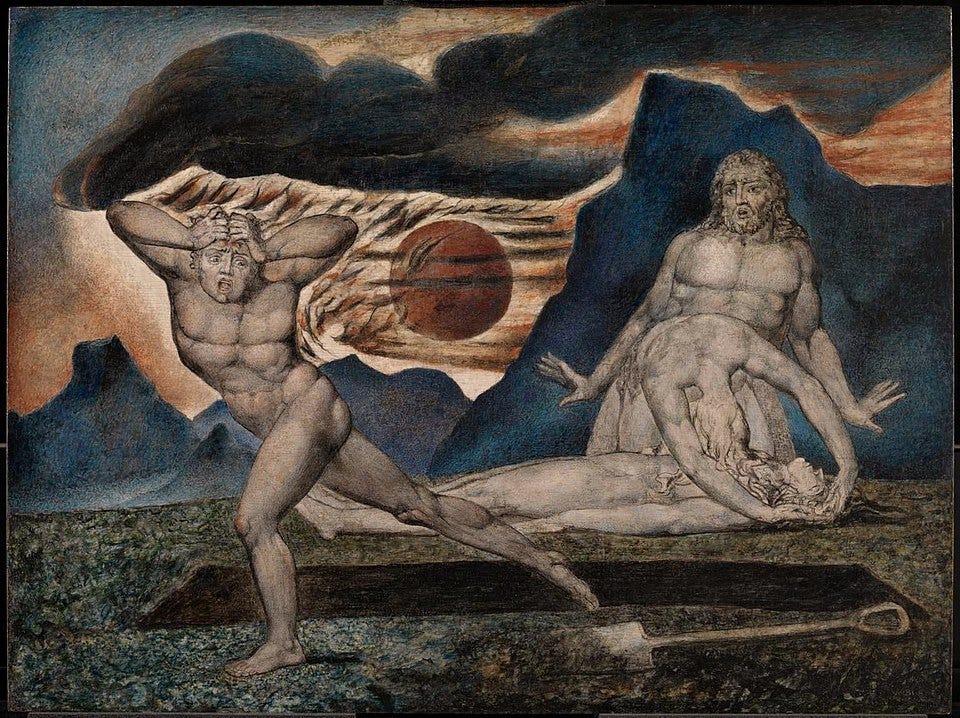
I remember first seeing this painting and thinking, wait wait Willliam Blake writes such good poems and he’s a great artist. But of course, talent is in a way a divine gift, and indeed in The Body of Abel Found by Adam and Eve1, Blake draws away the layers of divinity in the figures depicted here. We witness Cain fleeing into the wilderness with his hair seemingly on fire, mouth open in a howl, while Adam and Eve cradle the body of their dead son. There is a crack in the veil of light, of God, and evil has sprouted yes, but also there is family, and heartbreak, and as you ponder Cain’s interiority, just…humanity. This is exactly what Isabel J. Kim is so darn good at. She gives us strange, ancient, biblical even (as you saw in Nomenclature) characters and tales, and yet it is always their humanity, however marred, that shines through.

Image: The Body of Abel Found by Adam and Eve © William Blake (1826). Used for editorial commentary purposes only. All rights reserved.
I can see why you mention Isabel Kim's writing is "fall out of the chair" inducing...wow! Loved Kim's voice (Voice with a cap V, as you describe in an earlier craft post), humor, playfulness, and depth.
Also the advice is so good, particularly on writing more stories. Love this: "Ideas are cheap, work on your execution. Also, you can recycle those ideas into different executions over time." It's oddly freeing to think of ideas as something not to hoard in one perfect story but to find new ways to express them in other works.
Thanks for sharing this story!
This is the kind of story that will sit with me for a long time, I will keep returning to the ideas and images replaying in my head. It’s hard right after reading to put my finger on it, but perhaps the juxtaposition but also similarities between the two stories only made the other stronger and clearer.