



Hello fellow strange pilgrims, we’re excited to share our first photo-essay1 with you today. We were moved by how physical this piece is, how it trusts the land to hold what the mind can’t yet name. We’d also love to see more photo-essays in our next submission call (coming March 6th, mark your calendars)!
✦ As an indie, ad-free, reader-supported lit mag, your paid subscriptions keep us going. Please consider upgrading if you have the means. ✦


It’s nine a.m. and everything has led me here. On the way, I drive past an oil refinery, past smokestacks and open flames. I drive across two bridges. I drive through a redwood forest and I don’t stop. I open my windows and sing and sigh. Something inside of me is ending. Something is ending and I can’t name what it is. I can only turn left and right and left again, turn for miles and miles until I reach the rugged coast. Me and my camera and a strange, bright feeling strangling me as I park the car and walk into the mist.
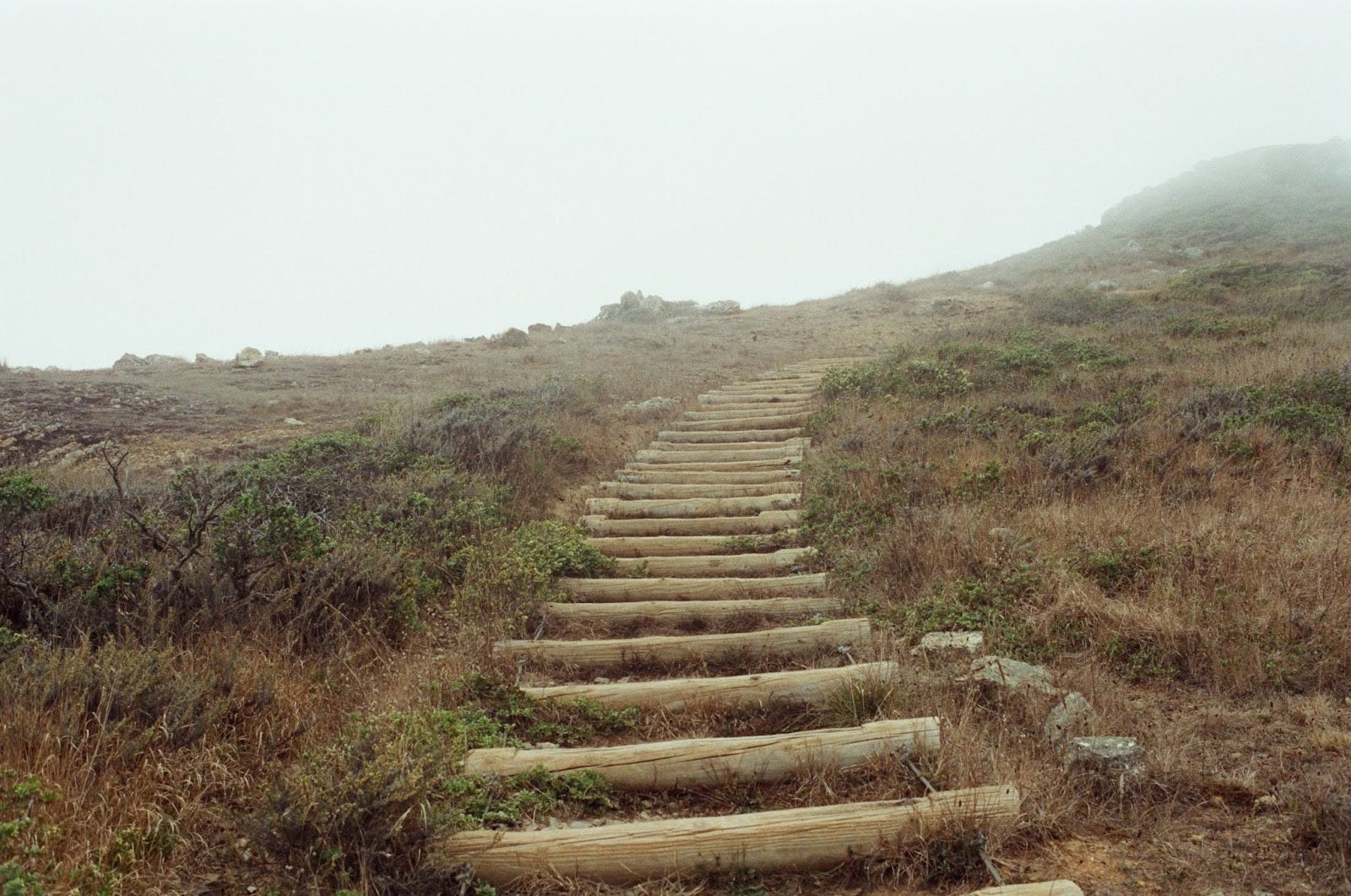
I head straight to the top. I’ve come for the military bunkers.
The trail is relentless up into the cliffs. I climb alone, leaving the surfers wet and black behind me, a handful of small shadows. The sky is surrounding. Not blue but ash—the color of pencil erased from a page with no answer. Halfway to the top, I crouch low to the ground, put my hands in the dirt, and examine a singular ice plant along the path. This is an invasive species in Northern California. A sign says, Warning: unstable landscape. Nearby, the San Andreas Fault splits beneath the sea.
I steady my footing. I’m thinking about a game my daughter likes to play before bed, tucked into the corner of her room. She turns into a kitten, an orphan, some creature lost and overlooked. Pretend I’m abandoned, she calls out, making her eyes big and her mouth sad, whimpering until I get real close. She likes it when I lift her body up to mine and whisper, Oh, you poor little thing. The game ends when she is found.
I’m breathing heavily now, a humming in my chest. I read once that grief is stored in our lungs. That we can, quite literally, suffocate from sorrow. But in the clouds there is so much air. I inhale the smell of stone, brine, bay laurel. The fog is dense and has a sound, distorted and damp. It wraps itself around the concrete walls, swiveling its hips, scattering light. What I think is a plane is the wind filling my ears. It pleads with me, tells me to run run run and so I do. I run through the open gates to Hill 88.
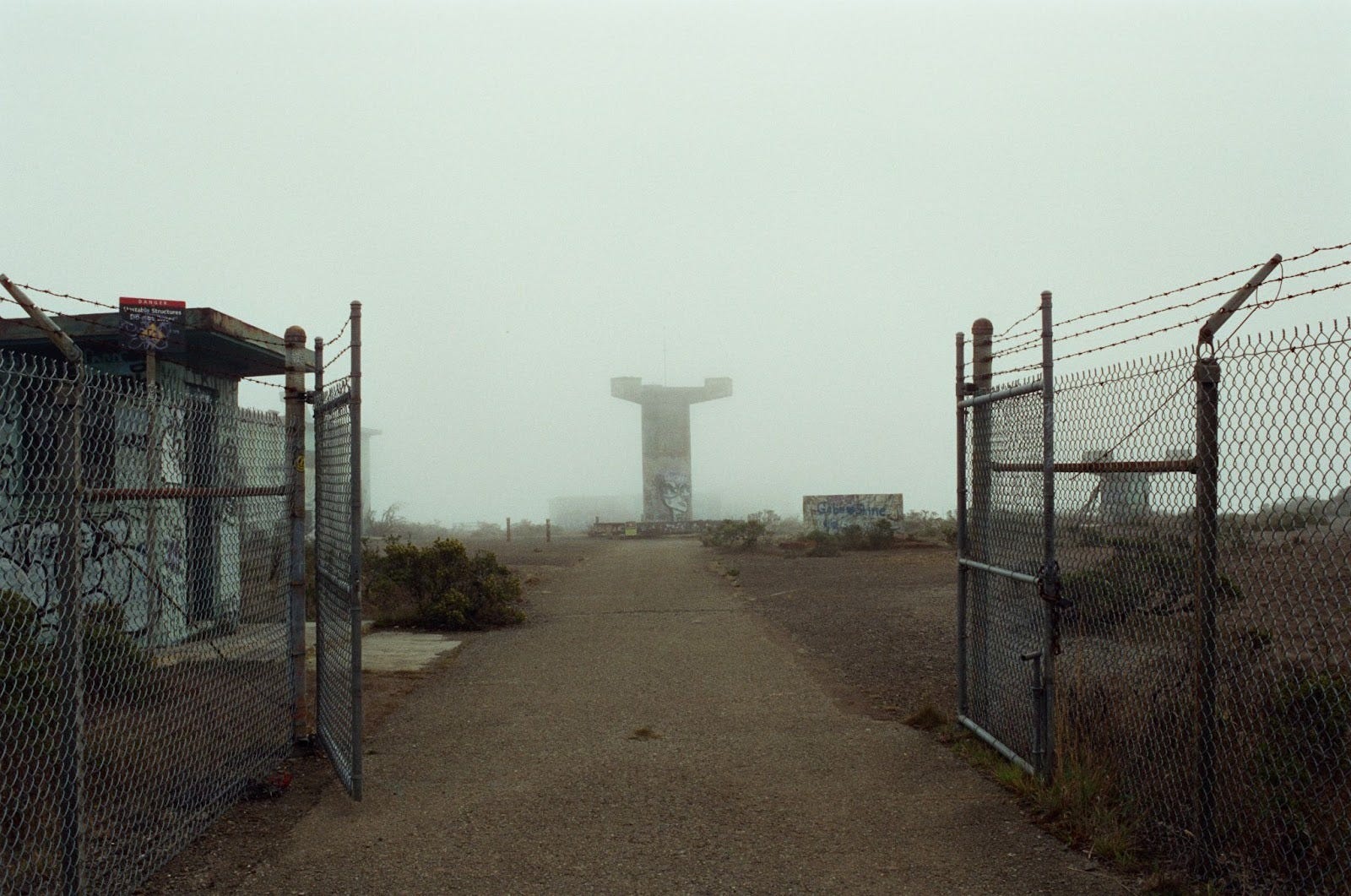
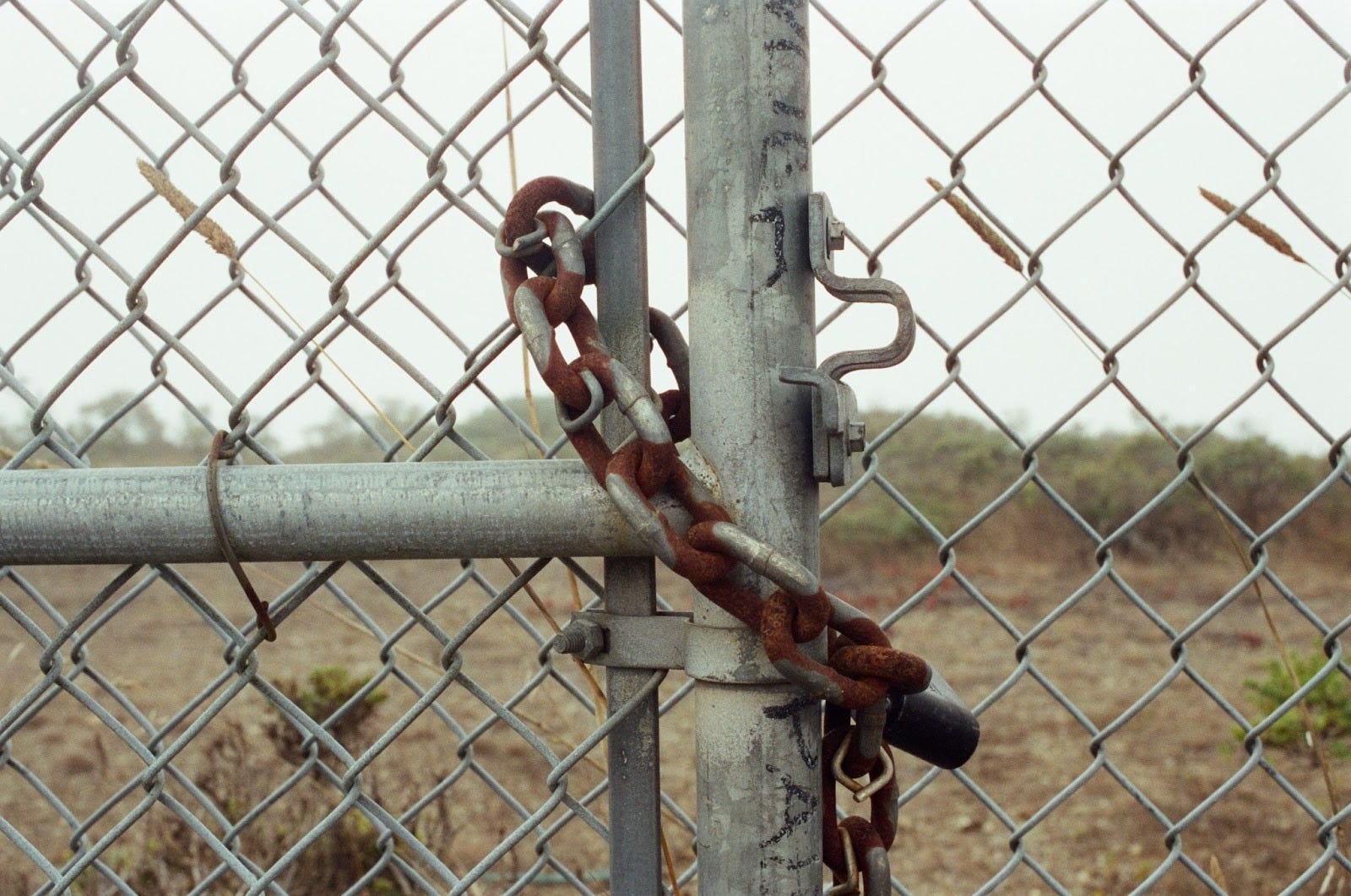
This place is not a prison, but it looks like one: a geography of walls built to divide the land from itself, cement dripping into the deep. Chain link fences hug the hillside, barbed wire pulled taut. A diamond quilt casting fractal shadows on the pavement. Thick locks tie the metal walls together, rust blossoming across the latches. They are lasting the only way they know how.
At the base of the hill, there’s a bronze plaque describing the structures in front of me. Cut into the coast in the early 1950s, Hill 88 was a radar station for a nearby missile launch area for two decades. Back then, we were at war with dark forces an ocean away, black mirrors reflecting each other’s dread. These towers and walls belonged to a contract of control and power—the last line of defense against Soviet attack on the west coast. A surveillance operation to detect and eliminate threat. A ruinous place, now a ruin.
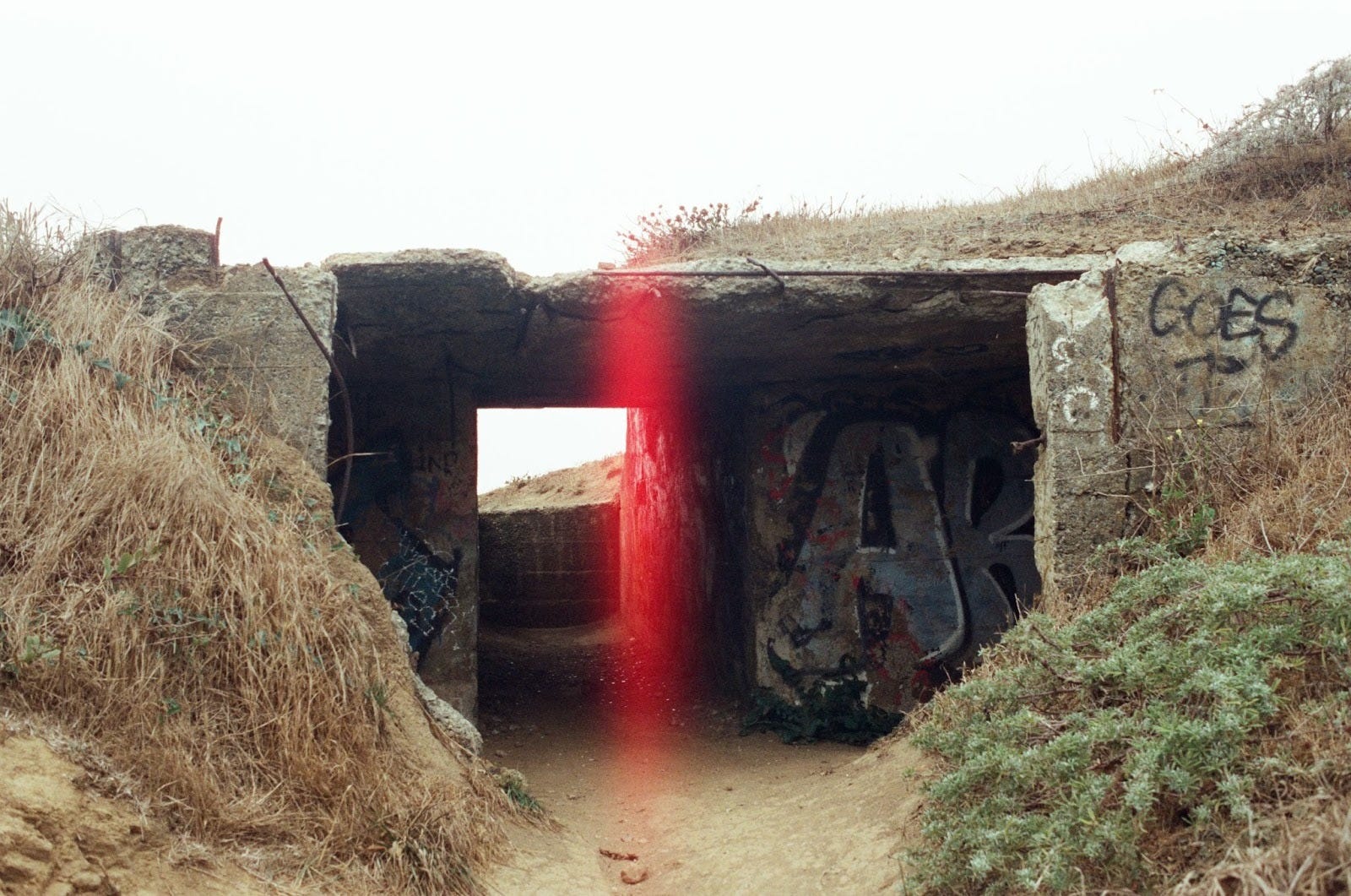
I look around at the crumbling walls. I’m running through a citadel.
I have been running my whole life. The first twenty years, running toward everything I thought I wanted, everything I was told to want. The last twenty years, running away—from my family of origin, a traditional marriage, my career. From a life I lived on the outside and no longer wanted to hold onto. From my own body and all the ways it was changing, the ways it wanted to change.
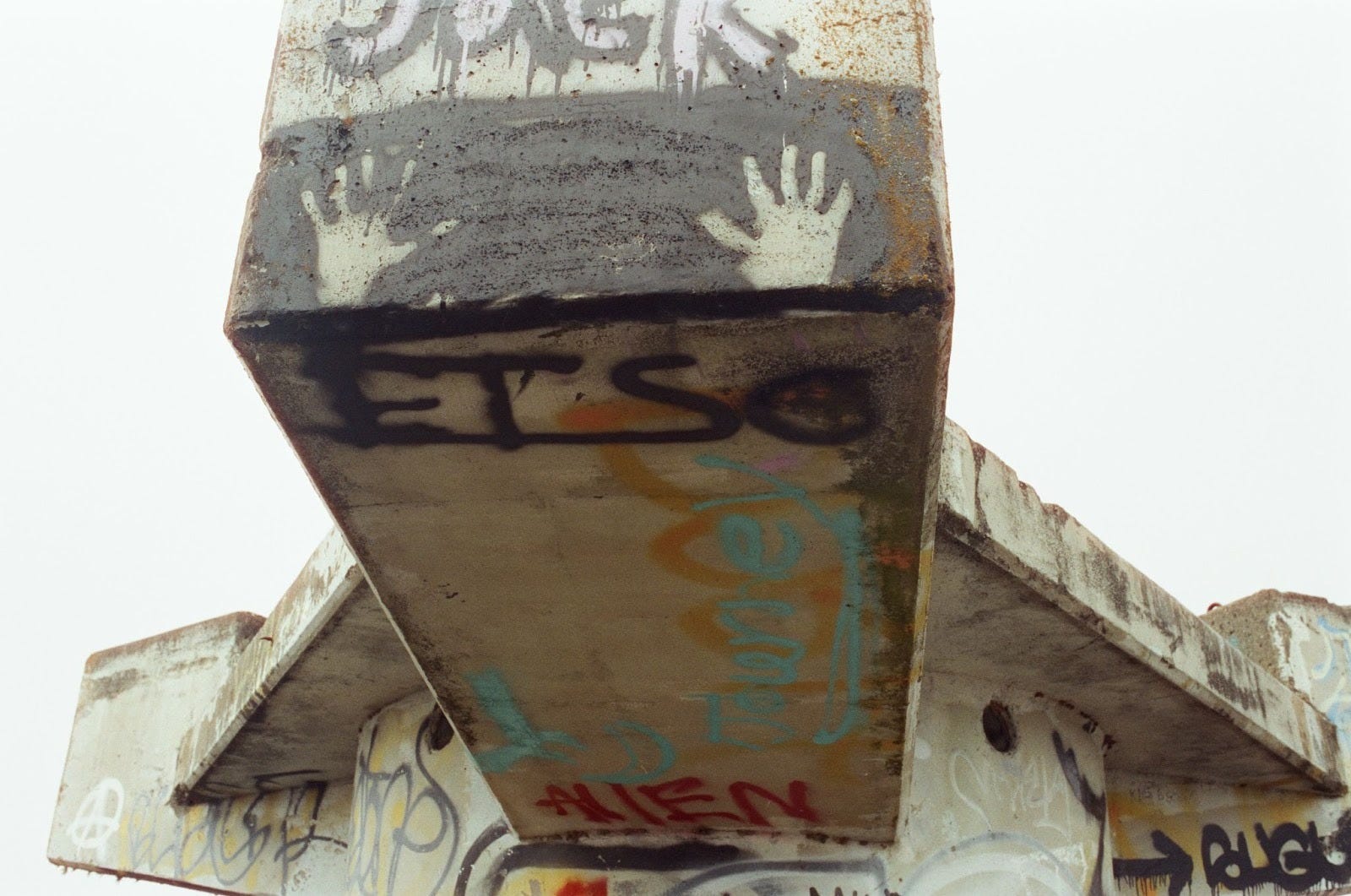
It’s late morning and I run past a helicopter landing pad, fat yellow lines underfoot. In the hazy blur, I read graffiti scrawled across every surface. Mostly initials, unidentifiable tags. A Free Palestine! banner in red. FACT in capital letters on one side.Above, two handprints higher than anyone could reach alone. A wall nearby reads you are worthy of love!
When I was a child, I wanted to be Daphne, a Greek nymph who spends all her time in nature, limbs loose and bare to the sun. She desires only freedom. When the god Apollo falls in love with her, he pursues her through the forest. She runs and runs, prey fleeing predator, praying for escape. Suddenly, her father transforms her into a laurel tree. Breasts turn into bark, arms into branches, hair into leaves, feet into roots. Her heart beating still beneath the wooden flesh. She no longer has to run to be safe.
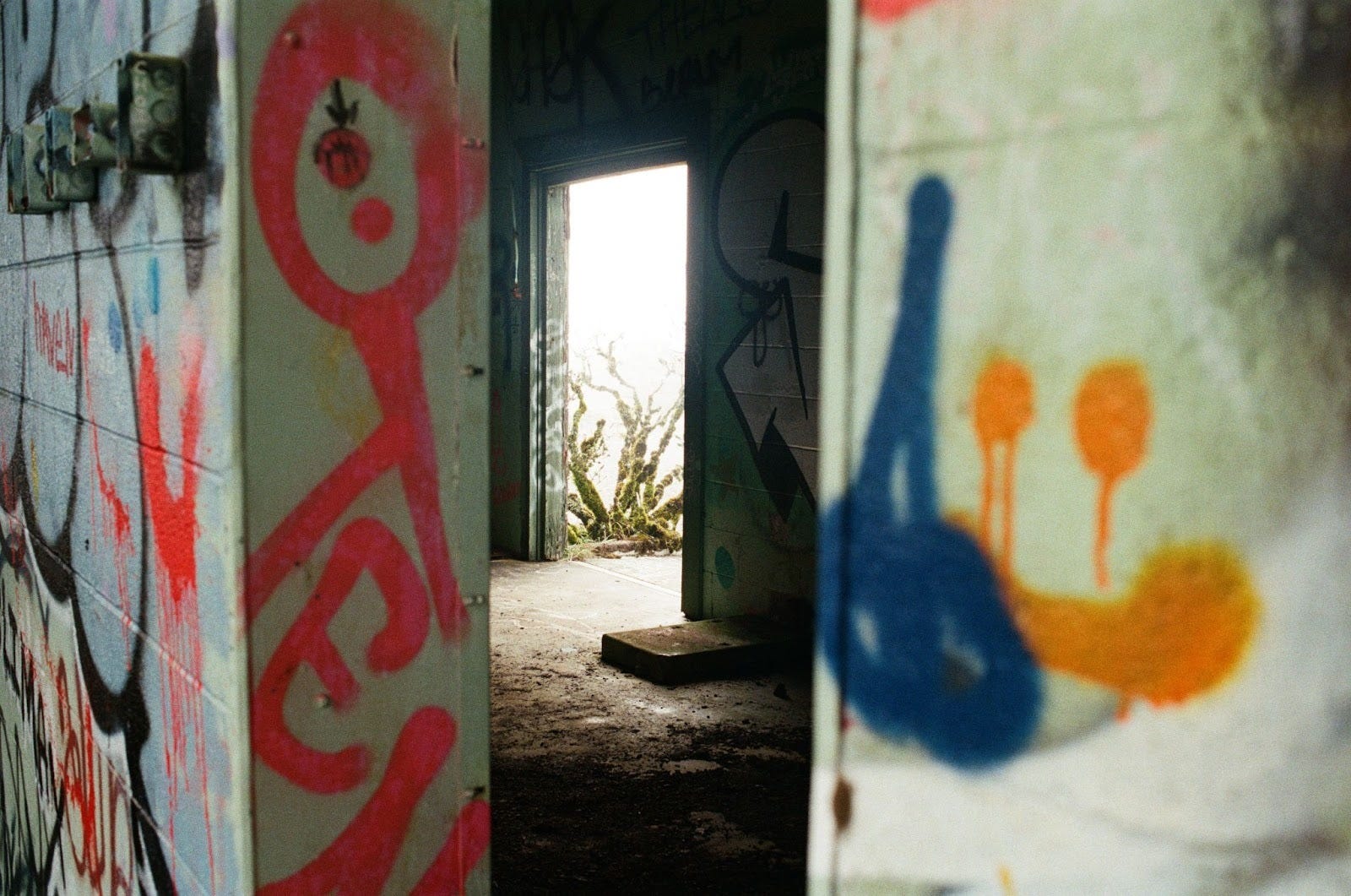
My father is not coming to save me. On this morning, he is six months dead, and I have become an archeologist, wandering the cliffs and excavating the strata. Dragging myself, my family, my Jewishness, my otherness, out into the light. Artifacts of addiction and mental illness, estrangement and violence. Generations of flight, of disconnection and severing. The near-constant building and building and building and watching it all burn down. My therapist says desire to control, drive for acceptance by way of perfection, self-hatred, self-hatred, self-hatred. She asks me where the fear lives in my body and I say everywhere.
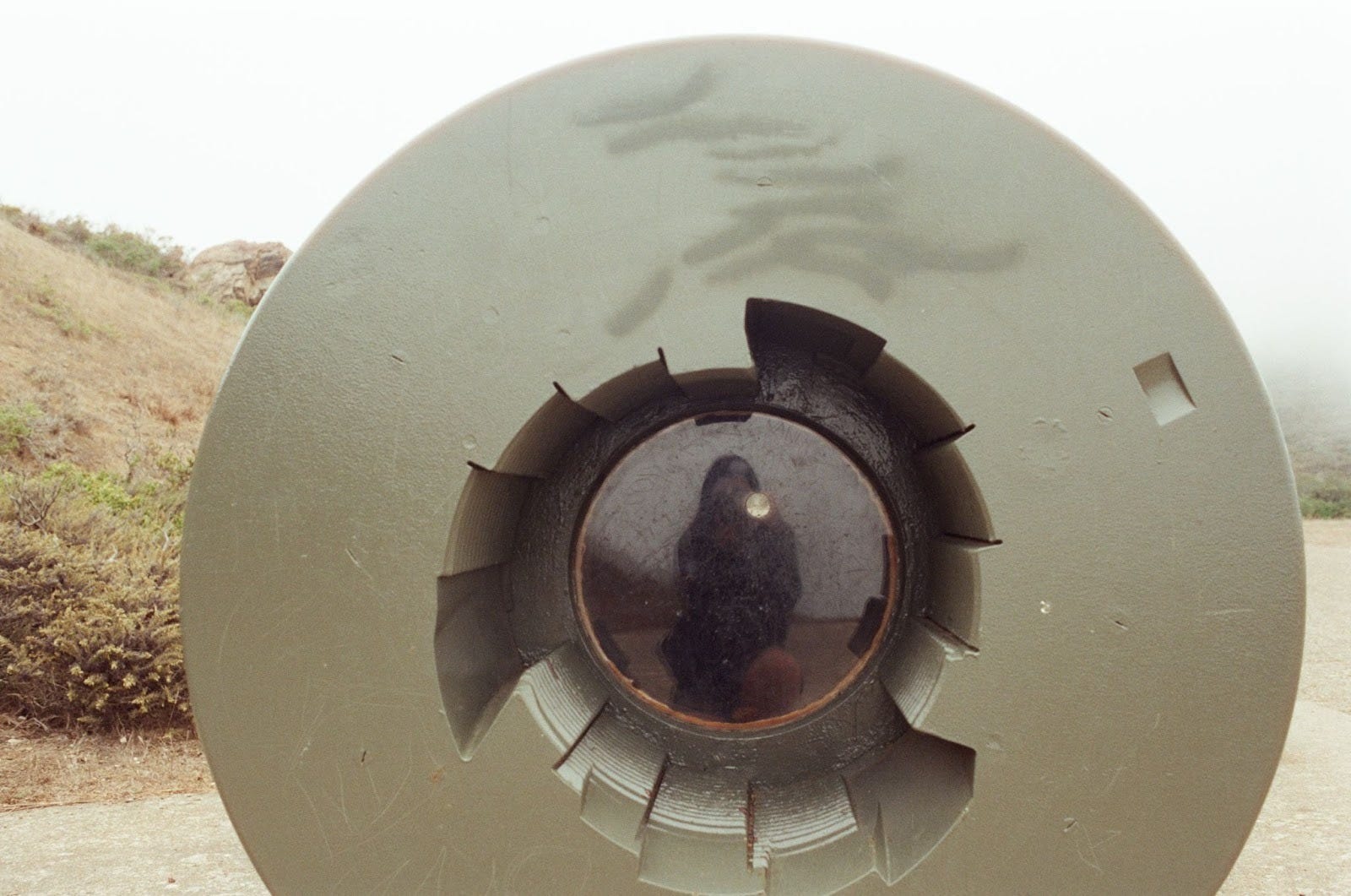
As a teenager, I liked to sink my nails into my forearms. Dozens of crescent moons flashing red. I pinched my thighs and twisted my flesh in a thousand different ways. Bit my nails, my lips, the inside of my cheeks. Sometimes I put my fingers in my mouth just to feel the bones beneath my teeth. I liked it when it hurt. My teacher told me I had a bad habit. She didn’t see the way I smiled when the bruises bloomed.
On Hill 88, my spine is cold and I am damp and breathless. I stop running. I spin around, entirely alone, holding a film camera in both hands. It was given to me by my lover: a sturdy SLR from the 90s that makes a satisfying sound when I press the shutter. I don’t always trust my eyes or my memory, but I trust this machine. I like feeling its weight against my face and squinting my eyes through the viewfinder. I like focusing on an object through glass, the world contained in a tidy square. The camera blinks and captures what I want to see.
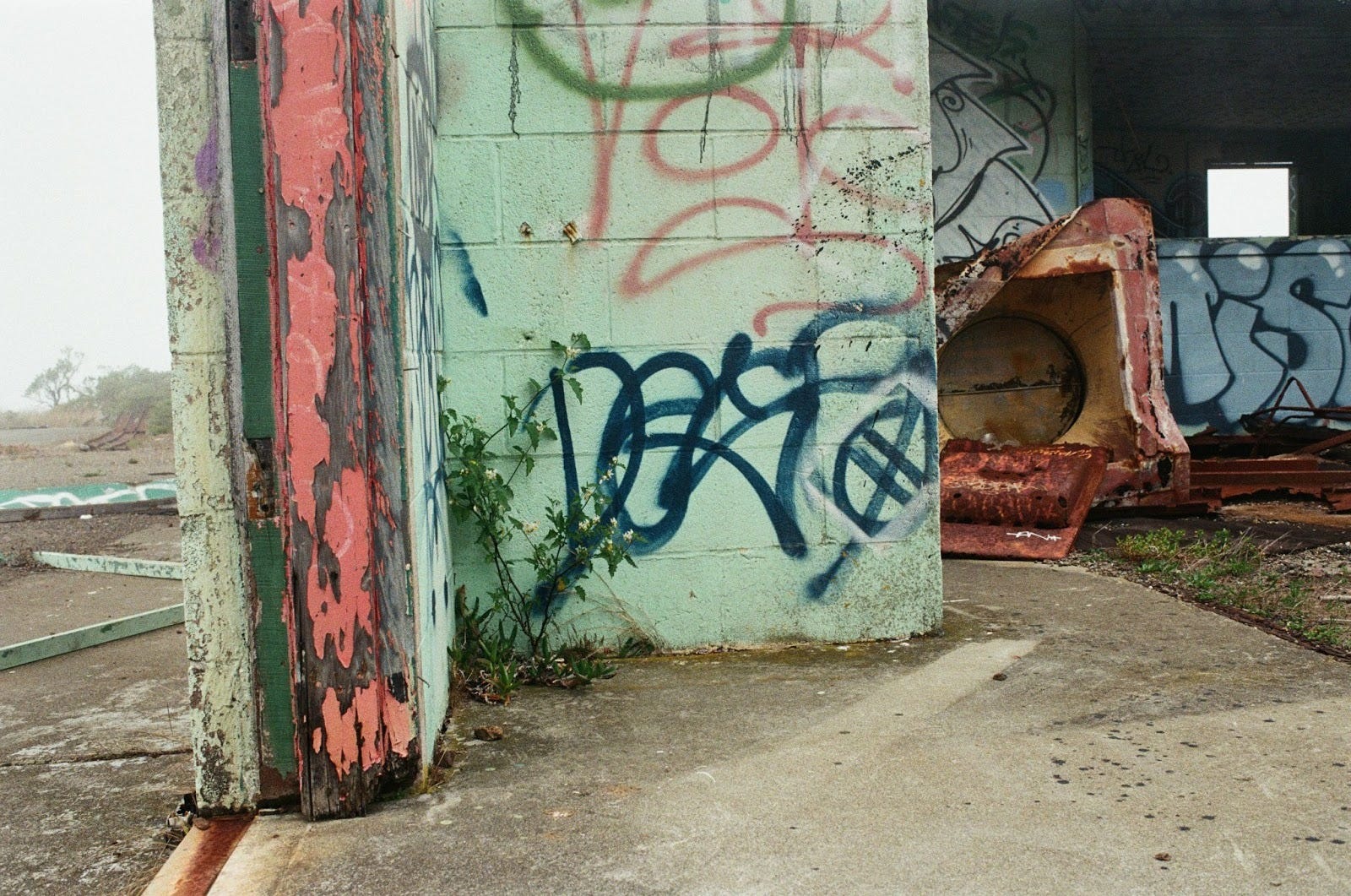
A cluster of thorny weeds growing through the asphalt.
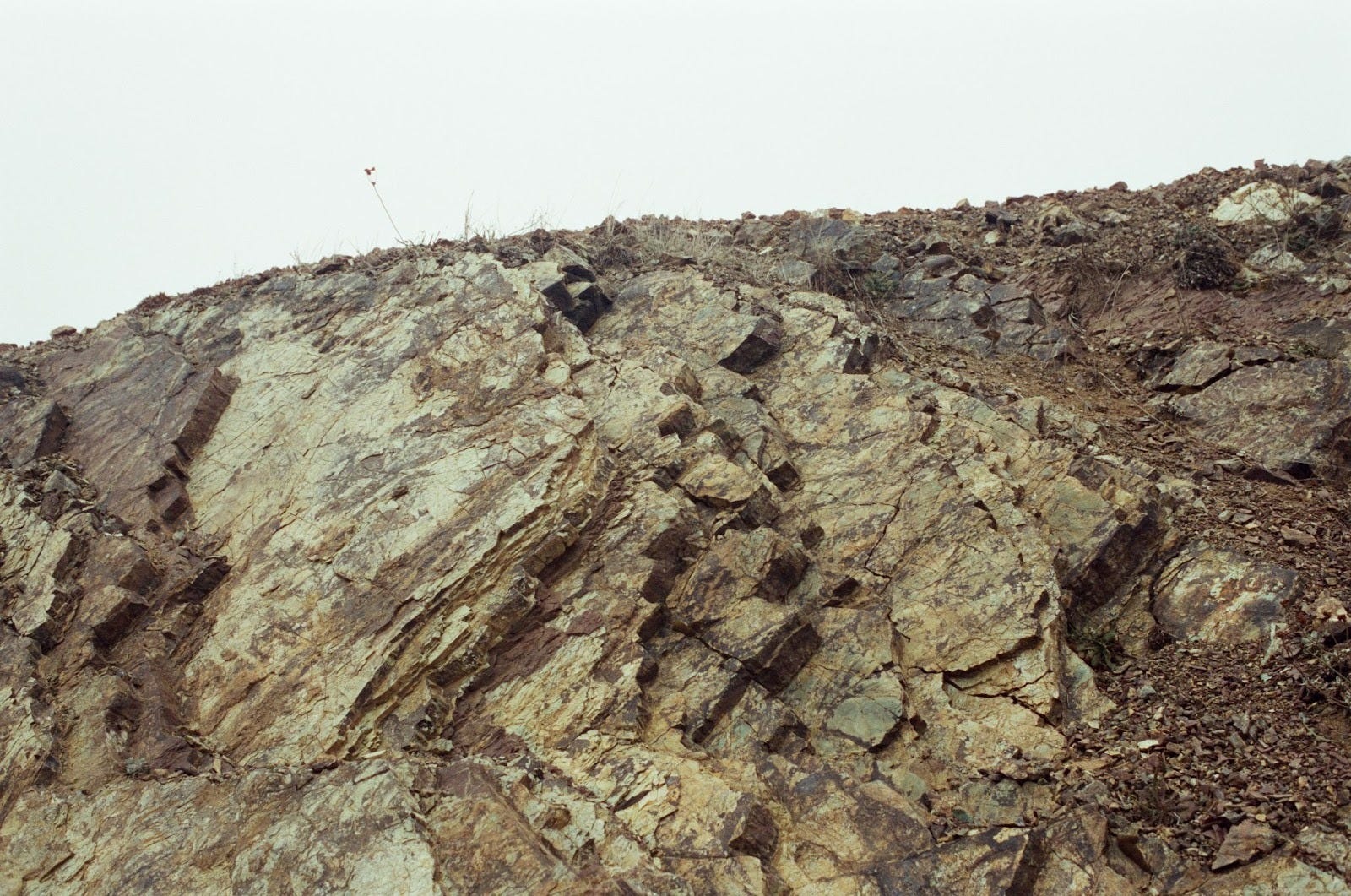
A layer cake of rocks sloping down the ridge.
A mossy branch extending up where there was once a door.
I am drawn to scenes of rupture, threshold spaces. The texture of change. The architecture of things becoming something else. Of things in deep metamorphosis.
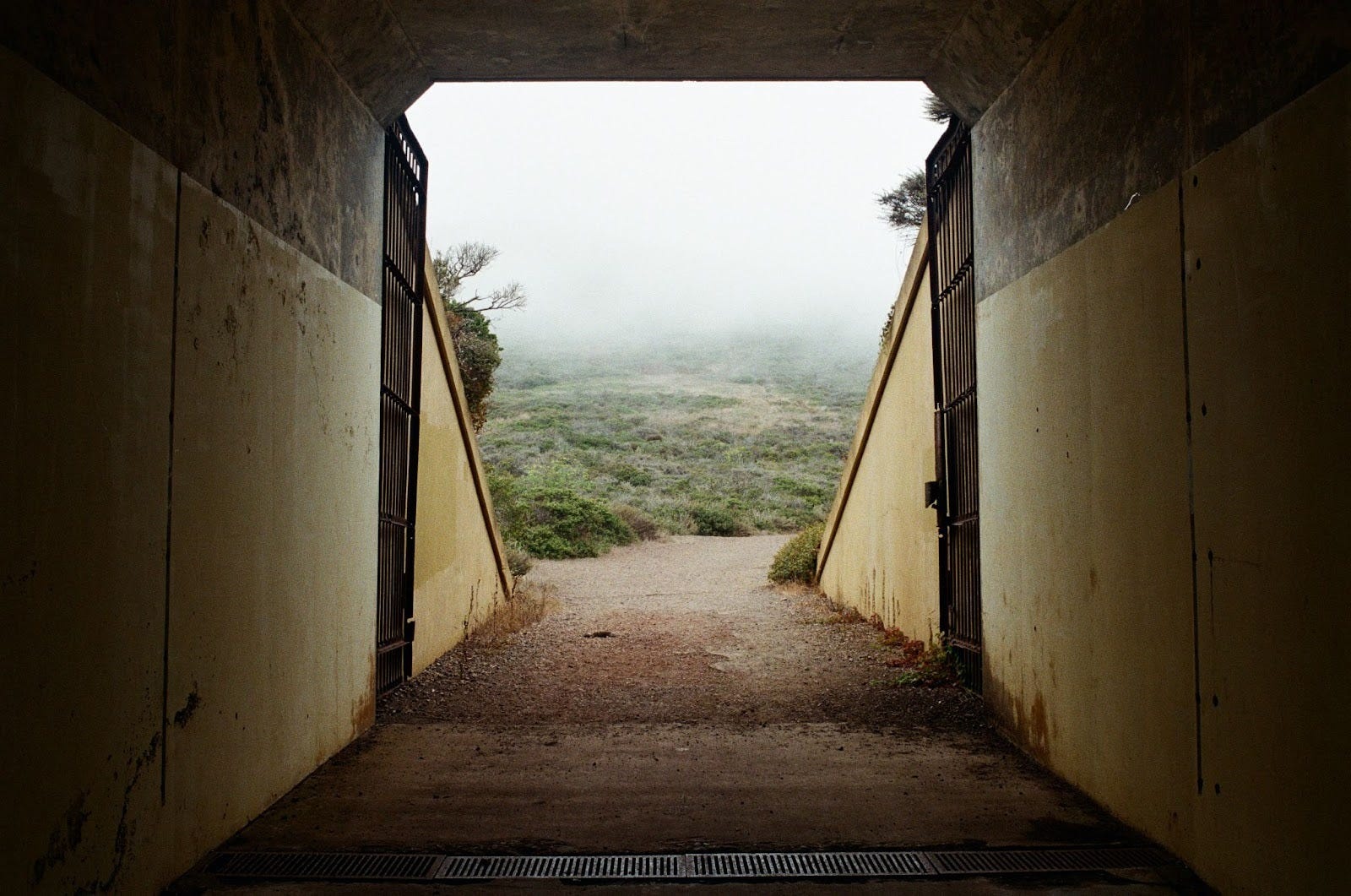
I’m here, I say to the flowers in their graves. They don’t say anything back.
I’m here, I say again, my words echoing down a long tunnel. It leads to a heavily fortified gun emplacement that is now filled with rainwater. The guns have been removed and California newts swim in the swamp. The green is very green against the gray. Lichen and moss spread across stone, across time. On the slopes, coastal sage, seaside daisies, boulders veiled in lace. Spotted towhee and redtailed hawk. Sometimes, a kestrel. There are waves in the bellies below, pushing against the shore. The planet is always pushing against itself. Always eroding.
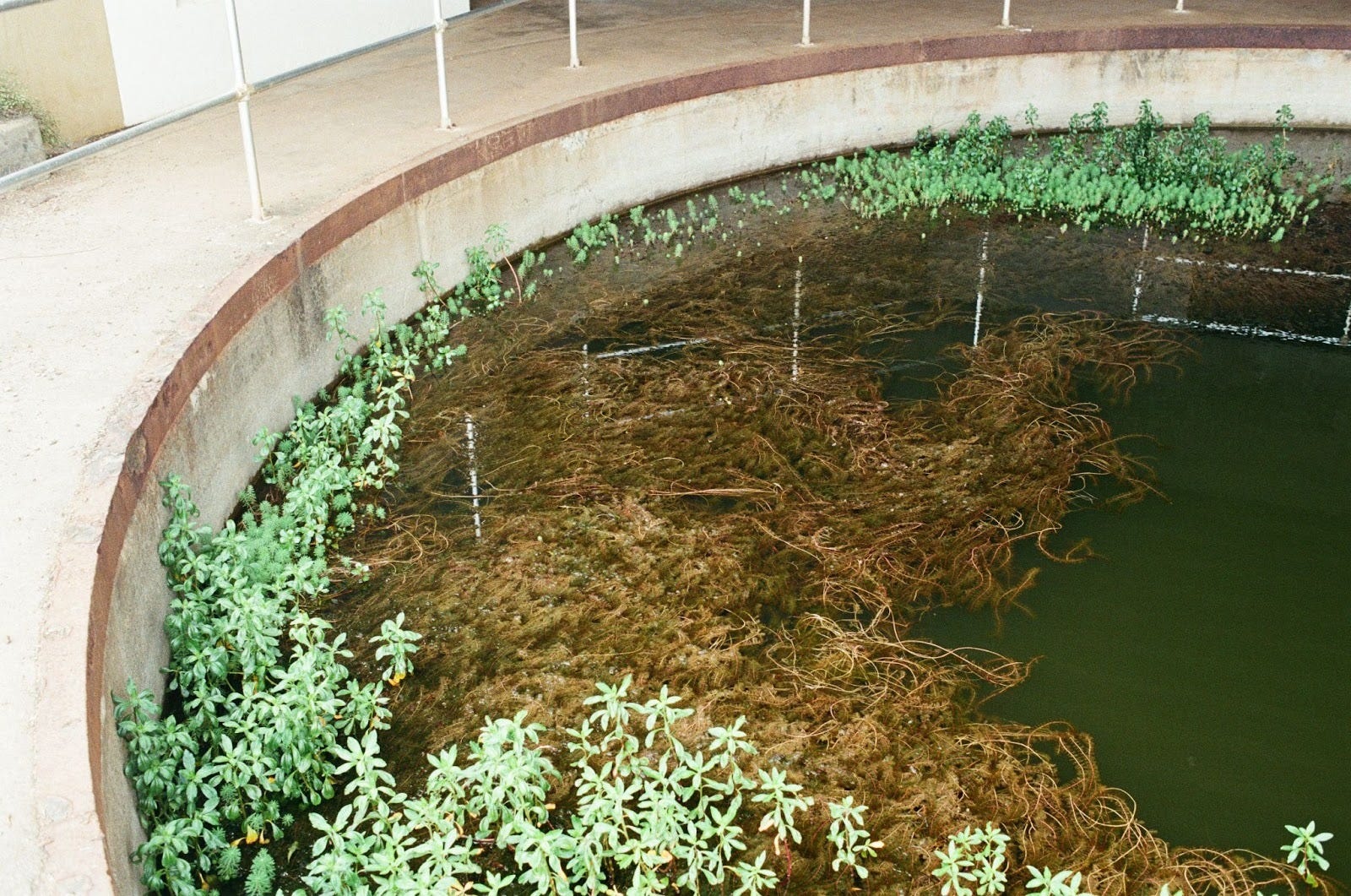
I keep moving. I think of my daughter, begging to be seen. I think of my own small body, a trembling thing. At some point in the 1970s, men walked away from Hill 88. They did not undo what they had done. There were no wars but their wars.
The earth here is fighting no one.
It’s noon. Past the battery, there is a dead rabbit lying in the dirt. Everything silky and still except a hole below its head where a wasp is crawling in circles. Dried blood and weathered bone, ears gentle in the dust. Its fur is so tender I almost touch it. Its killer has left the body behind. I can’t stop staring at its tiny feet resting on the path.
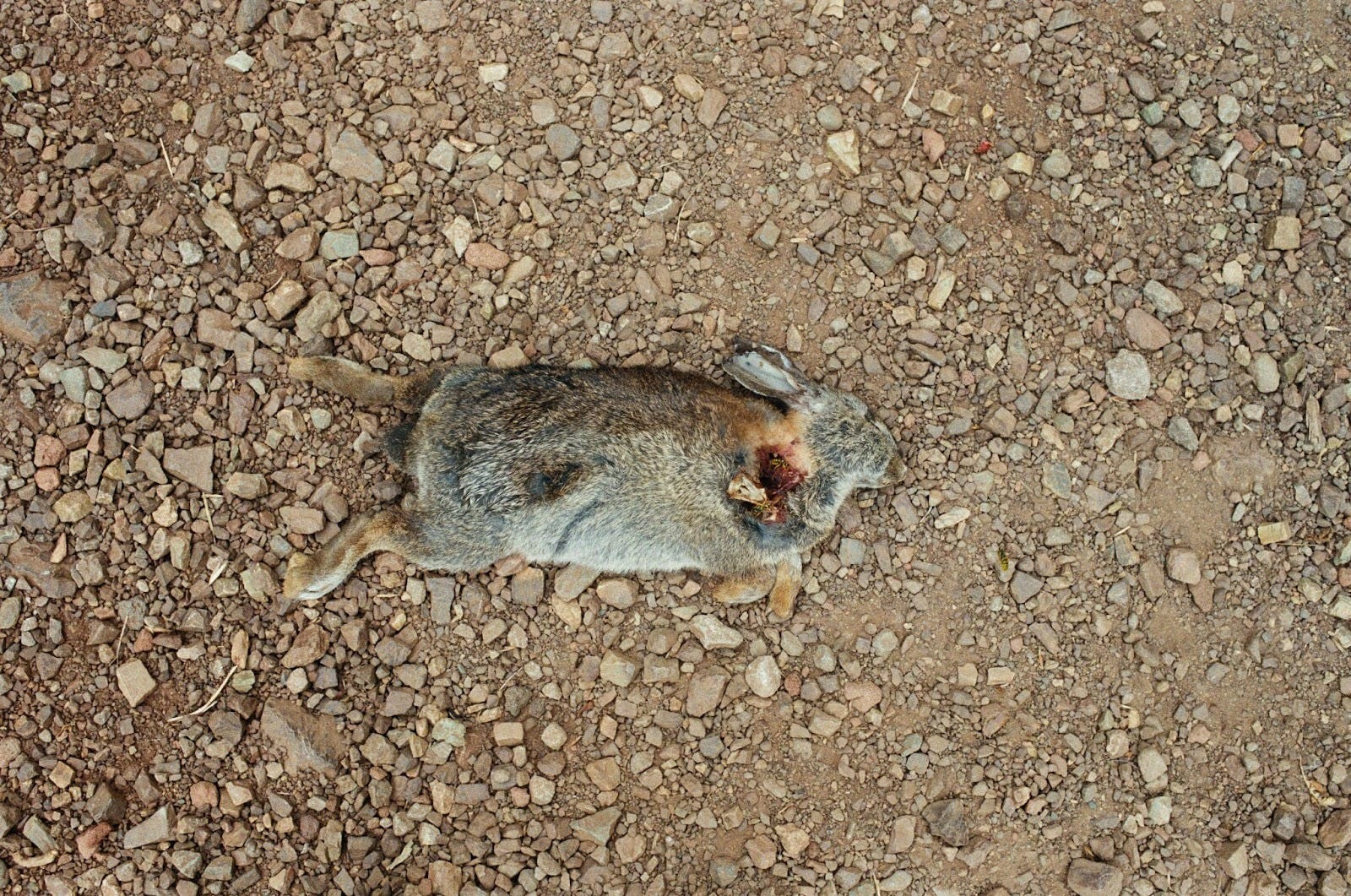
Once, I found a rabbit’s foot keychain at a roadside rest stop during a family vacation. Rich cream, with a tiny dewclaw sticking out along the side. I begged my father to buy it for me and he did, laughing, certain it would not bring me luck. At night, I’d hide in my closet and rub the velvet fur against my cheek. I wasn’t wishing for anything. I just liked the way it felt.
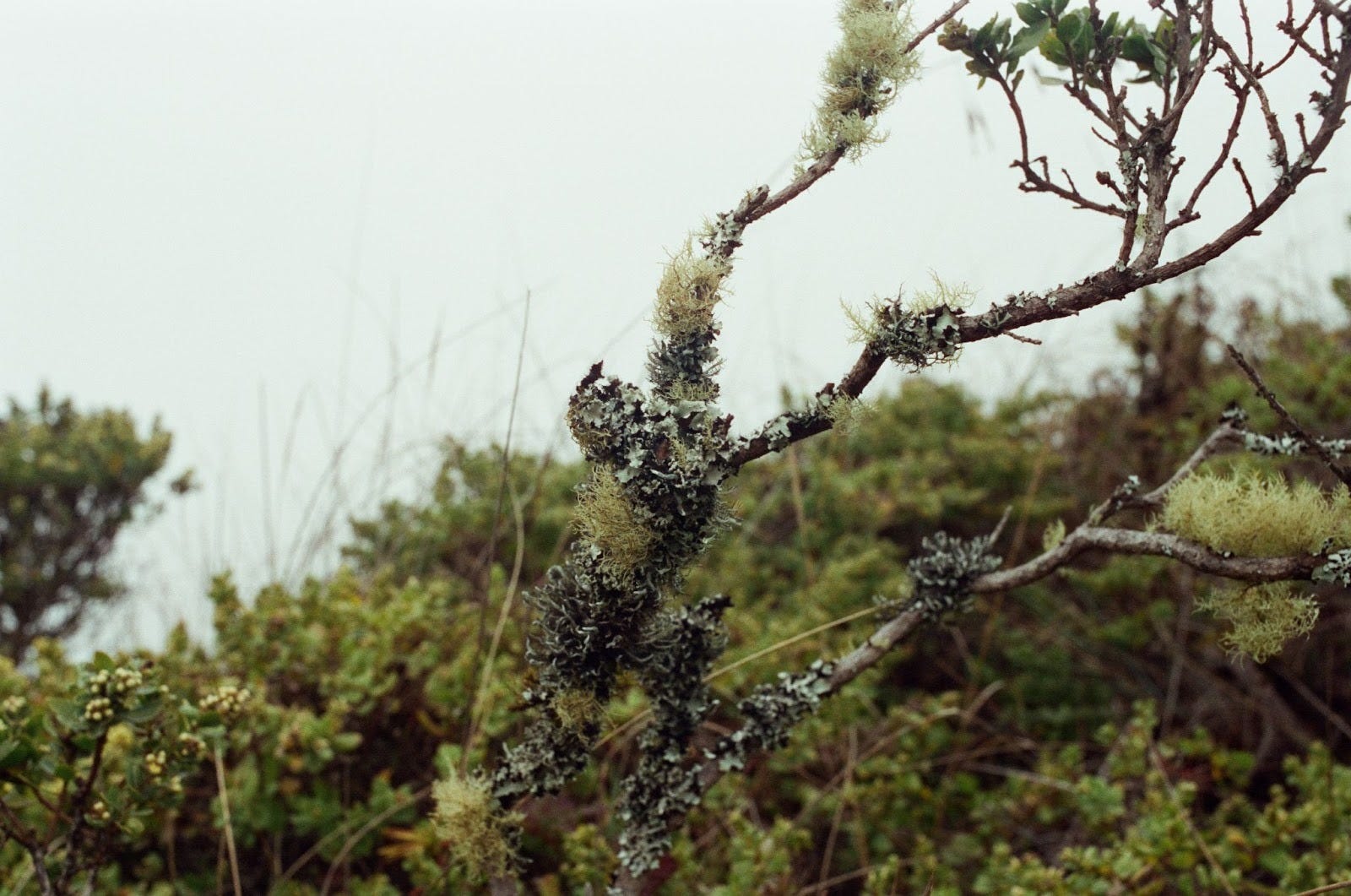
At the top of the ridge, the wind has picked up. I sit down in the dirt and rest my back against the stone scripture, next to a small bush with mossy stems. I close my eyes and think about soldiers and ancestors. I think about the women who came before me, who folded my body into theirs like so many Russian nesting dolls. Mother to grandmother, great-grandmother and beyond. Eight years ago I grew another life inside my own and barely paid attention to the growing. I felt half-asleep through it all. I had no god and no magic and I did not see the ways I was becoming an ancestor myself. In childbirth, my insides were ripped apart, abdomen and uterus exposed to the sky, and I did not feel my body beneath it all, wet and leaking.
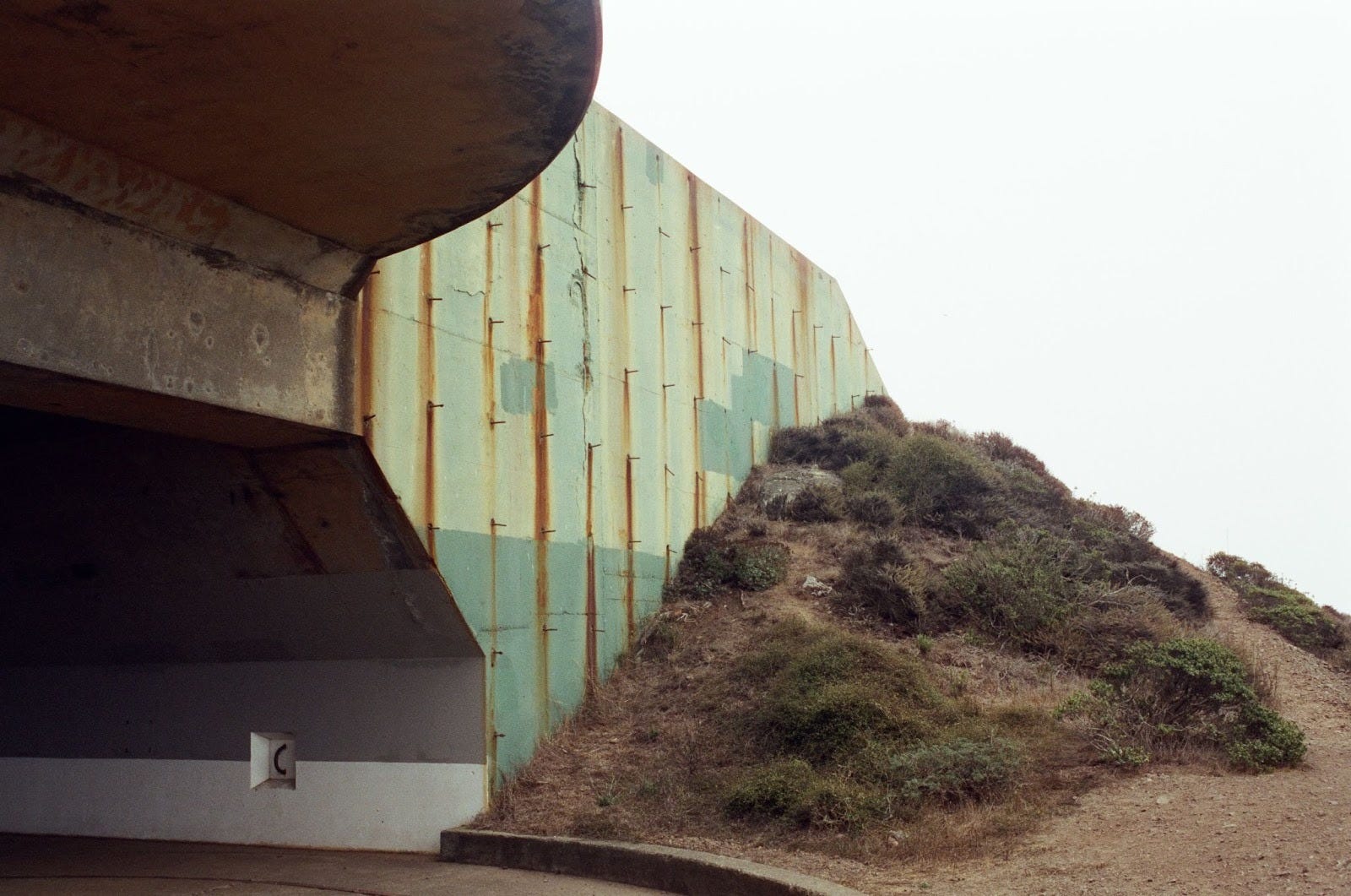
But on Hill 88, I feel everything. I feel how the land breaks again and again. I feel how the breaking means it’s still alive. I collapse in this familiar place of endings and beginnings, an upward spiral. My legs are sore and heavy but I am light, like the space between atoms rearranging. A molecular condensation and evaporation. I crave the mess of it all. The deterioration and abandonment. The contrasts and contradictions. The wild wild life climbing in the wreckage.
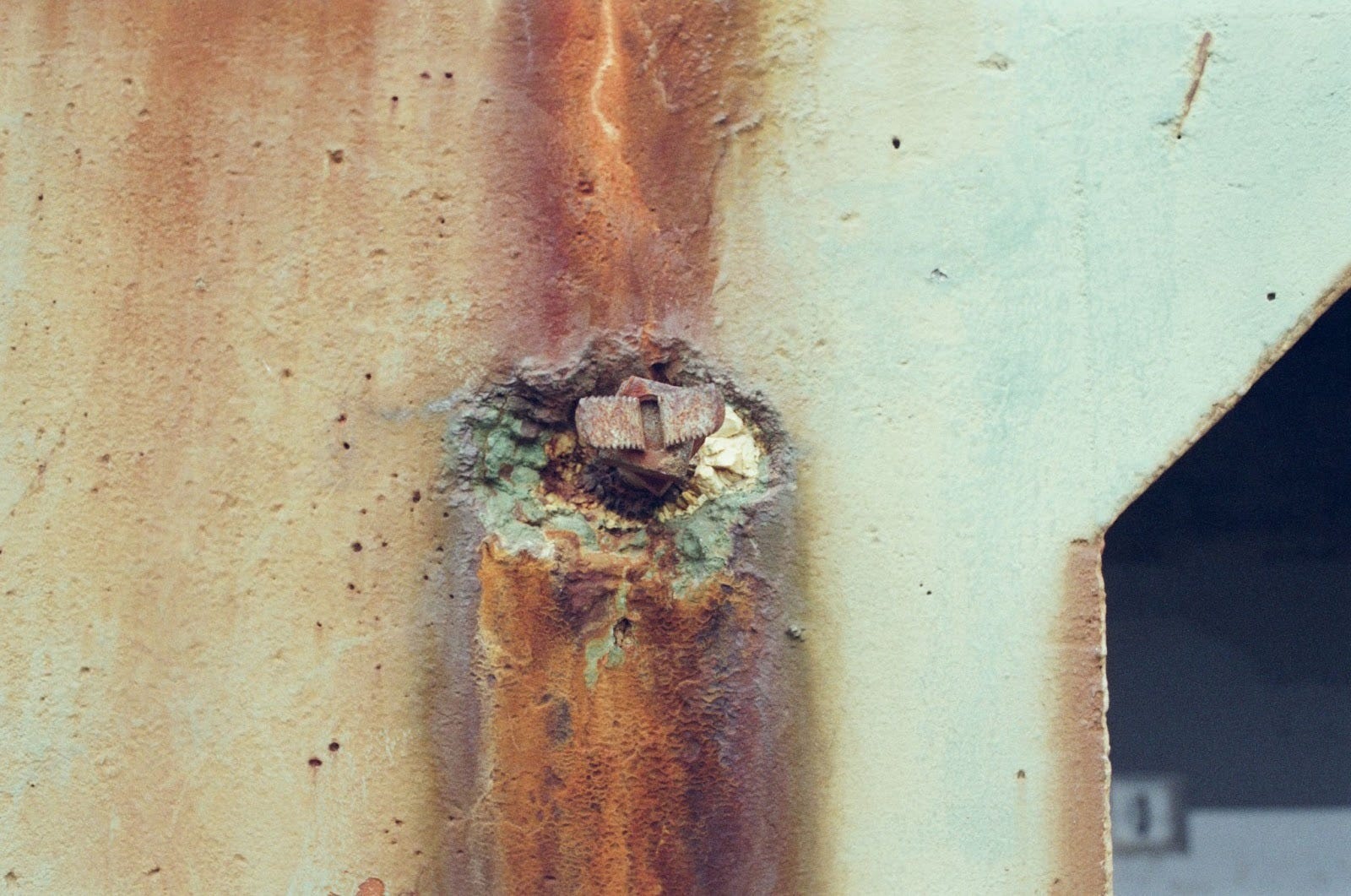
Below me, the battery wall is bleeding rust, the slow oxidizing of what’s been carried for too long. Corroded bolts, metal shutters warped open like tired eyes. Water collects in the wound. Before she died, my grandmother told me that she used to swim naked in the Atlantic at dawn. She was seventeen and didn’t know how to hide her Jewish nose. She said the salt water stung but wouldn’t show me the scars. I wonder if she held her breath the way I do. That fall, Hitler invaded Poland. My grandma shut her eyes and just kept swimming.
Up here, I open wide. I stretch my hands towards the darkest thing I can find and try to hold it softly. I listen to not-words, feel the edges of my body brush up against the world. I am learning what it means to stay inside my skin. To stop running from the impact. I breathe into my low belly, into the place where my daughter emerged. There is a thin white crescent from the incision, still visible all these years later. I like it when my lover places his hand over that fault line. That place where my body wants to remember itself.
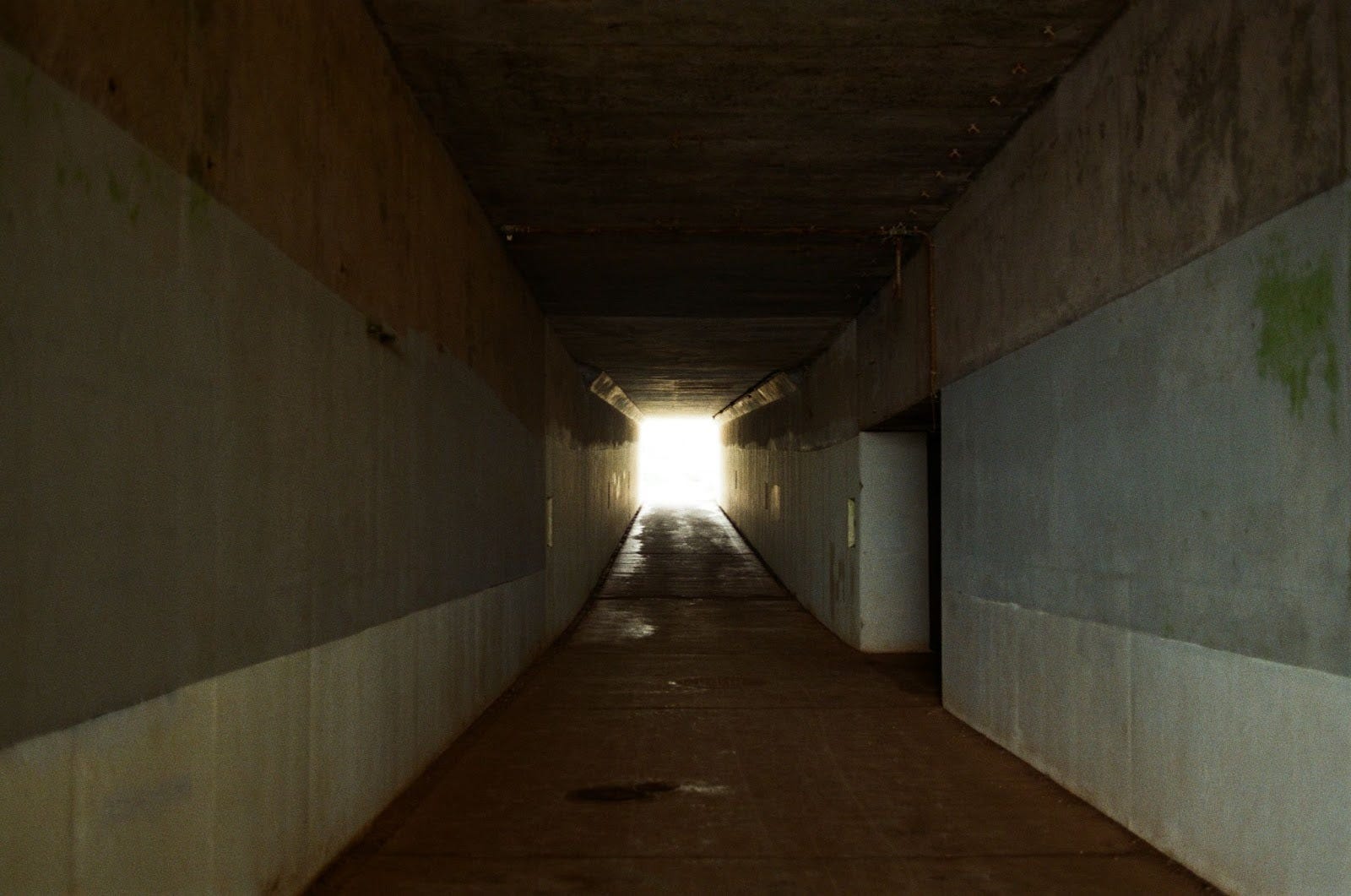
I hike down to the bottom of the hill the long way, winding through Wolf Ridge Trail to Miwok Trail. Before the parking lot, there’s a small lagoon. The water is calm, no wind, nothing to ripple the surface. I glance left to look for oncoming traffic and see a coyote staring at me. Eyes narrow and sharp, as if it’s measuring my intentions against its own long memory of survival. I resist the urge to pull the camera up to my face. It turns and trots away, towards the coast.
I stand rooted to the moment, awake to the hunger coiling inside my body like a double infinity. Two figure eights in an endless loop. I breathe in through my nose and out through my mouth, emptying my lungs.
And then I keep walking.

Tell us your origin story as a writer. When did you begin? What first drew you to writing as an instrument for asking questions that can’t be explored any other way?
Hannah Levy: I began writing by journaling. My first journal (okay, diary) is from 1994, when I was 8 years old. I have a big box of notebooks from over the years, my prima materia. Confessions, short stories, endless lists of hopes and dreams. Existential wonderings. I was unfiltered, and I think I knew I was writing to my future self. I wrote to hold on to experiences and ideas, to capture them for later exploration.
I also devoured books. In the summer, with endless unstructured time as a kid, I'd go through 5-10 books a week. Reading felt like falling through a trapdoor to somewhere lush and wild, like spiraling toward the center of the universe and back into myself. I've always wanted to take people there, to that place of deep feeling, using only my voice on the page. Connecting with people across space and time through language is magic.
What does your writing routine look like? Do you thrive in structure or wildness? And when you begin a piece of writing, what tends to announce itself first: a voice, an image, an unease, a philosophical conundrum?
HL: It's chaos over here. I have tried so many writing routines (morning pages, pomodoro technique, the list goes on) but frankly, what works best is surrendering to the energy I have on any given day.
Since ideas usually strike at the most inconvenient moments, I end up writing feverishly when I am anywhere but in front of a computer. I have hundreds of Notes app entries on my phone, some just a line or two, some sprawling thousand-word essays. Half stream of consciousness gibberish, half polished prose. I usually begin with place and setting, layering in detailed images before following the narrative thread from there.
When I feel stuck, I'll go on a hike and set a loose intention of opening my creative channel. It helps me glimpse all of the strange, intricate connections in the world. When I move my body and feel my pulse, I start to build on those connections. I'll leave myself voice memos as I walk.
When it's time to get serious about a piece, I sit at my laptop to write and edit. Usually at the same time, which I’ve been advised to stop doing, but I can’t seem to kick the habit. It’s a slow and dreadful experience. I love every moment.
I do have some guardrails slash guardian angels. I'm in a writing group called Gather, which offers both community and education. When it’s in session, we meet weekly for 12 continuous weeks. There are prompts for shaking things loose and opportunities to workshop drafts. I've also been working with Joseph Fasano, a poet and novelist, whose mentorship and editorial support has been transformative. I’m endlessly grateful.
Most artists are preoccupied by certain obsessions: lust, longing, death, the self. What persistent preoccupation—emotional, intellectual, or spiritual—threads through your work? Are there motifs, themes, or impulses you’ve tried to abandon but that keep returning, insisting on their relevance?
HL: Recurring obsessions include nonlinear time, memory, loneliness, abandonment, girlhood, grief, embodiment. Parenting as a portal. Water wells as a metaphor. Desire and eroticism.
I will often get very attached to a specific subject and research it relentlessly (see: black holes, electromagnetism, multiverse theories, cults, plant consciousness, ancient civilizations, mass extinction events). Sometimes those concepts surface in my writing, but not always. It’s more like I'm writing from beneath their shadow.
If not a writer, who would you be?
HL: I think I was born a writer and then proceeded to talk myself out of creative writing for most of my life. Probably why self-abandonment comes up a lot in my writing. I've spent the past 25 years (painfully, ecstatically) finding my voice and my way back to writing, so it's hard to imagine being anything else. But in a parallel universe, I’m living on a ranch. Riding horses, wrangling cattle, growing all my own vegetables. Letting my daughter have too many barn cats. Watching the sky every day.
What’s the best piece of writing advice you’ve ever received? Alternatively/additionally, what’s something you’d like to offer as advice to emerging writers trying to make a mark?
HL: Joy Sullivan once wrote, “A poet's true job is not to offer advice, but, rather, to aptly name the ache.” I think about that all the time as I'm writing. It helped me understand that my work doesn't need to feel conclusive. I don’t need to tie everything up with a bow. I can unravel on the page and that will be enough.
For writers “trying to make their mark": When I first started submitting my work to literary magazines and posting it online, I felt envious of the folks in my orbit who seemed to be moving faster, publishing in prestigious journals, getting book deals, growing their audience. Instead of fighting the feeling, I learned to use it as information. Envy is a signal: it clarifies what I want and gives me permission to reach for opportunities that might otherwise feel out of my league. The harder work has been in accepting that my timeline will not, and does not need to, look like anyone else's.
So my advice is to become a student of your envy and then respond accordingly. Submit boldly and take risks you might otherwise talk yourself out of. Then, try to stop measuring your progress against someone else’s pace. Stop looking sideways and return to yourself. The work only moves when you do.
What are you working on now and how is it trying to ruin your life (in a good, necessary way, of course)?
HL: I am working on a lyrical essay about time and memory, about bodies of water and the water in our bodies. It’s also about becoming a mother and ancestry. The different ways we submerge and save ourselves. There are references to outer space and hypnosis and past lives and Greek mythology. It’s trying to ruin my life because I want to be a flood, but instead I am a faucet that drips and drips and drips all night. I'm writing and deleting and rearranging and color coding in Google docs, I'm workshopping singular lines and ignoring too-long paragraphs. It’s unruly. A necessary mess.
I'm also currently in the middle of vetting submissions for The Rebis, the tarot-themed literary magazine I started in 2022. The creative process could not be more different. I approach editing a publication with so much more discipline and structure than with my own work. With my writing, I am in the basement, staggering in the dark, learning by touch rather than sight. Editing The Rebis, I have a clear vision. I can quickly and easily see the shape of things. I work a more typical 9-5 schedule.
The Rebis is print-only, and I enjoy the creative challenge of making a physical, tactile product. Creating an energetic experience for the reader. I think of it as an antidote to AI, to screens, to quick hit social media consumption. I'm going for depth. Every issue we publish explores a single tarot card through fiction, creative nonfiction, poetry, and artwork, and this next volume focuses on The Moon. It's a tricky archetype. The Moon is an obvious literary trope, so I want to give our readers something unexpected. I'm hoping to offer bewilderment, in the most provocative way possible. The mystique of the unknown.
Who are the artists—writers, filmmakers, thinkers, internet oddities—that have shaped your sense of narrative? How have they rearranged the way you see the world on the page?
HL: I read Francesca Lia Block’s “Dangerous Angels” series in the late 90s and felt transported. The imprint was immediate and deep. (Weetzie Bat, be still my heart!) Block’s writing is intense, mythic, embodied. It was unlike anything else I had read at the time—my twelve year old brain exploded. It's a saturated experience, with ethereal descriptions of skin, scent, hunger, taste. She has a distinct mosaic style of writing featuring interconnected vignettes that really inspired my voice. Her books are also deliciously feminist and queer.
I’m drawn to the visceral, dreamlike, and radically intimate. Recent sources of creative inspiration include: Adrianne Lenker’s songwriting, Clarice Lispector’s “Água Viva,” Natalie Diaz's “Postcolonial Love Poem,” and Sophie Strand's spiritually ecological storytelling.
Finally… adrienne maree brown’s book “Emergent Strategy” dramatically altered my relationship to the world when I read it in 2019, especially their writing on attention, presence, and fractals.
Please recommend a piece of art (a painting, a film, an album, anything that’s not a piece of creative writing, really) that you love and would like everyone to experience.
HL: “The Moon And Stars: Prescriptions For Dreamers” by Valerie June. One of my favorite albums. She’s otherworldly and a delight to witness in person.
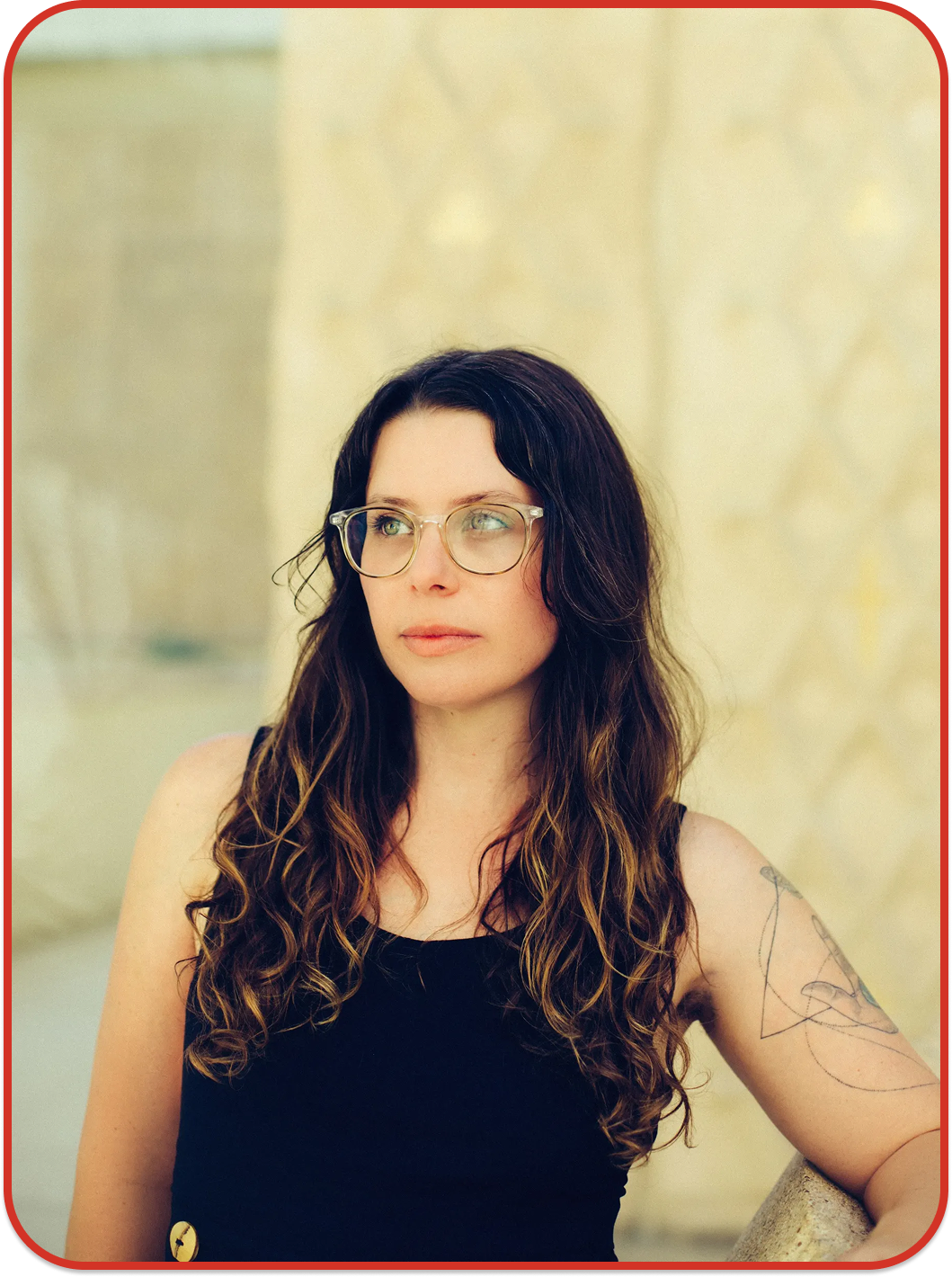
HANNAH LEVY is a writer and editor living in Berkeley, CA. She’s the editor-in-chief of The Rebis, an annual print anthology that celebrates the connection between tarot, art, and creative writing. When she’s not reading or writing, she’s hiking in the redwoods, horseback riding, and playing extensive make-believe games with her daughter.
Note on Art
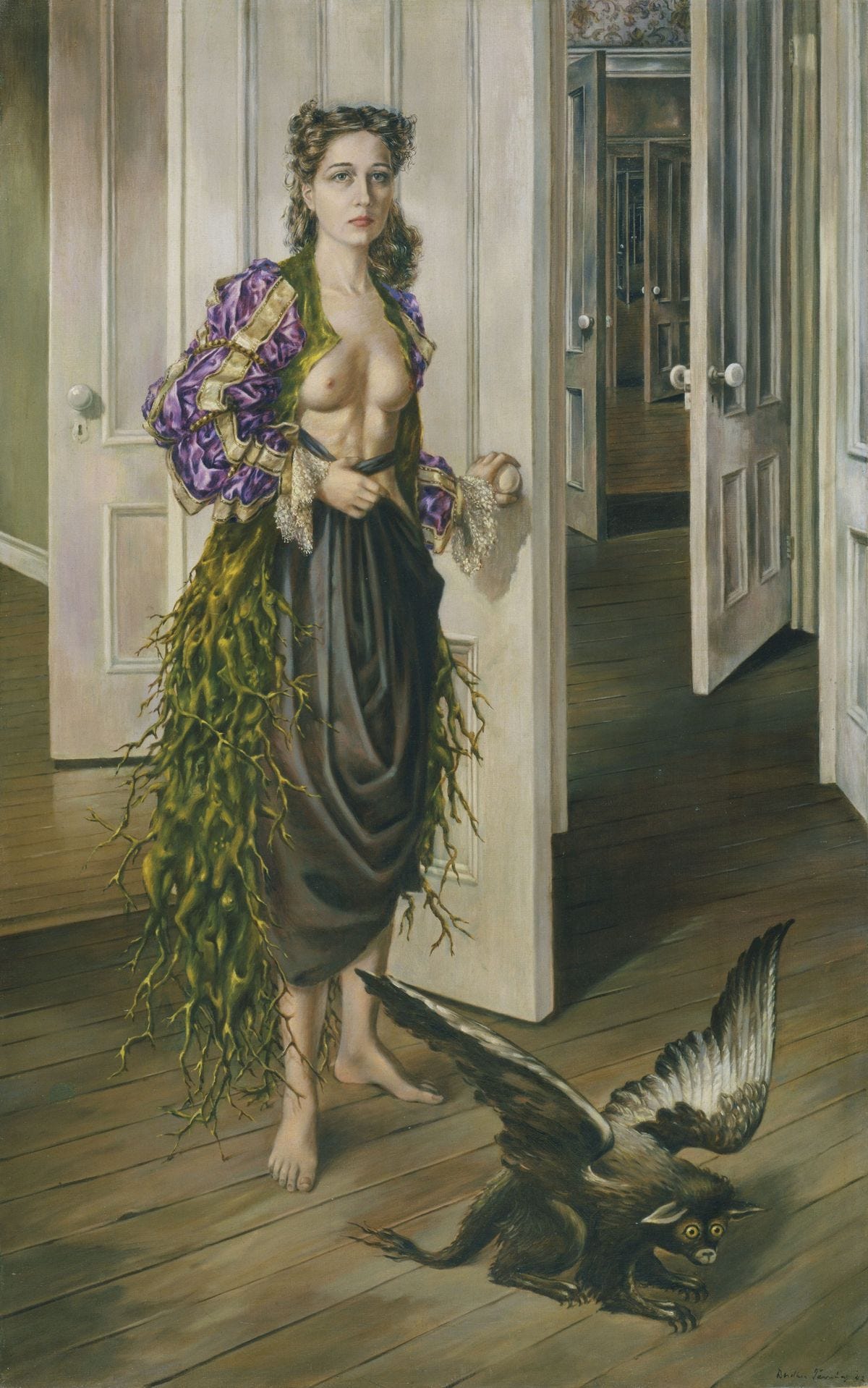
Tanning painted2 herself bare-chested in a hallway of infinite doors, a winged creature crouched at her feet, roots and vines scaling up her dress and body. Levy’s essay moves through a similar architecture—military bunkers returning to moss and stone, a body marked by incision and inheritance, the decision to stop running and feel it all. Tanning said she wanted to paint “unknown but knowable states.” On Hill 88, Levy photographs them: the “threshold”, the “rupture”, the “wild life climbing in the wreckage”.
All the photographs were taken on Kodak 400 film by © Hannah Levy.
Image: Birthday © Dorothea Tanning. Used for editorial commentary purposes only. All rights reserved.
Holy shit, this was a captivating read. I felt like I was on that hike with Hannah the whole way. It's my favorite Strange Pilgrims read so far.
And, I love this from the interview: "So my advice is to become a student of your envy and then respond accordingly. Submit boldly and take risks you might otherwise talk yourself out of. Then, try to stop measuring your progress against someone else’s pace. Stop looking sideways and return to yourself. The work only moves when you do."
There's so much good stuff in this, I am torn about what specifically to pull out and restack... (it is a good problem to have.)
Wow! Thankyou for sharing. I loved this imagery in particular:
‘The sky is surrounding. Not blue but ash—the color of pencil erased from a page with no answer.’