



Hello fellow strange pilgrims, finding a review or critique was one of the hardest things this first submission round and I must say, I was not expecting that. The whole lovely ordeal revealed to me even more that to review something—enter into a thing, idea, object, book, etc—deeper than just recommending it or experiencing it, is an act wholly more difficult than we might at first conceive. Charlie Ericson accomplishes something sublimely wonderful, then, by reviewing life itself!


There are good points and bad. No one ever seems to know what you mean the first time you say it; on the other hand, if you stand next to a ponderosa pine just before dawn in a thick snowfall you can catch a heady vanilla in one nostril and sharp clean winter in the other. There is an overabundance of big blocky-lettered logos on grocery items; your fellow participants so easily fall into hating one another; everyone has apparently agreed that efficacy is more important than both truth and delight, to the point of pretending the uniform duration of individual seconds is more real than how long or short each one becomes in its day. But there are wonderful boxes of heat and light where we put our beds and our dutch ovens and construct, based on centuries and millennia of accumulated knowledge, comforts our ancestors could never fathom.
A few of the more important gripes: no one has yet seen a unicorn. There seems to be an imbalanced agency mechanism, which means you will often feel that no matter what you do, the world passes by without seeming to glance up at you. At some point in your late twenties or early thirties you’ll notice that your heels and palms get weirdly dry and even speckle in places like a piece of igneous rock. Each year more of the items for sale in drug stores will be locked behind plexiglass sliding doors. You’ll be forced to acknowledge almost forty percent of the terrible things you do, and the lurking suspicion that more is going unacknowledged will eat away at you like the proverbial worm in the proverbial apple. Proverbs will seem less and less like public property, and more like something you imagined you heard one time when you were small. Your fingers (and at some point your knees, elbows, neck, ankles, upper back, wrists, base of the skull, hips, toes, and lower back, not necessarily in that order) start to ache when the weather turns cold. You don’t go all the places you want to go, but that one isn’t so bad, because you forget that you wanted to go some places. You wind up far more self-conscious of the things you say and do than you ever wanted to be, and the times this makes you proud of your actions are miserably few in comparison to the times this makes you aware even in the moment of your total social inadequacy. Insurance is a pain in the ass. You discover all the books you needed about six and a half years too late. Other people’s forgiveness doesn’t automatically generate your own. Everything breaks, even things you would never suspect of breaking, like ceilings or ovens or roads (these can even slide off into the creek sometimes, or crack open so badly in the changing seasons that they get closed down for nine months straight) and there will always have been signs the break was coming that you failed to recognize until way too late. Sometimes you feel like your body and your mind are not on the same team. Things you hate the first time you try them are surprising and good a decade later, and you have to wonder how many years you could have been enjoying anchovies or campari before you got wise. At least one of your fellow participants in any given room is a pain in the ass, always in a more inscrutable, unlikable, inane way than they first appear. Whole mornings will spin away in longing for something you can’t name. Everything is either tacky, drab, or gaudy on first perusal. Most objects are so enmeshed in the history of their form that you wind up making thousands of mistakes you’re never allowed to notice in which pictures you put in what frames and whether you use artichokes packed in water or oil for that appetizer and how you grabbed the winged corkscrew instead of the wine key to open the syrah for company. You will be constantly aware of the ways living at a different time would have been more comfortable (no internet to show you a better guitarist than you’ll ever be, no insurance companies profiting off of undeniably necessary fear, cleaner air, quieter days) and at the same time of the ways your life could not happen in those times (you will fall in love at least a little with someone who would not be accepted in yesterday’s society, you will need penicillin, you will confront the fact that milking a cow is weirdly hard, even if you technically know how to do it). Fellow participants you believe to be evil will have power over you. No one has recently encountered an angel.
I was all set to walk out with a totally negative review. I even tried to leave once, but I got caught in some brambles by the door and a few fellow participants convinced me to stick it out for a little while. Then recently (eight and a half years after I first decided to leave) I went to a used media store—physical media, which we’ve been saying for years is on its death bed, lying in its grave, spitting out the first handfuls of dirt, folding its hands over its chest, etc. I was flicking through DVDs and a worker came and started flicking through beside me. Assuming he was there to assist me, I told him I was getting rid of as many forms of internet as I could, one of which was streamed media, and that I needed to start a new DVD collection, and how would he go about building the core of that collection in my shoes. He stopped and turned to me—wow was he tall, and thin too, with hands the size of a light fixture—adjusted his glasses with a finger and thumb, and said “I’m doing the same thing.” Then he told me how he started with a couple of movies his parents loved but that he still hadn’t seen, two that he knew he could watch on a loop forever, a box set of his favorite sitcom, and the Jason Bourne trilogy. While he was explaining his choices I started grabbing movies that fit the same categories in my own life, and when I had them all he took the stack in one behemoth hand and carried them to the front desk, leaving me to keep poking around. I didn’t realize until I got home that he had not actually recommended anything; he had told me in an unpanicked voice about his own intimate preferences, the movie he watches when he’s sick, the one his dad loved that’s been looming as an obligation for years and even more so because he knows it shouldn’t be an obligation, will be a fun watch, but it’s been so long and so much pressure has built up for him to watch that movie; he named his favorite sitcom, which now roughly sixty percent of people would reject as outdated, problematic, and unfunny, without displaying an iota of worry that I would despise him for it. He had given me a way to reconstruct my own life in media, with no desire to sell anything. In fact, his other hand had carried away unnoticed the DVDs he had come to that shelf to find for himself.
This may not seem all that important in the face of the catalogue above. I guess I would just say that the bad points are persistent, but what is good in “Life” often is so because it was unpredictable until it happened; it does not fit neatly into a category of experience you’ve already had; unlike the bad, it is not dreamed of in sweaty, too-bright midnights. The good shows up like a ten-dollar bill in the pocket of your favorite coat from three years ago, and that means it is totally incomprehensible to our rational brains. So I’m going to say thank whatever holy you want to thank that we don’t have to decide whether to leave a good or bad review, because even in the last moment the incomprehensible could arrive.

Tell us your origin story as a writer. When did you begin? What first drew you to writing as an instrument for asking questions that can’t be explored any other way?
Charlie Ericson: I’m sure there was a time before I used (my own written) syntax and narrative to understand the world, but that time falls somewhere before my memory begins. I know that I started to catch a hint of the possibilities inherent in writing when my first year English professor started close reading Paradise Lost aloud; on the other hand, I remember being overwhelmed by the flutter and flock of stimuli as early as middle school, and trying to organize my perceptions with grammar, character, and metaphor at least that early.

What does your writing routine look like? Do you thrive in structure or wildness? And when you begin a piece of writing, what tends to announce itself first: a voice, an image, an unease, a philosophical conundrum?
CE: I’m always coming up with new routines, but in the end the work that has to get finished gets finished in odd moments while I drink a coffee between office hours and teaching, or at five a.m. while I snatch an hour of work while the rest of the apartment is still waking up. Usually the first thing I have to pin down is a set of perceptions, either internal or external, and how they relate to one another—what Ezra Pound would call “an emotional and intellectual complex”—but that comes into conflict awfully quick with the philosophical conundrum those perceptions have drawn up for me, and writing becomes the tracing of a narrow way between bland reflection and rote description. Pound would think letting conundrums intervene is a mistake, and it makes me breathe easier knowing we would disagree.
Most artists are preoccupied by certain obsessions: lust, longing, death, the self. What persistent preoccupation—emotional, intellectual, or spiritual—threads through your work? Are there motifs, themes, or impulses you’ve tried to abandon but that keep returning, insisting on their relevance?
CE: I guess I’m just a dualist living in a materialist's world, because I still believe it's worth trying to worry at the seams of our experience in the hope we’ll find something above or below existence without relying on a notion of the divine to get there.
If not a writer, who would you be?
CE: I truly can't sort out how many times the desire to spend all my days writing and reading sentences has shaped my decisions in life, but probably a hard drinking middle manager in a marketing department who's always talking about the things he did in his youth.
What’s the best piece of writing advice you’ve ever received? Alternatively/additionally, what’s something you’d like to offer as advice to emerging writers trying to make a mark?
CE: In Terry Southern’s interview with Henry Green (whose novels are every one of them polished, luminous little gems), Green says “one should never be known by sight.” Of course he’s being facetious, as he always was when speaking non-fictionally, but that facetiousness is toward the same goal as the sentence itself. Writing is about making something live using sentences. It has nothing to do with me as a writer, and everything to do with the sentences, well- or ill-crafted, that I write.
What are you working on now and how is it trying to ruin your life (in a good, necessary way, of course)?
CE: I’m writing a novel on political violence tentatively called An American Suicide that relies on nested narrators and a vague utopianism to do a whole lot of overambitious maneuvers at once, and be all the while both serious about the questions it asks and appropriately silly about the weight we attribute to concepts when we’re faced with real, horrible, overwhelming action.
Who are the artists—writers, filmmakers, thinkers, internet oddities—that have shaped your sense of narrative? How have they rearranged the way you see the world on the page?
CE: Henry Green, Sergei Parajanov, John Ashbery, Muriel Spark, Ali Smith, Percival Everett, Bohumil Hrabal, Dag Solstad, Miguel de Cervantes Saavedra, among others. The theme here is that silliness and seriousness co-exist, not sometimes, not possibly, but always, necessarily. Every insight worth having is deadly serious, and every sentence worth writing uses pith to make seriousness bearable. Of course, tomorrow I might disagree with this entirely.
Please recommend a piece of art (a painting, a film, an album, anything that's not a piece of creative writing, really) that you love and would like everyone to experience.
CE: Just one? Then Marc Chagall’s America Windows in the Art Institute of Chicago.


CHARLIE ERICSON rarely allows the dust of reading to settle.
Notes on Art
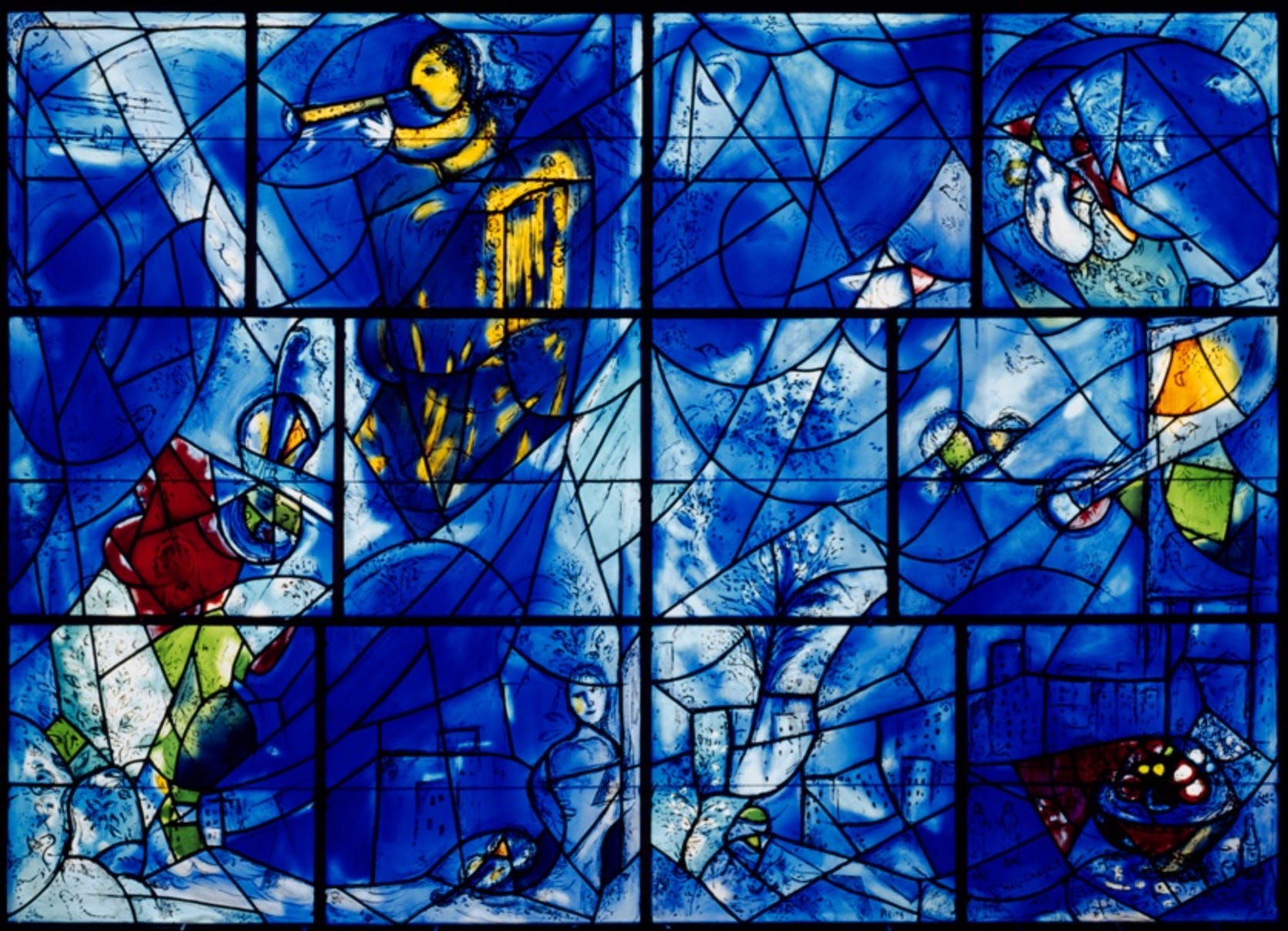
Marc Chagall’s America Windows (1977)1, a gift to the Art Institute of Chicago, is a wall of blue the size of a small apartment — eight feet high, thirty feet across, six panels of stained glass depicting music, painting, literature, theater, dance, and architecture. Chagall was a Russian Jew who fled the war to New York in 1940; thirty years later, he made these windows as a thank-you to the country that let him keep making art. The figures float through blue the way good things float through this essay, emerging as they need to and revealing their meaning. The windows were designed to change with the weather outside, bright off the lake one hour, shadowed by skyscrapers the next. You can’t predict what you’ll see when you walk in. That feels right for a piece about life’s incomprehensible strange arrivals.
Image: America Windows © Marc Chagall. Used for editorial commentary purposes only. All rights reserved.
Loved this! I left this piece with the wistful, Mona Lisa smile feeling I get from watching my favorite movies. I love how the register feels cinematic without using any specific tells, and then the piece kind of becomes about movies. And then after I think about it as a voiceover, and that’s fun, too.
I love this, and this person, just because