



hello fellow strange pilgrims,
I want to point you towards the audio recording of today’s piece. I mean, yes, it’s amazing hearing author’s in their own words, but I also want you to note that our recordings will now live at the top of the post. I was informed last week that the way we were uploading our recordings from writers to accompany their work was not the ideal way to do it.
Below the artwork, people sometimes missed them, but far fucking worse imo was that at the top the article voiceover option you’d get was a weird as AI one. Siiigh, live and learn. In anycase, I’ve gone ahead and done it the right way this time (I hope) and we’ll be going through our archive to update the rest of the recordings over this week also.
Alright, I shall now let you venture forth into this sublime piece of fiction by Kristina!
Yours,


If Dr. Giving knew I was driving eight hours to ride the world-famous jackrabbit outside Winslow, Arizona, she’d roll her lips and do that thing with her jaw that she must reserve for dumb bitches like me.
Which is how I knew, as soon as I heard about it, that I was going to go.
Dr. Giving isn’t her real name, just what I’ve always called her, since she can’t get through a whole appointment without saying her most favorite phrase.
“It’s giving risky, Louisa,” she told me this last time. I didn’t even mention the jackrabbit, a roadside mechanical-bull-type attraction off what used to be Route 66. I only let her know about the drive, which she kind of, sort of signed off on after I promised to wear sunglasses, and take lots of breaks, and pull off right away if I ever started feeling sleepy or lightheaded.
It probably bugs some of her patients, the way she talks, not buttoned-up like other doctors. But I don’t mind Dr. Giving’s slang. I like that she talks to me the way she must talk to other, regular people in her life, who don’t pay her to look at scans of their messed-up brains.
She doesn’t try to sound smart. Which might mean she actually is.
I was never like that, even before my brain got all shaken up inside my skull like the fastest spin cycle. It bugs some people the way I talk, too, I know: lazy, jerky, because the words get jammed up somewhere between where I come up with them and where they’re supposed to come out.
In school, I couldn’t keep up with the other kids. No matter how carefully I read those word problems in math class, by the end of the last line I couldn’t say what had happened. I mean, forget knowing the answer: I couldn’t remember if Little Billy had been handing out stickers or popsicles or pigs. Which is why everybody seemed awful happy for me when I got into cheer.
This was around the time people started paying attention to concussions in football players. But nobody was looking to the sidelines, at the girls in the skirts, and definitely not anywhere above our necks. Anyway, the spill I took was nothing, a bad grip during a basic pencil drop. The PT cleared me the next week and nobody felt bad joking that a few dinged-up brain cells wouldn’t be the worst thing on me. Not like I was tracking to be the next Einstein or anything.
We weren’t called the Jackrabbits, but we were called the Bobcats, or the boys were. And I’m pretty sure bobcats are one of jackrabbits’ biggest predators out in badlands like these. So I figure now that I’m here, at the world-famous jackrabbit, I can eat this one up, too.
I pull into the paved lot in front of the trading post: a long white building painted with cactuses and dancers and tapestries in patterns that make my head ache. Already sore from the bright glare that chased me through the windshield the whole way here, now my eyes feel like they’re vibrating. The jackrabbit must be inside, though the roof looks too low for there to be enough clearance. Once you factor in all the bucking and spinning, and the rider’s arm, which’s got to be held straight up for balance.
But probably somebody else mathed out that word problem a long time ago.
Couldn’t tell you how long this place has been around, but it looks old. Plenty worse for the wear, too, like it’s being pressed between the two hands of the wide flat scrubland and the big open sky.
The directions here were the beginning and end of the planning I did. Lights are no friend of mine, and sitting on the computer for longer than three minutes is one of the things that makes a whole yard of construction equipment go off in my head, still, after all this time.
It’ll be twenty years this September. I’ve done all the tests, laid still in the tight, buzzing tubes, and finally landed on just about the right combination of drugs and more drugs and bedtime supplements. Not much more to be done at this point, not till there’s more research, I’m told. For now, Dr. Giving keeps an eye on me. She’s the one who thought to ask if I’d had other concussions before I took my tumble that night against Central Valley. Except she didn’t use the word “concussions.” She said, in her super loose, undoctorly way: “knocked around.”
“Guess my dad was kind of an asshole,” I admitted, and she did a different thing with her jaw then that I hadn’t seen before.
The headaches come and go, and they aren’t the worst of it. That’s me losing my spot when I’m right in the middle of things, dropping out of conversations. I’ll hear the other person talking, but I won’t pick up that they’re talking to me. It’s just like the TV’s on quiet in another room.
So I have to concentrate real hard when the man inside the trading post says welcome in.
“Thanks,” I tell him, scanning the racks of Route 66 calendars, display cases filled with pretty Navajo beaded earrings, T-shirts printed with the wavy words “Mother Road.” It’s all too much, and I have to look down at the tile floor, where the dark speckles, jumping side to side, are the only dots I have to keep track of.
“Can I help you?” the man says.
“You still have that, um, jackrabbit around?” I ask, and immediately want to kick myself. No, Lou, of course not. They decided to move their main attraction, a probably-thousand-pound gyrating rabbit, steel frame and electric motors and big padded mat and everything, just for no good reason.
The man thumbs at the door behind him.
Pulling my hat down against the shop’s humming overheads, I tip the brim at him. I bring a handful of cactus-flavored candies up to the counter, then toss in one of those flashlight pens from a box next to the register, because it reminds me of the thing Dr. Giving shines in my eyes.
Behind the man, a wall of old photos shows Route 66 at what must’ve been its prime. A young Johnny Cash leaning against his Plymouth Savoy outside a sweet, dusty diner, exactly the kind that can’t afford to keep the lights on anymore. I know what it is to dwell on the past: if only my arms had stayed locked at my sides, if only my base hadn’t squeezed so damn hard. It’s a waste of time, but at least it’s only my time I’m wasting. This nostalgic Americana shit, though? It gets me down. Bound to keep some actually capable people from doing something of worth with their lives.
To the left of the photos, there’s a window, and through the window, I see the billboard.
It’s built on a handful of low wooden posts. Yellow background, huge black jackrabbit next to a row of letters in peeling red. I squint to read them:
HERE IT IS.
“Jackrabbit’s over there, I take it?” I ask the man behind the counter.
He looks over his shoulder, confused, like he’s hearing about this billboard for the very first time. “Oh, that? Nah. The rabbit’s on this side of the road, just out back. Can’t miss it.” He finishes ringing me up, adds, “This place was built on a former snake farm, you know. Careful where you set your boots down.”
I think I’m out fast enough he doesn’t see me wincing. At the megawatt, billion-bulb stadium his shop was getting to be, and the ringing echo his voice took on halfway through his first sentence. And at that word, “careful.”
That’s been my life these past two decades. Every doctor’s favorite phrase. Dr.
Giving’s second favorite phrase, which is why I like her best of all.
“The goal now,” she’s told me gently, lots of times, “is to prevent further injury. You need to be more careful, Louisa. I’m concerned about these new cognitive issues that’ve been popping up. All this negative self-talk…”
Before she could say those other words I can’t stand—CTA, neurochemical imbalance, dementia—I cut in.
“Careful. Got it.” Then, to give it a try, “It’s giving Bubble Boy.” She laughed so loud the nurses outside stopped talking, even though she admitted later she hadn’t seen the movie.
I can live that way, maybe. Can maybe even start soon. Just not in the sliver of time between learning the world-famous jackrabbit exists, only a couple states over, and getting the chance to ride it.
I used to be the Lady Bobcats’ lead flyer. Used to measure my life in the longer-than-normal seconds you earn when you’re hanging fifteen, twenty feet in the air—like that’s God’s gift to you for scooching up there closer to him, that extra time, stretched out and sticky-delicious like taffy. Back then, I’d throw myself at everything full force, without looking back for what might or might not catch me, perfectly unafraid. The ceiling, yeah, the sky. But other things, too. Every nook and cranny of our little town. The possibility of a world outside it.
How’s a mechanical jackrabbit any scarier than that?
It’s all the same principles. Watch your center of gravity, keep your eyes focused, trust your base. Riiiide the lift. And whatever else happens, don’t you go and do a stupid thing like fall.
“Want me to take your picture?” the man calls through the window. I’m about to say no thanks, it’ll just be a blurry mess—no camera out there fast enough to catch me and the great jackrabbit on our highest settings—when I turn the corner, and I get why he asked.
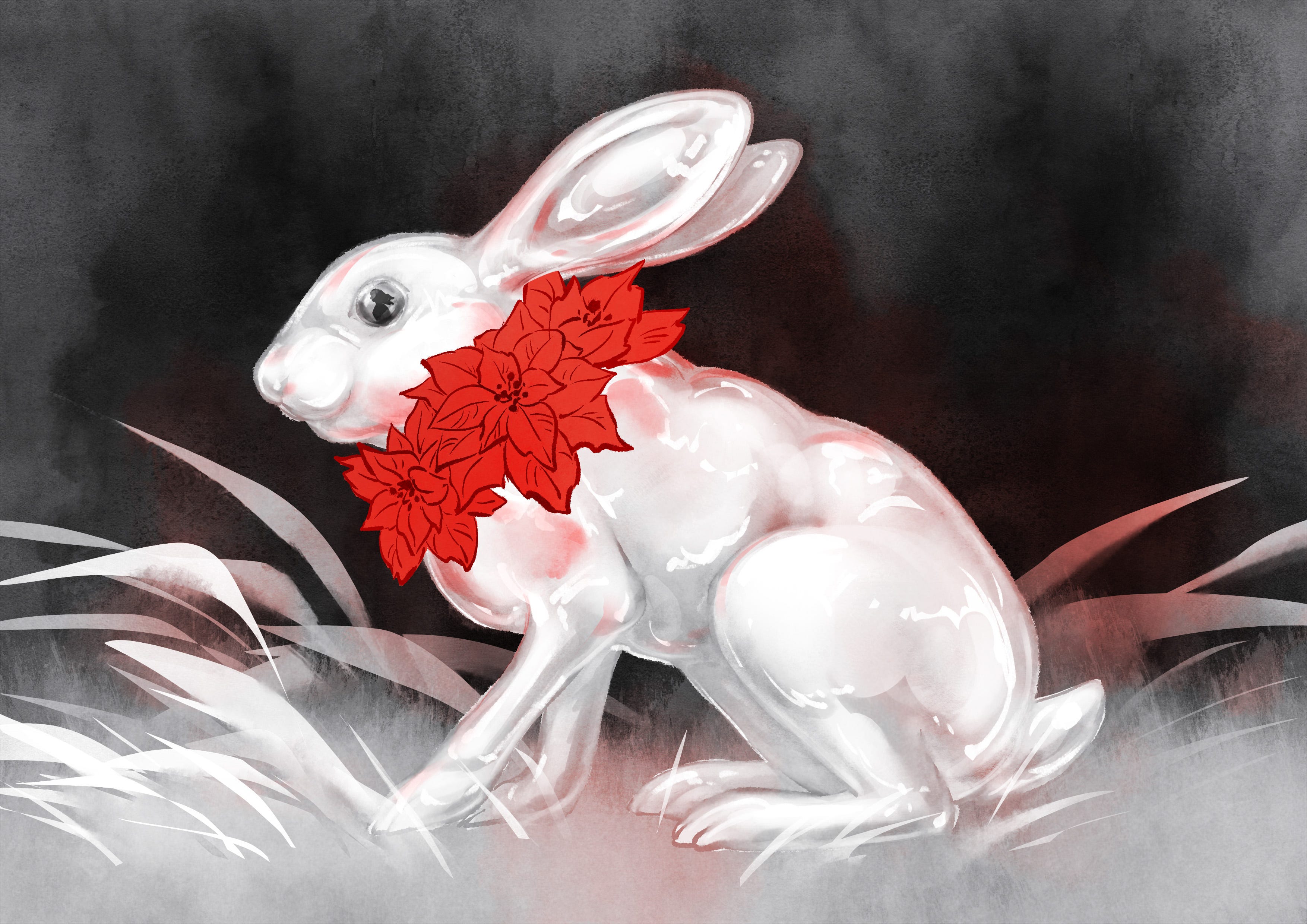
The world-famous jackrabbit outside Winslow, Arizona, sits on a concrete pad surrounded by fencing. It’s grey with a red-brown saddle, perked-up ears bringing it to about eight feet tall. But everything else is wrong. It’s not sprinting, or rearing up. It’s sitting back on its fat haunches, all four of its huge paws on the ground. I search the concrete for the inflatable ring riders are supposed to fall on, or the post the rabbit must get screwed onto, for it to do its swiveling and rolling thing.
But there’s nothing. Not a single wire. The jackrabbit isn’t a machine at all. It’s tame, just a statue—cheap-looking one, too—wearing a little smile and a ring of poinsettias around its neck for the winter holiday.
Nothing but a photo op. So down the line, when this and the nearest highway exits get blown up and replaced by a data center or the Southwest’s largest Tesla charging station, people can point to their picture and say, “Hey, remember the good old days?”
I wonder for a second if I’ve got the wrong rabbit. This must be the version that got installed for the kids, so they don’t work their parents’ last and final nerve begging to climb aboard the real thing. But even as I’m turning back toward the trading post, to confirm this theory with the man inside, I know it’s not true.
Computers make me dizzy, so I didn’t do my research. Was it possible I’d heard
“jackrabbit,” then went ahead and attached the word “hammering” to it, as in “jackhammer”—the way words get mixed up in my busted head all the time? Or had I just imagined its big feet thump-thump-thumping, and given it the power of motion it doesn’t have?
Up by the statue, a kid picks loose gravel out of the grooves on the bottom of his shoes, waiting for his parents to give up balancing a cat—their cat, I have to assume, which they have with them here, for some reason—on the rabbit’s saddle. The cat wears a tiny cowboy hat I remember from the trading post’s sale section. It yowls and claws at its owners and keeps trying to jump, until one of them settles for posing behind the cat, both hands buried deep in its fur.
Then the kid shouts something about color-changing lizard mugs, and the family, cat back in its carrier, head inside.
I duck out from the shadow I’ve been hiding in, and march up to see the jackrabbit for myself. To find out: world-famous for what?
I hold my palm against its side—it’s smooth, but not plastic; fiberglass, maybe?—and wait for something to happen. For a muscle to twitch ever so slightly, or for its ears to go see-through, the blazing sun behind them bringing out thousands of pink veins till the rabbit looks like it’s wearing two giant cabbage leaves on its head. I’m looking for its round black eyes to slide nervously to the side, without leaving me, without blinking, so it can warn the others about the fearsome bobcat come five hundred miles to hunt them. I’m looking for a fight.
But all those eyes do is reflect me back to me.
And there might be a warmth, but I know it’s just the afternoon heat beating down upon us.
And there might be a sudden jump beneath the skin, but I know it’s just my own blood pulsing in my fingertips.
Dr. Giving said things could get worse from here on out, my-big-dumb-brain-wise. But that doesn’t mean I’m going to let myself be fucking delusional.
I look at the road back out of here. Know it’ll be long past dark when I get home.

1.
Tell us your origin story as a writer. When did you begin? What first drew you to writing as an instrument for asking questions that can’t be explored any other way?
KRISTINA TEN: I've wanted to be a writer as long as I can remember. I was writing little adventure stories when I was maybe six or seven, kneeling over a notebook on the kitchen floor. I'm the daughter of scientists, the first native English speaker in my family, and the newest leaf on the one small branch of us living in America. So there's maybe some feeling of responsibility: if anyone's going to document our lives and histories, at least in the English language, it's going to be me. We're hard to pin down. My family's story is one of migration—for four generations on my dad's side, every new generation has been born in a different country than the previous generation, and if I have kids of my own, it'll be five. There are a lot of places I belong to, some of which I've never seen before or haven't seen in decades; some of which are very difficult to visit now; and others of which I experience as both home and alien, hostile terrain. For me, writing has been a way into the impenetrable. Just as fiction has given me the tools to dig into topics I want to better understand, it has given me a map for exploring places I can't otherwise inhabit, sometimes (in speculative fiction) remaking them and drawing them closer together.

2.
What does your writing routine look like? Do you thrive in structure or wildness? And when you begin a piece of writing, what tends to announce itself first: a voice, an image, an unease, a philosophical conundrum?
KT: I thrive in structure and historically have been most productive when staring down the barrel of a deadline. I'm an insufferable fan of school, workshops, classes, residencies, all that. But my life outside of those institutions is a little more chaotic and tends to look different every day, depending on my work schedule, events, travel, and other obligations. So I'm trying to let go of any expectation of routine in favor of fitting writing in whenever and wherever I can. Many a great novel is written in twenty-minute chunks over a long period of time, I tell myself, while sitting in the waiting room of the doctor's office, the waiting room of the auto repair shop... A story's kernel usually appears to me as an opening image, or an unlikely/fantastical conceit, or the tension between two nouns we consider opposites (but that maybe are more alike than we think).
3.
Most artists are preoccupied by certain obsessions: lust, longing, death, the self. What persistent preoccupation—emotional, intellectual, or spiritual—threads through your work? Are there motifs, themes, or impulses you’ve tried to abandon but that keep returning, insisting on their relevance?
KT: Homelands. Borders. Inheritance. Hyphenated or split identity. Domestic spaces. Bodily autonomy. Self-determination. Separation and belonging. Scarcity and abundance. Obedience and dissent. "Art versus craft." Difficult, isolated environments (taigas, polluted rivers, authoritarian states, remote lands erupting with geysers). Difficult, isolated people. Subversive fairy tales. Niche folklore. Anything weird, slippery, unsettling, and not-quite-right or not-as-it-seems. I grew up in Arizona and always seem to return to the desert.
4.
If not a writer, who would you be?
KT: A dog trainer? Neon bender? Puppeteer? Haunted house tour guide? I've been told I would make a good publicist but, man, I think I'd hate it. I worked in the hotel industry some years back and have always wanted to run a small third space/arts venue/B&B.
5.
What’s the best piece of writing advice you’ve ever received? Alternatively/additionally, what’s something you’d like to offer as advice to emerging writers trying to make a mark?
KT: Never let them make you other to yourself. The writers who "make it" (whatever that means for you) aren't necessarily the most talented, the most well-connected, or even the luckiest; they're the ones with the most discipline and perseverance, who keep chipping away at this thing long after their peers have quit. Too: plug into your community, support your fellow writers, and really mean it. However many pictures we've seen of the writer hunched over their gloomy desk, pinching the bridge of their nose in frustration, you don't actually have to do this alone. And it's a lot more bearable (and fun!) if you don't.
6.
What are you working on now and how is it trying to ruin your life (in a good, necessary way, of course)?
KT: A novella about restlessness, sugary drinks, and bats—also set in the American Southwest. Challenging because it's the first novella I've written, and I had every intention of it being a short story.
7.
Who are the artists—writers, filmmakers, thinkers, internet oddities—that have shaped your sense of narrative? How have they rearranged the way you see the world on the page?
KT: The sculptor Eloise Harcourt. The tattoo artist Bubzee. The poet Ilya Kaminsky. The muralist Bunnie Reiss. The paper-cut collages of Andrea Bergen. The Instagram account @subwayhands. The jewelry artist Jen Lorang. The textile artist Sheila Hicks. Soviet-era mosaics. Flacking and other visible repair (like the Buffalo Pothole Bandit, or the street art of Seoul). Marcel Dzama. Diedrick Brackens. The wearable sculptures of Polina Osipova. Interactive pole media (aka some the things you see stuck on public utility poles). Grace Paley. David Lynch. If I start listing more writers, this page may never load.
8.
Please recommend a piece of art (a painting, a film, an album, anything that’s not a piece of creative writing, really) that you love and would like everyone to experience.
KT: "Untitled (One Hundred Spaces)" (1995) by British sculptor Rachel Whiteread: an installation of one hundred multicolored polyester resin cubes cast from the empty space beneath one hundred different chairs.
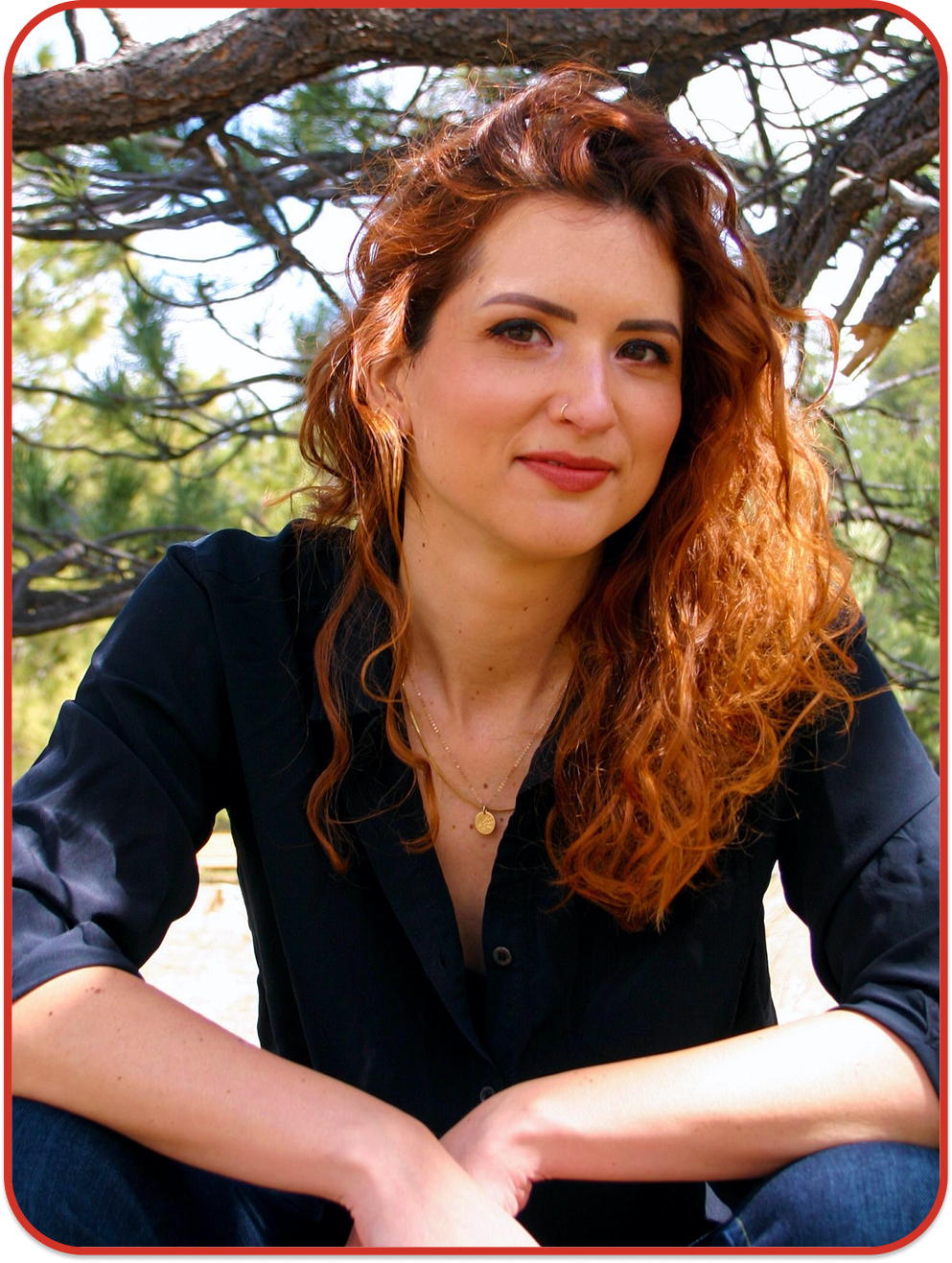
KRISTINA TEN is the author of Tell Me Yours, I’ll Tell You Mine (2025, Stillhouse Press). Her stories appear in The Best American Science Fiction and Fantasy, We’re Here: The Best Queer Speculative Fiction, The Best Weird Fiction of the Year, and elsewhere. She has won the McSweeney’s Stephen Dixon Award and has been a finalist for the Shirley Jackson Award, the Locus Award, and the Conjunctions Residency. Ten is a graduate of Clarion West Writers Workshop and the University of Colorado Boulder’s MFA program in fiction, and has received fellowships from the Ragdale Foundation and the Martha’s Vineyard Institute of Creative Writing.

Wow, what a great story. That one tiny mention of the father held the tension all throughout the story— just the lightest touch. So good.
Great story! I read all the way through and didn't realize until I saw the author photo at the end that this is a writer I'm familiar with! So exciting!
One note: I think you guys forgot to fill in the author name in the interview ;)