



Hello fellow strange pilgrims, below we share a flash nonfiction piece that could well be a prose poem or a series of handwritten letters torn at seemingly random places and yet it binds together into a delicate, cohesive whole full of longing and love. Enjoy!



Adele had a small waist, a blue Chevy pickup and a laugh that would fry an egg. She was studying Chinese and landscape architecture and finished with a law degree. Which was about the last I heard of her except for a single Internet post: “I am a dedicated commitment-phobic,” it read. “I dare call it freedom.”
She bought the truck with the last of the insurance money, which also paid her tuition at the American Academy of Dramatic Arts. Her father was a “hot-shit driver” passing on a double yellow line, top down on the Sunliner after a night out in Rolla, Missouri. “If you want to imagine that. I sure don’t. Killed them both.”
She was living in a tent when I met her. At twenty-eight she had four years on me. I had a black-cat tattoo and was a sucker for a bleach blonde with a soft southern drawl. I bought her a gun rack for the truck and we drank Genny Cream Ale and laughed until she peed herself and laughed some more, parked out by Rick’s Sunoco on a hot summer night.
“Dear Addie, Thank you for the newspaper article. Rider and I are so proud of you in New York. The days are longer now, and the pecans are green as lemons. We say that every spring now since you left. Rider’s got his postal pension. He spends his time at home now and is good company. We miss your Momma, and I know you do too. Here’s a little money. The bus still stops at the depot. Your loving Aunt Inez”
Adele and her cousin would shake the trees at her grandmother’s pecan ranch, where she went to live after Aunt Lu got too nervous to mind her. She took the bus from Little Rock to Okemah on her own and stayed in the house in back with Inez and Rider until she finished high school and got on a Greyhound to New York, where she lived with a jewelry maker whose name you’d know on the Lower East Side and saw Lee Morgan at Slug’s the night before his wife shot him between sets. He was thirty-three. It was the same year, ’72, that the Times mentioned her in a review of Moonchildren, and she moved to Vermont and bought the truck.
“Dear Pie,” she wrote me in Jamaica Plain, “I’m rather worried right now. How am I going to survive? You know what I mean? Nervous, nervous, nervousnervousnervous. Strung out. Crazy. Scared. Slippery. Cranial winds. Etc. etc. etc. Oh, I want to be light-hearted about it all, but I’m overwhelmed. I’m POOR. I’m TOO BUSY. I’ve got BUGS. I want to cry. I want my Momma. I long to see you. I would come down to Boston but I can’t afford it. I guess I’ll have to wait for you to come back up here. All my love, Pie.” I was still in love with her, so I did.
She planted a garden in the beds in front of the house, basil, thyme, garlic, and green onions that sprouted every spring after she left me. She could really cook. She made drop biscuits, brown gravy and fried chicken that was perfect, with ease, and talked about her brother who was in prison in Kansas for something he didn’t do or almost didn’t do and threw the plates at me after I washed them and the cups too when I called her a sad cliché.
I paid off all her debts before she left. She gave me a Leica camera to hold. Dinah and Bix, her cats, stayed on to love me on those long dark nights. Or when the stars were out, I would whistle and hear a rustle in the brush on Sunset Hill and whistle again and sit on the front steps until they came back to me.
I found a letter from her Aunt Inez in a file marked “Okemah,” tucked in with a faded studio photograph of her father in his army uniform, thin as a rail with a full-body smirk, lit cigarette and those same sharp cheekbones, “1944” penciled on the back; two snapshots of her mother, left hand on her elbow, ring on her finger, younger than Adele was when we met, prettier; and a two-dollar bill, still crisp, sealed in brown envelope marked “Good Luck” on the front.

Tell us your origin story as a writer. When did you begin? What first drew you to writing as an instrument for asking questions that can’t be explored any other way?
FLEMING MEEKS: I began in fits and starts, in high school, in college. I wanted to find out what was in my head. I wrote like a photographer. I took snap shots. I discovered I could do that by writing and rewriting and rewriting. My first work was very short. I went from there to longer narratives. Word by word. Figuring it out, writing it. Trial and error and patience.

What does your writing routine look like? Do you thrive in structure or wildness? And when you begin a piece of writing, what tends to announce itself first: a voice, an image, an unease, a philosophical conundrum?
FM: Voice, image, unease. That's all of a piece for me. I don't have a routine. I sit down when I can and where I can and write and think. And boil it down. Compress, And I go where it takes me. I look for ideas and things I could note resolve. Time, time and time helps me figure it out. Many things I couldn't figure out a year or five years or ten years ago start to make sense. I figure it out by stripping the work down and building it back.
I don't have a routine. I don't have a writers room. I can write anywhere. I find stories in what I see all around me. Sometimes things I see and hear touch things I want to know more about, things I want to understand. Snippets of conversation, body language, frustration. When I was a journalist, an editor said he could put me in an empty room for an hour and I would find a story.
The magic is to do it. To fail and fail again. To never give up. much more about failure than success. She published a book of photos of her family. There are something like 60 photos in the book. Or 62 or 64. She and assistant went back and looked at all of the photographs she took for this book, all of glass plates that are her negatives. She uses large format cameras. There were 6,000 plates. Only one in a hundred was acceptable to her. One good photograph out of a hundred, It's very gratifying. I saw her show at the National Gallery of Art in 2018. Sally Mann: A Thousand Crossings. I have not gotten over it.
It's not about that 10,000 hours crap. It's about working every fucking day and believing in yourself no matter how difficult it is. Sally Mann inspires me more than any other artist. Off the top of my head I can't name a writer who inspires me at that level. Who inspires me day in and day out. No, I can. Philip Roth, Bob Dylan. Yes, they inspire me day in and day out and have for decades.
Most artists are preoccupied by certain obsessions: lust, longing, death, the self. What persistent preoccupation—emotional, intellectual, or spiritual—threads through your work? Are there motifs, themes, or impulses you’ve tried to abandon but that keep returning, insisting on their relevance?
FM: I think about it like this. Put two people in a room and create a stituation. A problem. A conflict. Emotional, yes. Intellectual, yes. Spiritual, not so much. Conflicts between people, misunderstandings, arguments, longing and desire. I try to land in the middle of it. In media res. To create problems and try to solve them. Resolve them. Often there is not satisfaction, no real resolution. But understanding. These conflicts are also with the self. All of these "people" are parts of the self. Life is tough.
If not a writer, who would you be?
FM: A photographer. Photography for me is always learning. I would love to have done that full time.
What’s the best piece of writing advice you’ve ever received? Alternatively/additionally, what’s something you’d like to offer as advice to emerging writers trying to make a mark?
FM: Keep working back into a piece. Build it stitch by stitch. Don't be in a hurry.
What are you working on now and how is it trying to ruin your life (in a good, necessary way, of course)?
FM: I am combing photography and text. I have something like 35,000 photographs, and I've probably lost another 30,000. I think about my pictures and what I am writing. There is a commonality to it. There is often a connection between what I have written and what I have photographed. I put them together in my head and then on paper.
Who are the artists—writers, filmmakers, thinkers, internet oddities—that have shaped your sense of narrative? How have they rearranged the way you see the world on the page?
FM: Bob Dylan. Sally Mann. They are people of my generation or almost of my generation. I marvel about how they figure it out again and again. I constanly learn from them. And learn about persistence.
Please recommend a piece of art (a painting, a film, an album, anything that's not a piece of creative writing, really) that you love and would like everyone to experience.
FM: Any photograph by Saul Leiter. The late interiors of Pierre Bonnard. In the Mood for Love directed by Wong Kar-wai. Every second of it is brilliant.

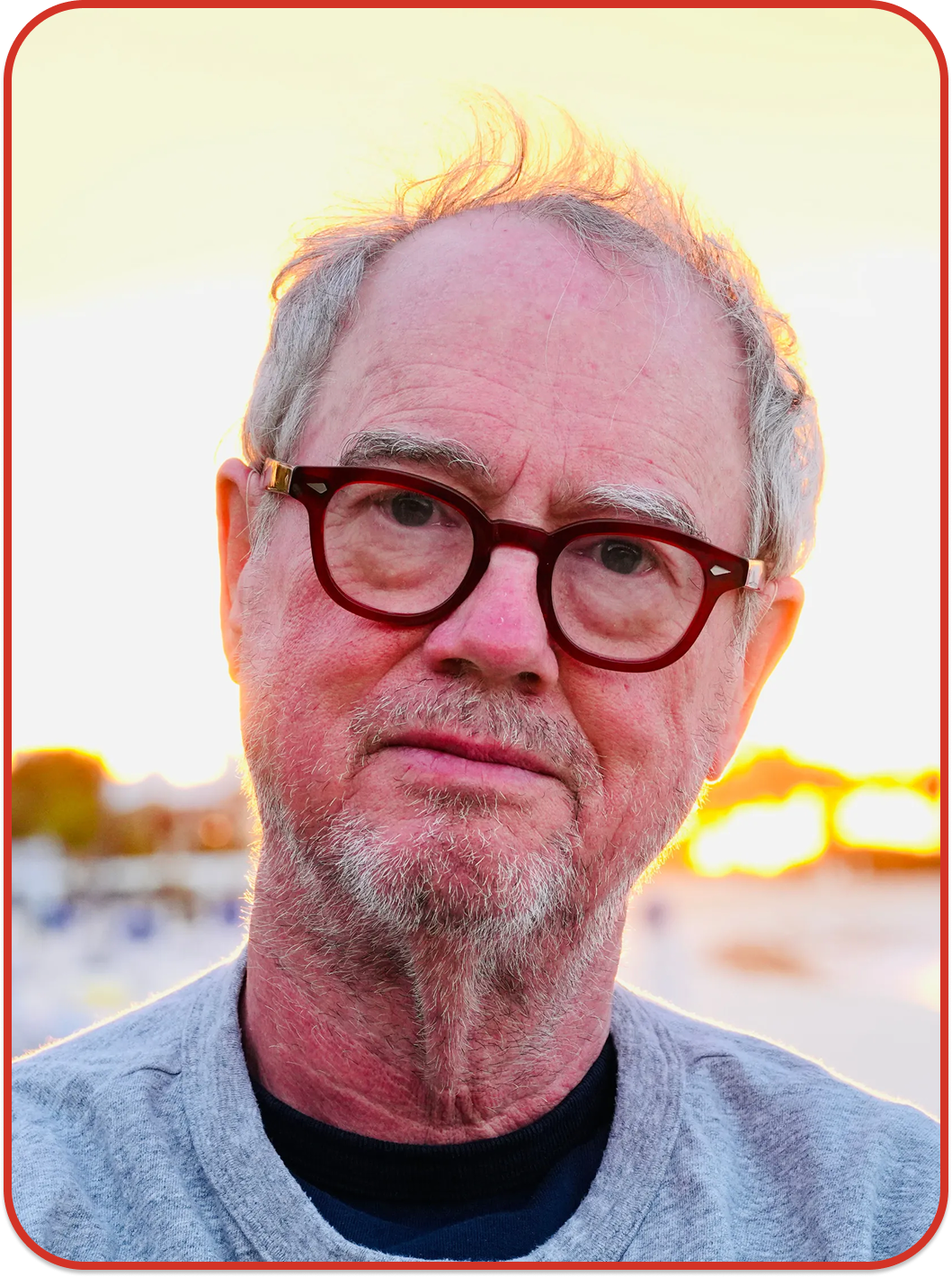
FLEMING MEEKS is a poet and former journalist. His poems and essays have appeared in American Poetry Review, Brevity, Kenyon Review, New Ohio Review, Painted Bride Quarterly and Yale Review. His 1990 interviews with actress Hedy Lamarr for a feature story in Forbes magazine formed the backbone of the 2017 documentary “Bombshell: The Hedy Lamarr Story.” The film premiered at the Tribeca Film Festival and was broadcast on PBS in the American Masters series. He lives in Montclair, N.J.
Notes on Art
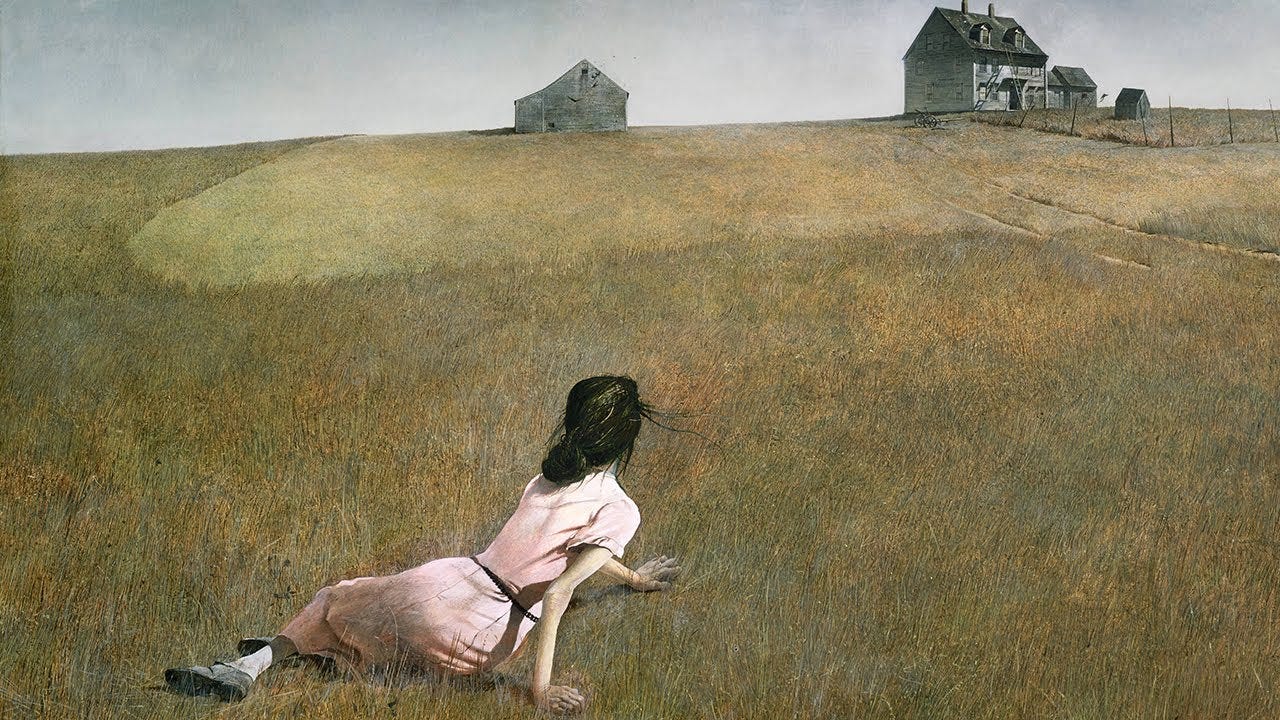
We’ve paired this piece with Andrew Wyeth’s Christina’s World1 (1948) — a woman in a pink dress turned away from us, seemingly dragging herself across a field of dry grass toward a gray house on a distant hill. We never see her face. This piece has a similar aesthetic and heart I feel. Adele is rendered down to the cheekbones, the laugh, the bleach blonde, and yet she keeps slipping out of frame so to speak — to New York, to Vermont, to law school, to a single internet post years later while the narrator stays in the field and the pecans go green as lemons every spring.
Image: Christina’s World © Andrew Wyeth. Used for editorial commentary purposes only. All rights reserved.
It's flash but unhurried. Everything feels so considered. Will definitely look for more from Fleming.
This is fucking great writing. I wish with all my heart that I could have written a line like “…a laugh that would fry an egg.” Brilliant.