



Hello fellow strange pilgrims, I can’t quite believe that we’re publishing our third essay already, though I also feel like we’ve been around for years! Today’s piece is an enthralling dive into all things werewolf lore and if I were you, I’d curl up right now in a comfy spot in the house and get to reading (& listening)!


Werewolves! You know them: Hairy, slavering half-men, half-beasts, vulnerable to silver, slaves to the full moon, and for some reason, the mortal enemies of vampires. Yet if you look back to the werewolf stories of 100, 200, or 800 years ago, you find quite a different type of creature. In fact, throughout their history, there have been several distinct werewolf archetypes. In some periods, werewolves were heroic. Other times, they were usually female. And sometimes they were just plain weird.

The Werewolf Knight
While stories of humans transforming into beasts of various sorts go back to Greek mythology and, no doubt, further, the werewolf as we know it first appears in the romances of the Middle Ages. In this earliest incarnation, he is no bloodthirsty monster, but rather a genteel knight transformed into a wolf by some misfortune—most often through a woman’s treachery.
Several of these stories are so similar that they clearly stem from the same root story (now most likely lost). A knight has a beautiful but duplicitous wife. She convinces him to tell her his secrets, and he reluctantly confesses that there is a way to transform him into a wolf. This she does, trapping him in wolf form so that she can marry a secret lover.
Later, the king is out hunting when the transformed knight runs up to him and kisses his stirrup. The king is astounded by the wolf’s human-like behavior and has him brought to court as an honored pet. One day, the duplicitous wife and her new husband come to court. The wolf, which has previously shown no sign of aggression, attacks them. Surprised by this, the king interrogates the woman and the whole story comes out, including the secret to the transformation. The knight is transformed back and the wife given some suitable punishment.
Stories in this format include “Bisclavret” by Marie of France (12th century) and the anonymous stories “Melion” (13th century), “Morraha” (also 13th century), and “Arthur and Gorlagon” (15th century). The primary difference is what causes the transformation: Bisclavret must transform for three days every month but can be trapped in lupine form by stealing his clothes; Melion has a ring set with two stones, one of which transforms him into a wolf and the other of which transforms him back; Morraha’s wife has a rod of magic mastery which allows her to transform him into anything she chooses, but she also suffers from a bad case of indecision—she turns him first into a raven, then a horse, then a fox, before finally settling on the inevitable wolf.
The karmic comeuppances vary too, though Bisclavret’s is probably the best: In wolf form, he bites off his wife’s nose, and her descendants, suffering the curse of Lamarckian inheritance, are born without noses.
Retold over the centuries, these stories wend, entwine, and double back on themselves. Bits of other folktales wander in here and there. Sometimes the wolf is falsely accused of killing a baby, a clear influence to the tale of Gelert the Faithful Hound. Other times the same element appears in duplicate. “William and the Werewolf,” from the 12th-13th century, features not one but two child princes deposed by jealous women and reported drowned. The first, Alphonse, is transformed by his wicked stepmother into a werewolf, but manages to flee. He later overhears the plot against the second prince, William, and kidnaps him to keep him safe. After many adventures and battles, including an unusual (and implausible) sequence where William and his lady-love successfully disguise themselves by dressing up as bears and deer, Alphonse is restored, both princes are reunited with their grieving parents, both marry princesses, both are crowned king, and—of course—all the conniving women are punished.
“William and the Werewolf” has some unusual elements, but “The Werewolves of Ossory,” an old Irish folktale written down by Gerald of Wales in 13th century, is more unusual overall. It tells of a priest who is approached by a wolf who explains that his town is under a curse: Two of its inhabitants must transform into wolves and wander the wilderness. At the end of seven years, they transform back into humans and another two people must transform. But his wife, the other werewolf, is sick, and he wishes the priest to perform last rites for her. To prove his story, he peels the wolf skin off his wife’s head, revealing the head of an old woman.
This story is unusual in several ways: The werewolf speaks, the werewolves are commoners instead of nobles, they’re elderly, and one of them is a woman—deeply unusual at the time (though, as you’ll see, this won’t always be true). The sympathetic role of the woman is also a break from a story type where women are usually portrayed as conniving and evil, even when depicted by female authors like Marie of France.
The idea of the werewolf as an evil monster wouldn’t emerge until the early modern era. When Christianity in Europe moved to homogenize and stamp out earlier folk religion as satanic witchcraft, werewolves also began to be seen as monstrous. Yet it was a gradual transition. The delightful case of Thiess of Kaltenbrun (1692) took place at this inflection point. Thiess was an alleged werewolf who took an accused witch to court, accusing her of breaking his nose. Thiess claimed that he and his compatriots were “hounds of God” who transformed into wolves and traveled to Hell to do battle with witches. (Why is this not a movie?) In the course of one of these battles, a witch hit him with a broomstick and broke his nose. The case was laughed out of court, but the judges later called into question whether a self-admitted werewolf was at odds with Christianity, and had him flogged and banished for his heathen practices.
The Werewolf Seductress
By the nineteenth century, the werewolf’s role as a monster was well established. In the Victorian era, it took on a new shape—and this time the form was female. These stories take place in remote, romanticized locations like Russian Poland or the deep forests of Germany. The werewolf seductress is a beautiful woman clad in white fur who appears outside a cabin in the middle of a snowstorm. The man of the house quickly falls in love, but something about the mysterious woman seems off. It turns out that she can transform into a white wolf—always a white one—and has been preying on the local villagers. Often her victims are children, and her unmatronly ways may be the clue that exposes her.
These stories are consummately Victorian in their overwrought descriptions and moralizing tone: Don’t talk to strangers, don’t get horny, and—just like the medieval lays—never, ever trust a woman.
You may be wondering “How many stories can there possibly be with such a wildly specific plot?” At least three: “The White Wolf of the Hartz Mountains,” which is a stand-alone excerpt from Frederick Marryat’s The Phantom Ship (1839), “The White Wolf of Kostopchin” by Sir Gilbert Campbell (1889), and “The Were-Wolf” by Clemence Housman (1896). Of these, “The White Wolf of Kostopchin” deserves special mention this instructive example of the difference between the letter of the law and the spirit of the law:
“All I have is yours, Ravina,” returned Paul, “name, wealth, and the devoted love of a lifetime.”
“But your heart,” persisted she; “it is your heart that I want; tell me, Paul, that it is mine and mine only.”
“Yes, my heart is yours, dearest Ravina,” answered Paul…
“I am hungry,” she murmured, “oh, so hungry; but now, Paul Sergevitch, your heart is mine.”
…With a sudden, quick movement, she tore open his garments, and in another moment she had perforated his left breast with a ghastly wound, and, plunging in her delicate hands, tore out his heart and bit at it ravenously.
Moon lore becomes canonically associated with werewolves during this period, though it’s far from strict. In that same scene from “The White Wolf of Kostopchin,” we are told, “The moon was at its full, and shone coldly down upon the leafless trees.” “The White Wolf of the Hartz Mountains” describes its wolf-woman on the prowl: “She was in her white night-dress and the moon shone full upon her.” But the moon seems to control their hunger rather than their form—both are human in those scenes. And in “The Were-Wolf,” the denouement happens under the new moon.
The 19th-century romantic literature scene was a big one, however, and many voices fell outside this archetype. One is George MacDonald’s “The Gray Wolf” (1864). While she is beautiful and hungry and the protagonist does seem attracted to her, the denouement takes an unusual turn: “But the creature as she sprung eluded his grasp, and just as he expected to feel her fangs, he found a woman weeping on his bosom, with her arms around his neck. The next instant, the gray wolf broke from him, and bounded howling up the cliff.” MacDonald was a universalist, a type of Christian who believes that everyone goes to heaven. Thus, even a ravenous werewolf can feel remorse and be an object of pity.
Women were also an important part of the literary scene in this era. Some, like Clemence Housman, cleave closely to the standard misogynist depictions of female werewolves—even though she was an active suffragette in real life. But women’s werewolf stories could also push the mold. One of these is the misleadingly-titled “A Story of a Weir-Wolf” by Catherine Crowe (1846), which, despite the name, doesn’t actually feature a werewolf. Two 16th-century cousins, Francoise and Manon, are bitter romantic rivals, but when a wolf begins ravaging the countryside, Francoise is falsely accused of being a werewolf and sentenced to be burned at the stake. But just before the sentence is carried out, “there came forward, slowly and with difficulty, disheveled, with clothes torn and stained with blood Manon Thierry, dragging behind her a dead wolf.” She had gone into the woods and killed the wolf to prove her cousin’s innocence, getting mortally wounded in the process. “Manon herself was much torn and lacerated; and on the spot where the creature had apparently been slain, was found her gun, a knife, and a pool of blood, in which lay several fragments of her dress”. Go Manon!
By the beginning of the 20th century, werewolf stories were diversifying in many different directions. Saki’s delightful story “Gabriel-Ernest” (1909) demonstrates that werewolves can be funny. When the buttoned-down gentleman Van Cheele finds a nude youth basking first in his woods and later on his ottoman, he’s so concerned about the impropriety of the situation (he “hastily obscured as much of his unwelcome guest as possible under the folds of a Morning Post” to keep his aunt from catching an eyeful) that he fails to anticipate that his unwanted guest is a werewolf. When he finally catches on, he can’t figure out how to communicate it to his aunt: “‘Gabriel-Ernest is a werewolf’ was a hopelessly inadequate effort at conveying the situation, and his aunt would think it was a code message to which he had omitted to give her the key.”
But a much bigger change was coming in the next few decades.
The Weird Werewolf
Weird fiction, an innovative branch of horror that emerged in the early 20th century, propelled by a glut of pulp magazines, is better known for tentacle monsters like Cthulhu than for traditional creatures like werewolves. Yet if you look back at the weird magazines of this era, you’ll find that traditional monsters outnumber their newer counterparts. The bizarre visions of Lovecraft and his ilk did not leap from their foreheads fully formed—they were the result of a gradual evolution. And werewolves were part of that evolution.
In weird fiction, the werewolf (who, in this iteration, can be either male or female) comes trotting out of the remote forests of yore and into modern-day boarding houses, trains, and city streets, though it often has a heritage tying it to romantic locations like Russia and Romania. The protagonist (naturally, a bookish, skeptical young man) initially scoffs at lycanthropy as a silly superstition, but some bit of evidence casts the whole affair in a different light. Often, the story ends without him ever discovering whether the beast was real or just a fanciful story. We also see the first glimmers of the perspective of the werewolf itself.
“The Fisherman’s Special” by H.L Thomson (1939)—one of those cipher authors of the early pulps who never wrote anything else—is typical. A grizzled old man riding next to the protagonist on the train spins a tall tale about a man who fights a werewolf and drives it off after cutting off one of its ears. When the old man gets off the train, the protagonist notices that he’s missing an ear.
“Lupa” by Robert Barbour Johnson (1941) features werewolf who shares much in common with the werewolf-seductresses of the 19th century. She is young and beautiful, she can transform into a white wolf, and a young man is in love with her. But this werewolf is determined not to harm anyone. She rebuffs her suitor, not wanting to pass on her condition. When she transforms under the full moon, she stays holed up in her boarding house room, telling concerned would-be visitors only “I’m all right.” But her affliction proves too much for her and she dies during one of these bouts. Police are astonished to break down her door and find a white wolf-creature lying in her place.
Greye La Spina, one of the great underappreciated workhorses of the pulp era, wrote about werewolves several times. One of her stories, “Wolf of the Steppes,” plays with the werewolf seductress but turns it on its head. Here is the beautiful woman who appears mysteriously in the wilderness, begging for help, but it is her guardian, not her, who turns out to be the werewolf. He pinned his crimes on her father, who committed suicide, leaving him free to sexually harass both her and her mother. He gaslights her and anyone who might hear her strange tale into thinking that she’s insane. Knowing the history of the genre makes this story more interesting: “Innocent girl menaced by male monster” is the expected story now, but as we have seen, prior to the pulp era it would have been the other way around.
In many ways, weird werewolf stories sound very modern. Yet there are many aspects of werewolf lore that weren’t yet prominent. Silver doesn’t play a role in any of these stories. They don’t fight vampires. And through all three periods, the werewolf appears as a wolf or large dog indistinguishable from any other wolf except through features like red eyes or general size and monstrousness. The now-ubiquitous bipedal wolf-man turns out to be a purely cinematic invention that would only appear in books after it was well established onscreen.
We also don’t see any sign of contagion from these werewolves, most of whom are extremely thorough about killing their victims. That’s a bit of lore that seems to have recently drifted over from vampire stories. Being bitten by a werewolf won’t turn you or your progeny into werewolves, though it may turn them into nose amputees.
And remember, if a beautiful woman in a fur coat knocks on your door in the middle of a snowstorm, you may at least want to check her ID.

Tell us your origin story as a writer. When did you begin? What first drew you to writing as an instrument for asking questions that can’t be explored any other way?
GWEN C. KATZ: Like a lot of authors I began writing as soon as I could read. It just doesn’t occur to me to consume something without also wanting to contribute to it. If I enjoy video games, I want to make video games. If I like a painting, I want to paint.

What does your writing routine look like? Do you thrive in structure or wildness? And when you begin a piece of writing, what tends to announce itself first: a voice, an image, an unease, a philosophical conundrum?
GCK: I’m really not a routine person. I do whatever seems right for that project. Some are handwritten. Some are composed entirely in the notes app on my phone.
Most artists are preoccupied by certain obsessions: lust, longing, death, the self. What persistent preoccupation—emotional, intellectual, or spiritual—threads through your work? Are there motifs, themes, or impulses you’ve tried to abandon but that keep returning, insisting on their relevance?
GCK: In nonfiction, it’s all about pulling the threads that are already there. That’s what was so interesting about reading so many werewolf stories: The emotional beats and themes aren’t always what you expect.
If not a writer, who would you be?
GCK: Oddly, since the fire I’ve been supporting myself primarily as a visual artist, which truly was not something I anticipated. Being in the creative arts is all about being ready to change course when you need to.
What’s the best piece of writing advice you’ve ever received? Alternatively/additionally, what’s something you’d like to offer as advice to emerging writers trying to make a mark?
GCK: My uncle, who is an editor, gave me one of my favorite pieces of advice when I was a teenager: “You can’t put all your good ideas in one place.”
What are you working on now and how is it trying to ruin your life (in a good, necessary way, of course)?
GCK: One of my post-fire projects was learning to silk screen so I can design my own clothes. There's something wonderful about combining fine art skills with practical tools that make something you can actually wear. You can find my designs here.
Who are the artists—writers, filmmakers, thinkers, internet oddities—that have shaped your sense of narrative? How have they rearranged the way you see the world on the page?
GCK: My favorite artist is Leonora Carrington, one of the women associated with surrealism. She’s well known as a painter but she’s beginning to be more widely recognized as an author of fiction that walks an interesting line between literary and speculative, always with strong feminist themes.
Please recommend a piece of art (a painting, a film, an album, anything that's not a piece of creative writing, really) that you love and would like everyone to experience.
GCK: Since we're on the topic of werewolves, I highly recommend the Brazilian film Good Manners (2017). It's a tremendously interesting deconstruction of werewolf narratives. Historical werewolf stories went interesting directions, but contemporary ones are going interesting directions as well.

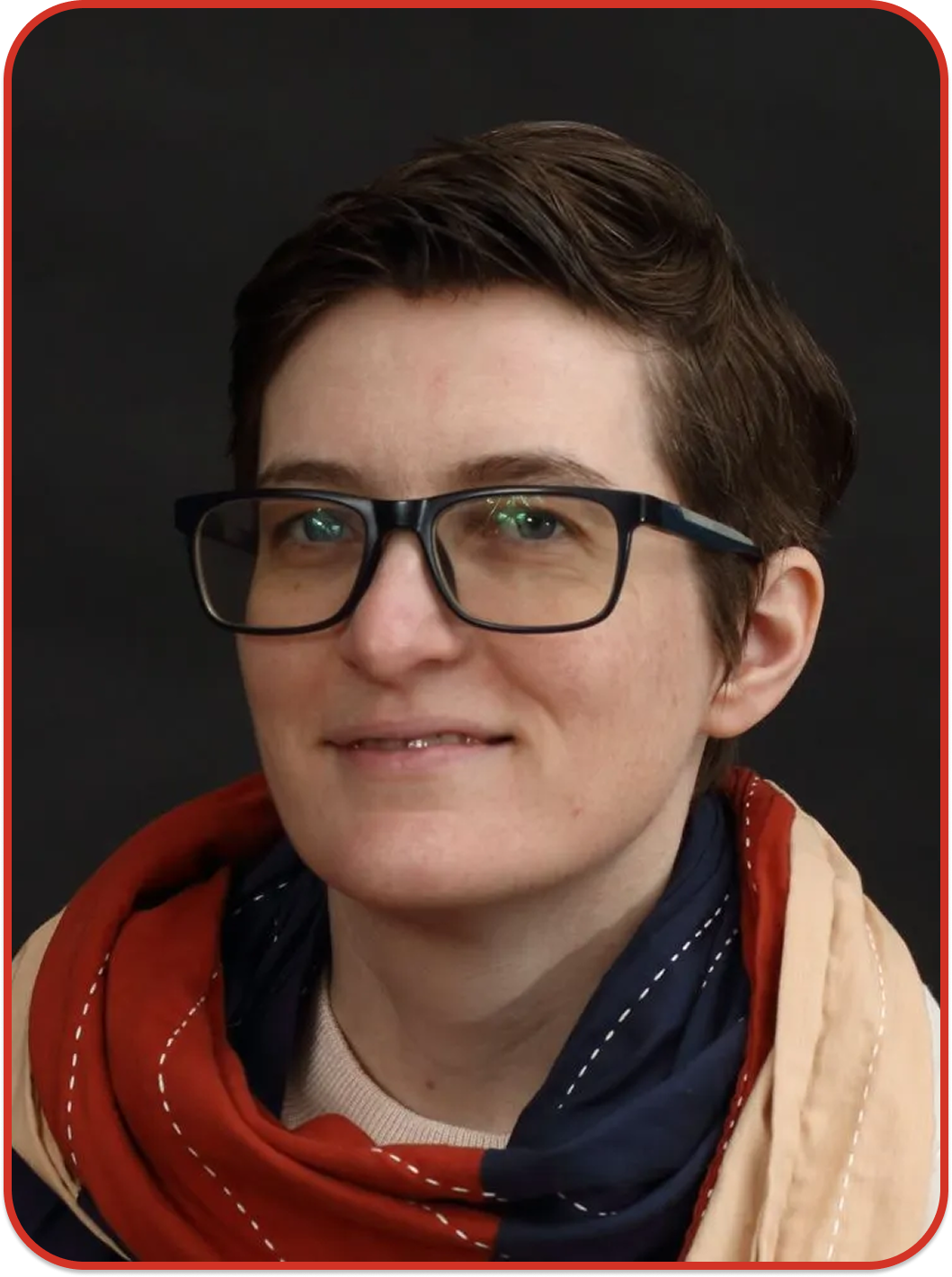
GWEN C. KATZ is an author, artist, and game designer surviving the aftermath of the Eaton Fire by writing and making art. You can find more of her nonfiction here.
Notes on Art
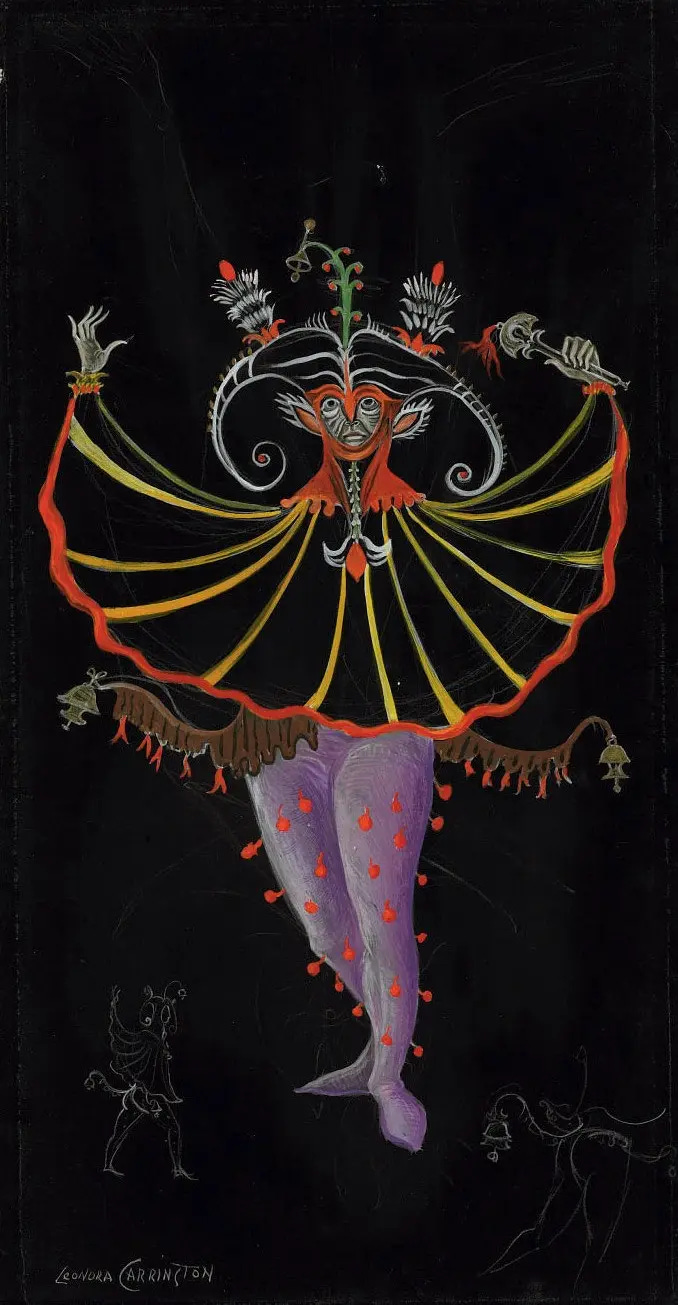
We’ve paired this piece with Leonora Carrington’s Untitled1 (sometimes known as Mexican Jester) — a figure suspended against black, part bird, part trickster, part something that hasn’t decided yet. Thistles and flowers erupt from its head. Its hands end in claws and skeletal fish. Its striped wings are held open like a dare. Carrington spent her life painting creatures mid-transformation, bodies that refuse to settle into one species, one gender, one story. Katz’s essay traces that same refusal across eight centuries of werewolf literature — the knight trapped in wolf form by a treacherous wife, the white-furred seductress, the girl who locks herself in her room under the full moon. Every era gets the shapeshifter it deserves. Carrington’s jester looks like it could walk out of any of them.

Image: Untitled © Leonora Carrington’. Used for editorial commentary purposes only. All rights reserved.
A damn good essay. It's instructive to know how deep this sub-genre goes in the past and its various forms.
What a fascinating and comprehensive piece! It really gets my imagination flowing.